ESP Clock Needs More Power

[Victor-Chew] is tired of setting clocks. After all, here we are in the 21st century, why do we have to adjust clocks (something we just did for daylight savings time)? That’s why [Victor] came up with ESPClock.

Based on a $2 Ikea analog clock, [Victor] had a few design goals for the project:

  • Automatically set the time from the network
  • Automatically adjust for daylight savings time
  • Not cost much more than a regular clock
  • Run for a year on batteries

The last goal is the only one that remains unmet. Even with a large battery pack, [Victor’s] clock runs out of juice in a week or so. You can see some videos of the clock syncing with network time, below.

Continue reading “ESP Clock Needs More Power”

One Hundred Weeks Of Legal Car Hacking

There is a scene in the movie “Magic Mike” where the lead character — a male stripper — explains to a room of women the laws against having physical contact with a performer. Then he intones, “… but I see a lot of lawbreakers up in this house.”

We know if we could look out through the Web browser, we could say the same thing. There’s a lot of gray zone activities considered commonplace. Have you ever ripped a CD or DVD to take with your on your phone? Gray; we won’t judge. A lot of the legal issues involved are thorny (and I should point out, I’m not a lawyer, so take what I say with a grain of salt).

Do you own your car? Well, probably you and the bank, but certainly the deal you made involves the idea that you own the car. If it is paid off, you can do what you like with it, including — if you wanted to — stripping it bare for parts. Back in the day, your car was some wheels and some mechanical devices. These days, it is a computer (actually, a few computers) and some I/O devices that process gasoline into rotary motion. Computers have software. Do you own that software?

The answer has, legally, been no. However, a recent decision by the US Copyright office allows car owners to legally analyze and modify their vehicle software (with some limitations) for the next two years. After that? We’ll see.

Continue reading “One Hundred Weeks Of Legal Car Hacking”

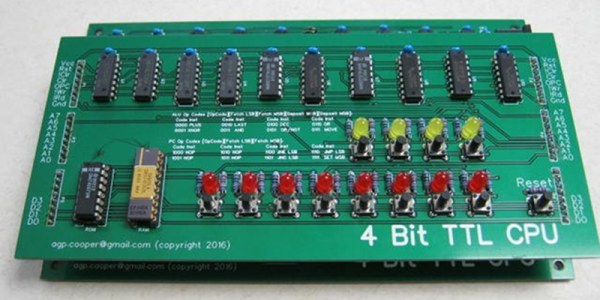
1MHz, 2 Boards, 4 Bits And A Homebrew CPU

[Agp.cooper] saw a vintage 4Kx4 bit RAM chip and decided that it needed a CPU design to match. The TTL design fits on two boards and has a functional front panel.

This custom CPU project has a few interesting bits worth noting. First, it is small enough that you can wrap your head around it pretty easily. And [Agp.cooper] gives  a good account of the instructions set architecture choices he considered and why he settled on the final design.

Continue reading “1MHz, 2 Boards, 4 Bits And A Homebrew CPU”

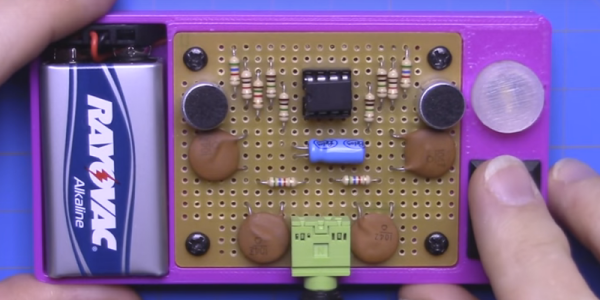
Simple Hearing Amplifier

Hearing aids are probably more high-tech than you think. They are tiny. They have to go through a lot of trouble to prevent feedback. They need a long battery life. The good ones match their amplification to the inverse of your hearing loss (amplifying only the bands where you don’t hear as well).

[NotionSunday] put together a hearing amplifier project that probably doesn’t hit many of those design criteria. However, thanks to a 3D printed case, it looks pretty good. The device uses a dual opamp to boost the output from two microphones and feeds it to a conventional headphone.

Continue reading “Simple Hearing Amplifier”

Perceptrons In C++

Last time, I talked about a simple kind of neural net called a perceptron that you can cause to learn simple functions. For the purposes of experimenting, I coded a simple example using Excel. That’s handy for changing things on the fly, but not so handy for putting the code in a microcontroller. This time, I’ll show you how the code looks in C++ and also tell you more about what you can do when faced with a more complex problem.

Continue reading “Perceptrons In C++”

Hollow State Receiver

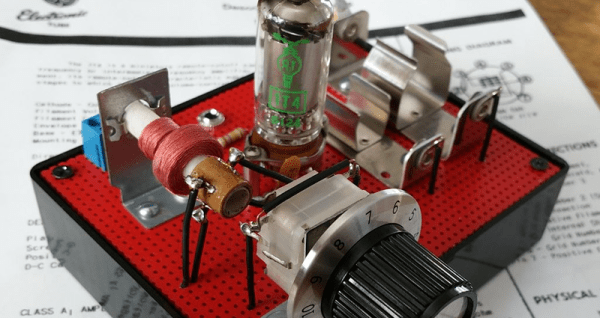
[Netzener] received a Radio Shack P-Box one tube receiver as a gift. However, at the time, his construction skills were not up to the task and he never completed the project. Years later, he did complete a version of it with a few modern parts substitutions. The radio worked, but he was disappointed in its performance. Turns out, the original Radio Shack kit didn’t work so well, either. So [Netzener] did a redesign using some some old books from the 1920’s. The resulting radio — using parts you can easily buy today — works much better than the original design.

The most expensive part of the build was a 22.5 V battery, which cost about $25. However, you can get away with using three 9 V batteries in series if you want to save some money. The battery provides the plate voltage for the 1T4 vacuum tube. A more conventional AA battery drives the tube’s filament. The original Radio Shack design relied on a variable inductor for tuning. These are difficult to find now, so [Netzener] uses a more conventional adjustable coil and a common tuning capacitor.

As an extra touch, [Netzener] painted the perf board to look as much like the original Radio Shack kit as possible. You can see from the pictures, it came out looking very good. If this isn’t challenging enough for you, maybe you want to roll your own tube. Or maybe you should just settle for the socket.

Continue reading “Hollow State Receiver”

Fictional Hacking: Michael Westen

I don’t know if it is true or not today, but in fiction, spies depend on lots of high-tech gadgets. I do know that during World War II, the various secret services like the OSS and the SOE did have gadgets like secret transmitters and concealed weapons. But, like [James Bond’s] grenade-launching ink pen, to [Maxwell Smart’s] shoe phone, those gadgets came from some organized lab. (When you watch the video below, remember that at that time, a personal phone going off in a theater was unknown as cell phones were years in the future.)

Continue reading “Fictional Hacking: Michael Westen”