3D Printing Permanent Magnets

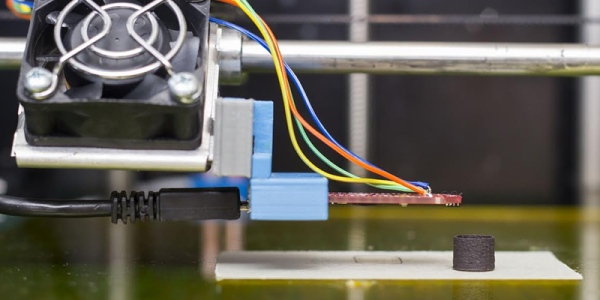
Researchers at TU Wien wanted to create magnets with exactly the right magnetic field for a particular application. Their solution? 3D printing of magnets. Previously, it has been difficult to produce permanent magnets with a specific shape of the magnetic field. The resulting magnets will be a boon to magnetic sensor construction.

Previously, after designing a magnet with a specific shape and magnetic field, a researcher would have to create tooling for injection molding. This is expensive and time-consuming and often not worth it for small quantities of magnets.

Continue reading “3D Printing Permanent Magnets”

Pi Zero Transforms To Game Boy

[GreatScott] bought a Game Boy case. Normally, you’d assume you wanted this to repair a damaged Game Boy, but in this case [GreatScott] used a Pi Zero and some 3D printing to build a game system into the tiny box. You can see some videos, below.

Two interesting parts of the project are the source of the LCD display (a rearview camera screen) and the selection of batteries. Lithium ion batteries are all the rage. But if you watch the news, you know there are some safety issues with using the batteries, especially if you use them improperly. [GreatScott] decided to go with nickel metal hydride cells which still need a protection circuit, but are typically less of a danger than the newer technology cells.

Continue reading “Pi Zero Transforms To Game Boy”

ESP8266 Lullaby

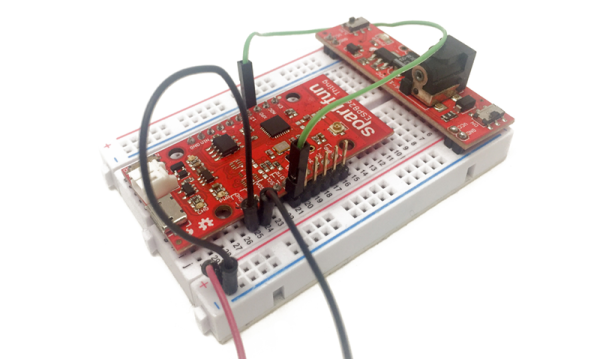
The ESP8266 is certainly a versatile device. It does, however, draw a bit of power. That isn’t really surprising, though, since you would expect beaming out WiFi signals to take a little juice. The trick is to not keep the device on all the time and spend the rest of the time in deep sleep mode. [Marco Schwartz] has a good tutorial about how to use this mode to run for “years” on a battery.

[Marco] notes that even using a 2500 mAh LiPo battery, he only gets about 30 hours of operation without sleep. By putting the chip in sleep mode, the current consumption drops from about 88 mA to just over 8 mA. That’s still high, though, because the board has a power LED! By removing a jumper or cutting a trace (depending on the board), you can drop the current draw to about 0.08 mA (80 uA) when it’s not doing anything.

Continue reading “ESP8266 Lullaby”

Think You Know C? Find Out

I’ve had the fortune or misfortune of interviewing a lot of job candidates over the years. It amazes me how often someone will claim to know something, sound reasonable, but then if you quiz them on it, it becomes really obvious that they don’t know much. To flush this out, we had a three-question test that would tell you a lot. People who got the right answer were ahead of the game, of course, but even looking at how people approached the answer (right or wrong) would tell you a lot, too.

I remember one case where the answer involved casting a value. A candidate had impressed me until faced with the question to which he said (more or less): “Well, there’s this function. I think it is called ‘cast’…” I think the look on my face told him that I actually knew the answer (not surprising, since I was giving the test) and that wasn’t it.

[Oleksandr Kaleniuk] has a C quiz of only five simple questions. They reminded me of at least one of my old company’s three-question quiz. I don’t want to say too much about the character of the test because I don’t want to give away the answers, but if you think you are a C wizard, go check it out. Then come back in the comments and tell us how you did. Just try to avoid posting spoilers (although you should probably avoid the comment section until you come back).

Continue reading “Think You Know C? Find Out”

Retrotechtacular: The Golden Book Of Chemistry Experiments

Back in “the old days” (that is, when I was a kid), kids led lives of danger and excitement. We rode bikes with no protective gear. We stayed out roaming the streets after dark without adult supervision. We had toy guns that looked like real ones. Dentists gave us mercury to play with. We also blew things up and did other dangerous science experiments.

If you want a taste of what that was like, you might enjoy The Golden Book of Chemistry Experiments. The book, first published in 1960, offers to show you how to set up a home laboratory and provides 200 experiments. The colorfully illustrated book shows you how to do some basic lab work as well as offering some science history and terminology.

Want to make oxygen? There’s several methods on page 27. Page 28 covers making hydrogen. To test the hydrogen for purity, the suggest you collect a test tube full, invert it, and stick a match up to the tube. If the hydrogen is pure it will burn with a pop noise. If air is mixed it, it will explode. Yeah, that sound safe to us.

Continue reading “Retrotechtacular: The Golden Book Of Chemistry Experiments”

Chemical Hacking At A Store Near You

Imagine for a minute that you aren’t an electronic-savvy Hackaday reader. But you find an old chemistry book at a garage sale and start reading it. It has lots of interesting looking experiments, but they all require chemicals with strange exotic names. One of them is ferric chloride. You could go find a scientific supply company, but that’s expensive and often difficult to deal with as an individual (for example, 2.5 liters of nitric acid costs over $300 for a case of six at a common lab supply company). Where would you go?

As an astute electronics guy (or gal) you probably know that ferric chloride is common for PCB etching, so you would check the electronic store down the street or maybe Radio Shack if you are lucky enough to find one that still stocks it.

So sometimes knowing where to look for a chemical is a key part of acquiring it, especially when the names are not the same. For example, do you have any amylose? No? That’s corn starch. Want to try making your own cadmium sulfide light sensor? Go to the art supply store and ask for cadmium yellow pigment. Need magnesium carbonate? Stop by a sporting goods store and ask for athlete’s chalk.

Continue reading “Chemical Hacking At A Store Near You”

Listening To Jupiter On A DIY Radio

By Jove, he built a radio!

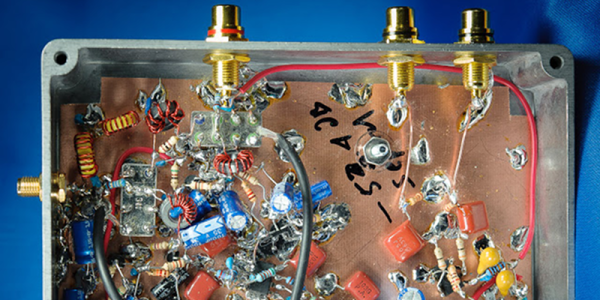
If you want to get started with radio astronomy, Jupiter is one of the easiest celestial objects to hear from Earth. [Vasily Ivanenko] wanted to listen, and decided to build a modular radio receiver for the task. So far he’s written up six of the eight planned blog posts.

The system uses an LNA, a direct conversion receiver block, and provides audio output to a speaker, output to a PC soundcard, and a processed connection for an analog to digital converter. The modules are well-documented and would be moderately challenging to reproduce.

Continue reading “Listening To Jupiter On A DIY Radio”