Beautiful Weather Station Uses Acrylic, RGB LED, And And ESP8266

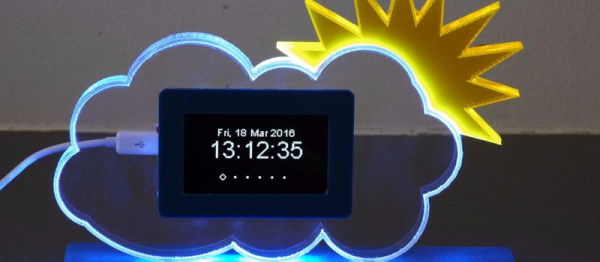
Everyone knows there’s form and there’s function. It isn’t fair, but people do judge on appearance, sometimes even overriding all other concerns. So while your Makerspace buddies might be impressed by your weather station built on a breadboard, your significant other probably isn’t. [Dennisv15] took an ordinary looking weather station design with a 0.96″ display and turned into an attractive desk piece with a much larger display and an artistic–and functional–enclosure.

The acrylic cloud lights up thanks to an RGB LED Neopixel strip and can indicate weather trends at a glance: red for warmer, blue for colder, flashing for inclement weather. The project was truly multidisciplinary, using a laser cutter to produce the body and the stand, a 3D-printed display bezel, and a PCB to make it easy to build.

Continue reading “Beautiful Weather Station Uses Acrylic, RGB LED, And And ESP8266” →
Handy Power Supply With 3D Printed Case

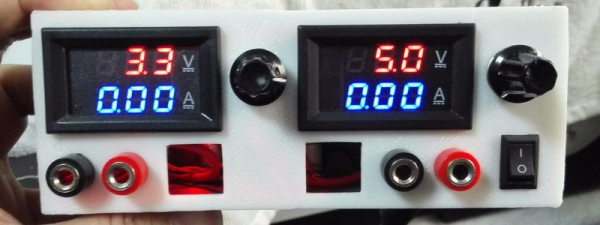
You can never have too many power supplies around your workbench. It is easy to buy them or cobble something together for most purposes. But once in a while you see one that is simple and also looks good, like this one from [RegisHsu].

The project is simple since it uses off-the-shelf DC-to-DC converter modules, and good-looking LED meters to measure voltage and current. The dual supply can accept 5 to 16 V in (presumably from a wall transformer) and deliver 1.3 V to 15.5 V out at 2 amps. [RegisHsu] removed an adjustment pot from the converter board and replaced it with a 10-turn pot to allow voltage adjustment.

Given the parts, you probably don’t even need a wiring diagram. However, the part that brings it together is the 3D-printed case, which [RegisHsu] has on Thingiverse. We’ve looked at muti-turn pot replacements before, and this is hardly the first power supply project we’ve posted.

They Put The “P” In Power

Fuel cells are like batteries, sort of. Both use chemical reactions to produce electricity. The difference is that when a battery exhausts its reactants, it goes dead. In some cases, you can recharge it, but you typically get less energy back with each recharge. A fuel cell, on the other hand, will make electricity as long as you keep supplying fuel. What kind of fuel? Depends on the cell, but most often it is hydrogen or methanol.

Researchers at the University of Bath, Queen Mary University of London, and the Bristol Robotics Laboratory want to use a different fuel: urine. According to the researchers, that’s one resource we will never deplete. The fuel cell is a type of microbial fuel cell which is nothing new. The breakthrough is that the new cell is relatively inexpensive, using carbon cloth and titanium wire. Titanium isn’t usually something you think of as cheap, until you realize that conventional cells usually use platinum.

Continue reading “They Put The “P” In Power” →

Pipe In (Robot) Hand

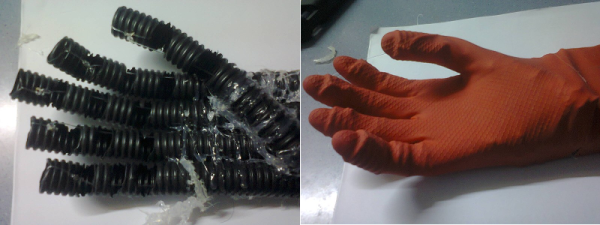
How do you make a robot hand? If you are [Robimek], you start with some plastic spiral tubing, some servo motors, and some fishing line. Oh, and you also need an old glove.

The spiral tubing (or pipe, if you prefer) is cut in a hand-like shape and fused together with adhesive. The knuckle joints are cut out to allow the tubing to flex at that point. The fishing line connects the fingertips to the servo motors.

The project uses an Arduino to drive the servos, although you could do the job with any microcontroller. Winding up the fishing line contracts the associated finger. Reeling it out lets the springy plastic pipe pull back to its original position.The glove covers the pipes and adds a realistic look to the hand.
Continue reading “Pipe In (Robot) Hand” →

Crawl, Walk, Run: A Starter CPU

Last time I talked about getting started with CPU design by looking at older designs before trying to tackle a more modern architecture. In particular, I recommended Caxton Foster’s Blue, even though (or maybe because) it was in schematic form. Even though the schematics are easy to understand, Blue does use a few dated constructs and you probably ought to build your take on the design using your choice of VHDL or Verilog.

In my case, my choice was Verilog. You can find my implementation of Blue on Opencores.org. I made quite a few changes to Foster’s original design. For example, armed with semiconductor memory, I managed to get all instructions to operate in one major cycle (which is, of course, 8 minor cycles). I also modernized the clock generation and added some resources and instructions.

Continue reading “Crawl, Walk, Run: A Starter CPU” →

Moldy Rechargeable Batteries

What’s worse than coming in from the workbench for a sandwich only to discover that the bread has molded? That red bread mold–Neurospora crassa–can transform manganese into a mineral composite that may improve rechargeable batteries, according to a recent paper inĀ Current Biology.

Researchers used the carbonized fungal biomass-mineral composite in both lithium ion cells and supercapacitors. The same team earlier showed how fungi could stabilize toxic lead and uranium. Mold, of course, is a type of fungus that grows in multi-cellular filaments. Apparently, the fungal filaments that form are ideal for electrochemical use of manganese oxide. Early tests showed batteries using the new material had excellent stability and exceeded 90% capacity after 200 discharge cycles.

The team plans to continue the use of fungus in various metallurgical contexts, including recovering scarce metal elements. This is probably good news for [Kyle]. This is quite an organic contrast to the usual news about graphene batteries.

Image: Qianwei Li and Geoffrey Michael Gadd

Homebrew Multimode Digital Voice Modem

There’s an old saying that the nice thing about standards is there are so many of them. For digital voice modes, hams have choices of D-Star, DMR, System Fusion, and others. An open source project, the Multimode Digital Voice Modem (MMDVM), allows you to use multiple modes with one set of hardware.

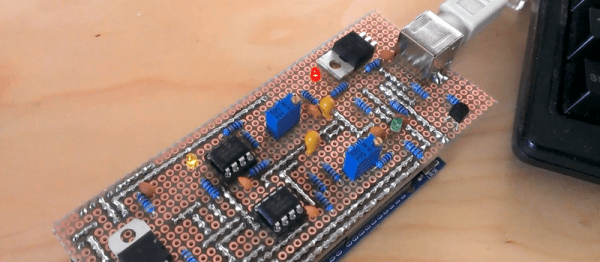
There are some kits available, but [flo_0_] couldn’t wait for his order to arrive. So he built his own version without using a PCB. Since it is a relatively complex circuit for perf board, [flo_0_] used Blackboard to plan the build before heating up a soldering iron. You can see the MMDVM in action below.

Continue reading “Homebrew Multimode Digital Voice Modem” →