Unlock The Phase Locked Loop

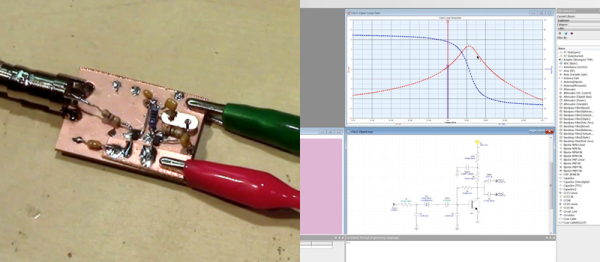
If you want a stable oscillator, you usually think of using a crystal. The piezoelectric qualities of quartz means that it can be cut in a particular way that it will oscillate at a very precise frequency. If you present a constant load and keep the temperature stable, a crystal oscillator will maintain its frequency better than most other options.

There are downsides to crystals, though. As you might expect, because crystals are so stable it’s hard to change the frequency much when you want a different one. You can use a trimming capacitor to pull the frequency a little, but to really change frequency, you have to change crystals.

There are other kinds of oscillators that are more frequency agile. However, they aren’t usually as stable. To combine flexibility with crystal-like stability, you can use a Phase Locked Loop (PLL). Many modern systems use direct digital synthesis, but the PLL is a venerable and time-tested technique.

Continue reading “Unlock The Phase Locked Loop” →

SDR Cape For BeagleBone

In the old days if you wanted to listen to shortwave you had to turn a dial. Later, you might have been able to tap in a frequency with a keypad. With modern software-defined radio (and the right hardware) you can just listen to the entire high-frequency spectrum at one time. That’s the idea behind KiwiSDR, an open source daughterboard (ok, cape) for the BeagleBone.

The front end covers 10 kHz to 30 MHz and has a 14-bit converter operating at 65 MHz. There is a Xilinx Artix-7 A35 FPGA onboard and a GPS, too. The design is open source and on GitHub.

The interface uses the OpenWebRX project for a powerful HTML 5 interface. You can see a video of its operation below or, if you can get one of the four available slots, you can listen online. From a network point of view, the demo station in Canada worked best for us. However, there are also stations in New Zealand and Sweden.

Continue reading “SDR Cape For BeagleBone” →

Oscillator Design By Simulation

[Craig] wanted to build a 19.2 MHz crystal oscillator. He knew he wanted a Pierce oscillator, but he also knew that getting a good design is often a matter of trial and error. He used a 30-day trial of a professional simulation package, Genesys from Keysight, to look at the oscillator’s performance without having to build anything. He not only did a nice write up about his experience, but he also did a great video walkthrough (see below).

The tool generates a sample schematic, although [Craig] deleted it and put his own design into the simulator. By running simulations, he was able to look at the oscillator’s performance. His first cut showed that the circuit didn’t meet the Barkhausen criteria and shouldn’t oscillate. Unfortunately, his prototype did, in fact, oscillate.

Continue reading “Oscillator Design By Simulation” →

The Infrared Theremin

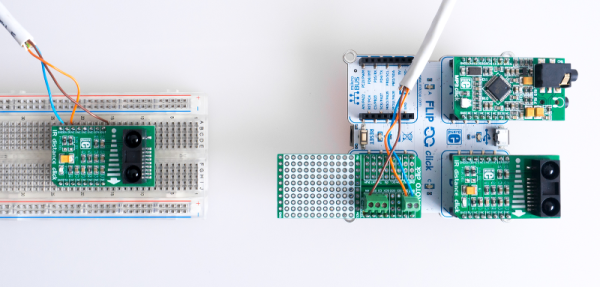
The traditional theremin is more or less an audio oscillator with two metal rods. Using proximity sensing, one rod controls the pitch of the oscillator and the other controls the volume. [Teodor Costachiou] apparently asked himself the excellent question: Why does the proximity sensor have to use capacitance? The result is an Arduino-based theremin that uses IR sensors to determine hand position.

[Teodor] used a particular type of Arduino–the Flip and Click–because he wanted to use Click boards for the IR sensors and also to generate sound via an MP3 board based around a VS1053. The trick is that the VS1053 has a realtime MIDI mode, and that’s how this Theremin makes it tones.

Continue reading “The Infrared Theremin” →

Organic Chemistry Circuits Are Flexible And Work Wet

As circuits find their way into more and more real-world environments, the old standard circuitry isn’t always up to the task. It wasn’t that long ago that a computer needed special power, cooling, and a large room. Now those computers wouldn’t cut it for the top-of-the-line smartphone. However, most modern circuits don’t bend well and don’t like getting wet.

An international team of researchers is developing chemical-based circuitry that uses gold nanoparticles and electrically charged organic molecules to build circuit elements that behave like semiconductor diode junctions. It’s simple to make flexible circuits that don’t mind being wet using this chemical soup.

In an interview with IEEE Spectrum, the developers mentioned that other circuit elements similar to transistors and light sensors should be possible. The circuits aren’t perfect, however. The switching speed needs improvement. Also, while conventional circuits don’t like to get wet, these chemical circuits have difficulties if things get dry. Still, like all technology, things will probably improve over time.

This technology needs a good bit of engineering refinement before it is practical. If you need flexible photosensitive circuits in the near term, you might try here. Meanwhile, waterproof circuitry just needs the right kind of enclosure.

Photo Credit: UNIST/Nature Nanotechnology

Anti-Hack: Free Automated SSL Certificates

You want to put your credit card number into a web site. You know to look for a secure web site. But what does that really prove? And now that so many electronic projects have Web servers (ok, I’ll say it… the Internet of Things), do you need to secure your web server?

There was a time when getting a secure certificate (at least one that was meaningful) cost a pretty penny. However, a new initiative backed by some major players (like Cisco, Google, Mozilla, and many others) wants to give you a free SSL certificate. One reason they can afford to do this is they have automated the verification process so the cost to provide a certificate is very low.

Continue reading “Anti-Hack: Free Automated SSL Certificates” →

Crawl, Walk, Run: Planning Your First CPU Design

I’ve worked with a lot of students who want to program computers. In particular, a lot of them want to program games. However, when they find out that after a few weeks of work they won’t be able to create the next version of Skyrim or Halo, they often get disillusioned and move on to other things. When I was a kid, if you could get a text-based Hi-Lo game running, you were a wizard, but clearly the bar is a lot higher than it used to be. Think of the “Karate Kid”–he had to do “wax on, wax off” before he could get to the cool stuff. Same goes for a lot of technical projects, programming or otherwise.

I talk to a lot of people who are interested in CPU design, and I think there’s quite a bit of the same problem here, as well. Today’s commercial CPUs are huge beasts, with sophisticated memory subsystems, instruction interpreters, and superscalar execution. That’s the Skyrim of CPU design. Maybe you should start with something simpler. Sure, you probably want to start learning Verilog or VHDL with even simpler projects. But the gulf between an FPGA PWM generator and a full-blown CPU is pretty daunting.

Continue reading “Crawl, Walk, Run: Planning Your First CPU Design” →