3D Printed Hydraulics

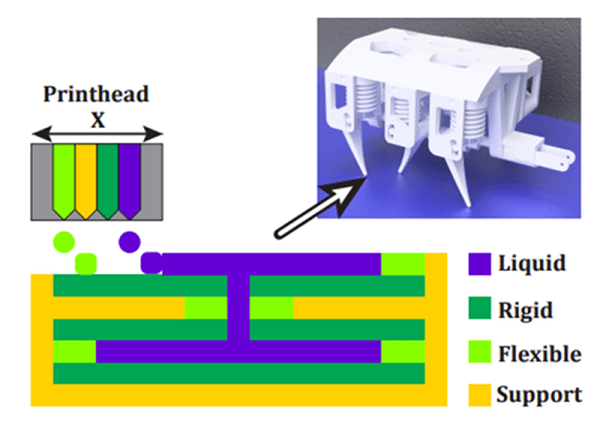
[Robert MacCurdy] at MIT wants to change how people think about hydraulics. Using fluid can be very useful in systems like robots, but it is often the case that the tubing that carries hydraulic fluid is not an integrated part of the overall design. [MacCurdy] and his colleagues have modified a 3D printer to allow it directly include hydraulic components as it prints.

The idea is simple. The team started with a printer that uses a liquid ink that is UV cured to produce solid layers. The printer has the ability to use multiple liquids, and [MacCurdy] uses hydraulic fluid (that does not UV cure) as one of the print materials. Just as you can use a 3D printer to build structures within other structures, printing the hydraulics allows for complex closed systems that use the UV-cured resin as mechanical parts that can transfer pressure to and from the hydraulic system.

Continue reading “3D Printed Hydraulics”

SDR Pan Adapter

Ham radio operators have a long history of using pan adapters to visualize an entire range of the radio spectrum. Traditionally, an adapter was essentially a spectrum analyzer that shows a trace where the X-axis is the frequency, and the Y-axis shows the signal strength at any particular frequency. You can quickly find either busy frequencies or empty frequencies at a glance.

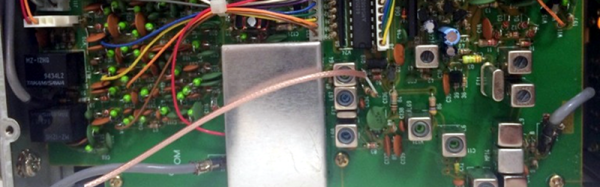
Although the pan adapter has been around since the 1930’s, they aren’t as common as you’d think with regular analog radios. However, if you’ve used an SDR (Software Defined Radio), a spectrum display is par for the course. [Mehdi Asgari] did what a lot of hams have been doing lately: he married an SDR and his traditional receiver to provide a great pan adapter with very little effort.

Continue reading “SDR Pan Adapter”

Not Ready For FPGAs? Try A CPLD

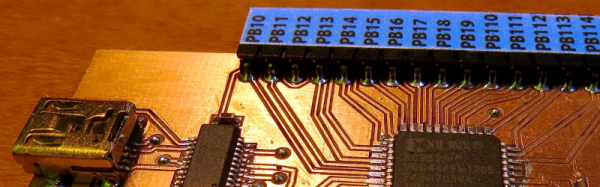
[Kodera2t]  wanted to experiment with programmable logic. Instead of going with an FPGA board, he decided to build his own CPLD (complex programmable logic device) board, with a built-in programmer. The CPLD is a Xilinx 9536 which is inexpensive and, though obsolete, still readily available. The programmer for the board uses an FT232RL and the total cost is very low ([kodera2t] says it is in the price range of a Raspberry Pi Zero or about $4).

From a user’s point of view, a CPLD is just a small FPGA. Internally, there is a significant difference in how they implement your design. Although there are differences between different product families, CPLDs usually use a sea of logic gates arranged as an AND/OR chain. By feeding inputs and inverted inputs into the AND gates and then ORing the results, you can build interesting logic circuits. However, modern CPLDs use Verilog or VHDL, so you describe what you want just like with an FPGA and the software figures out how to use the underlying circuits to give you what you want.

Continue reading “Not Ready For FPGAs? Try A CPLD”

Reading Smart Cards From A PLC (with A Little Arduino Help)

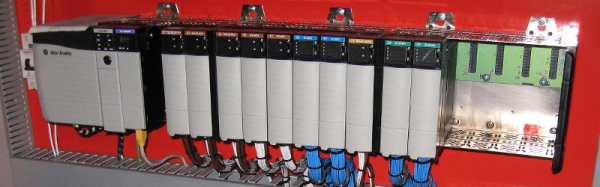
If you’ve spent any time on a factory or plant floor, it is a good bet you’ve run into PLCs (Programmable Logic Controllers). These are rugged computers that do simple control and monitoring functions, usually using ladder logic to set their programs. [plc4u] wanted to connect a smart card reader to an Allen Bradley PLC, so he turned to an Arduino to act as a go-between.

The Arduino talks to a USB card reader using a USB host shield. Then it communicates with the PLC using an RS232 link and the DF1 protocol that most Allen Bradley PLCs understand. You may not need a smart card, but once you know how to communicate between an Arduino and the PLC, you could do many different projects that leverage other I/O devices and code available on the Arduino and connects to existing PLC installations. Just remember that you’ll probably need to ruggedize the Arduino a bit to survive and be safe to the same level as a PLC (which might include a NEMA enclosure or even an explosion-proof box).

Continue reading “Reading Smart Cards From A PLC (with A Little Arduino Help)”

The rust language logo being branded onto a microcontroller housing

Programming With Rust

Do hardware hackers need a new programming language? Your first answer might be no, but hold off a bit until you hear about a new language called Rust before you decide for sure.

We all know real hackers use assembly language to program CPUs directly, right? Well, most of us don’t do as much assembly language as we used to do. Languages like C can generate tight, predictable code and are easier to manage.

Although some people use more abstract languages in some embedded systems, it is no secret that for real-time systems, device driver development, and other similar tasks, you want a language that doesn’t obscure underlying details or generate code that’s difficult to reason about (like, for example, garbage collection). It is possible to use special techniques (like the Real-Time Java Specification) to help languages, but in the general case a lean language is still what most programmers reach for when you have to program bare metal.

Even C++, which is very popular, obscures some details if you use things like virtual functions (a controversial subject) although it is workable. It is attractive to get the benefit of modern programming tools even if it does conceal some of the underlying code more than straight C.

About Rust

That’s where Rust comes in. I could describe what Rust attempts to achieve, but it is probably easier to just quote the first part of the Rust documentation:

Rust is a systems programming language focused on three goals: safety, speed, and concurrency. It maintains these goals without having a garbage collector, making it a useful language for a number of use cases other languages aren’t good at: embedding in other languages, programs with specific space and time requirements, and writing low-level code, like device drivers and operating systems. It improves on current languages targeting this space by having a number of compile-time safety checks that produce no runtime overhead, while eliminating all data races. Rust also aims to achieve ‘zero-cost abstractions’ even though some of these abstractions feel like those of a high-level language. Even then, Rust still allows precise control like a low-level language would.

Continue reading “Programming With Rust”

Open Sesame Raspberry Pi Style

[Don] installed an Android tablet into his wife’s vehicle and realized he wanted to allow it to operate and monitor the garage door. His biggest challenge? Meeting the (what he refers to) as the WAF or Wife Acceptance Factor. He decided to use a Web app on a Raspberry Pi, along with a handful of switches and a relay. His list of goals were straightforward:

  • Provide the status of the door (open/closed/unknown)
  • Open and close the door
  • Work across multiple platforms
  • Secure enough to connect to the Internet
  • Reliable and simple

Continue reading “Open Sesame Raspberry Pi Style”

Xilinx FPGAs In C For Free

When you think of developing with FPGAs, you usually think of writing Verilog or VHDL. However, there’s been a relatively recent trend to use C to describe what an FPGA should do and have tools that convert that to an FPGA. However, at least in the case of Xilinx parts, this capability is only available in their newest tool (Vivado), and Vivado doesn’t target the older lower-cost FPGAs that most low-cost development boards use.

[Sleibso] who blogs for Xilinx, has an answer. It turns out you can use the Vivado C compilation tools to generate code for older FPGAs; it just involves a less convenient workflow. Vivado (even the free version) generates unique files that the rest of the tool uses to pick up compiled C code. However, it also generates RTL (Verilog or VHDL) as a by-product, and you can import that into the older ISE tool (which has a perfectly fine free version) and treat it as you would any other RTL files.

There’s an example of using the Vivado tool in the video below. [Sleibso] points out that the video is three years old, and the talk about licensing on the video is out of date. The free tools now including this capability. [Sleibso] talks about using a Spartan 6, but the same split workflow should work with most devices ISE supports.

Continue reading “Xilinx FPGAs In C For Free”