Echo, Meet Mycroft

The Amazon Echo is an attempt to usher in a new product category. A box that listens to you and obeys your wishes. Sort of like Siri or Google Now for your house. Kickstarter creator [Joshua Montgomery] likes the idea, but he wants to do it all Open Source with a Raspberry Pi and an Arduino.

The Kickstarter (which reached its funding goal earlier this month) claims the device will use natural language to access media, control IoT devices, and will be open both for hardware and software hacking. The Kickstarter page says that Mycroft has partnerships with Lucid and Canonical (the people behind Ubuntu). In addition, they have added stretch goals to add computer vision and Linux desktop control to Mycroft.
Continue reading “Echo, Meet Mycroft”

Why Are You Still Making PCBs?

Few things have had the impact on electronics that printed circuit boards (PCBs) have had. Cheap consumer electronics would not be as cheap if someone still had to wire everything (although by now we’d be seeing wiring robots, I’m sure). Between removing the human from the wiring process and providing many excellent electrical properties (at least, on a well-designed board), it isn’t surprising that even the cheapest examples of electronics now use PCBs.

For many years, the hallmark of being a big-time electronic hacker was the ability to make your own PCBs. There have been many ways that people have tried to bring PCB manufacturing into the hacker’s garage: stick on decals, light-sensitive blank PCBs, and even using laser printer toner (that last one spurred me to write a book on PCB layout many years back). You also see a lot of people using 3D printers or CNC mills to create PCBs. Hardly a week goes by that someone doesn’t ask me how to make a PCB in a home or small business lab.

Continue reading “Why Are You Still Making PCBs?”

FPGA CNC

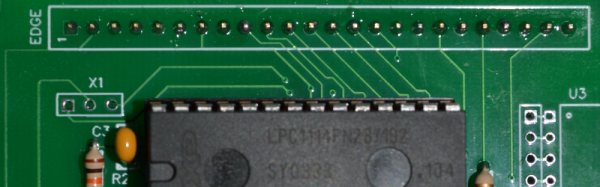
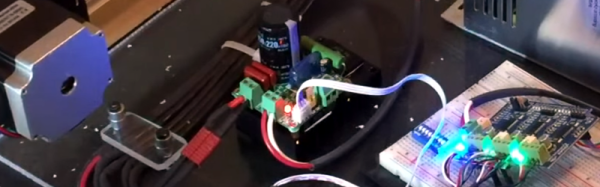
When you think of a CNC controller you probably think of a PC with a parallel port or some microcontroller-based solution like a Smoothie Board. [Mhouse1] has a different idea: use FPGAs as CNC controllers.

FPGAs inherently handle things in parallel, so processing G code, computing curves and accelerations, and driving multiple stepper motors at one time would not be an issue at all for an FPGA. Most computer-based designs will have slight delays when trying to drive everything at once and this introduces some mechanical jitter. Even worse jitter occurs when you have an old PC trying to run everything when some other task takes over the CPU.

Continue reading “FPGA CNC”

Hacking 2.4GHz Radio Control

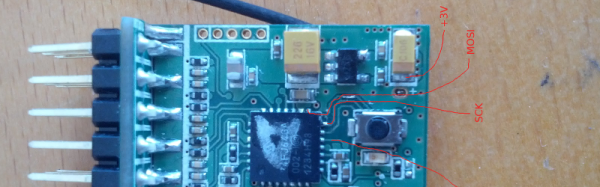
Many modern radio control (RC) systems use frequency hopping to prevent interference. Unfortunately, hopping all over the 2.4GHz band can interfere with video or WiFi using the same frequency band. [Befinitiv] was trying to solve this problem when he realized that most of the systems used a TI CC2500 chip and a microcontroller. The microcontroller commands the chip via SPI and controls the frequency by writing into a frequency register.

Updating the microcontroller firmware was impractical. The firmware is encrypted, for one thing. In addition, the change would have to be reinserted on any future updates and repeated for every RC vendor. So [Befinitiv] took a different approach. He did a classic man in the middle attack by inserting an CPLD in between the controller and the CC2500.

Continue reading “Hacking 2.4GHz Radio Control”

Getting Biometrics In Hand

It is amazing how quickly you get used to a car that starts as long as you have the key somewhere on your person. When you switch vehicles, it becomes a nuisance to fish the key out and insert it into the ignition. Biometrics aims to make it even easier. Why carry around a key (or an access card), if a computer can uniquely identify you?

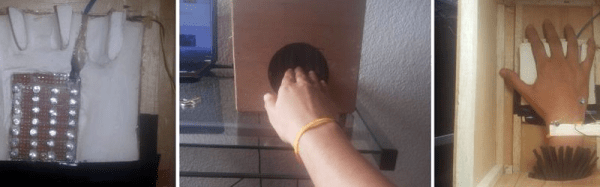
[Alexis Ospitia] wanted to experiment with vein matching biometrics and had good results with a Raspberry Pi, a web cam, and a custom IR illumination system. Apparently, hemoglobin is a good IR reflector and the pattern of veins in your hand is as unique as other biometrics (like fingerprints, ear prints, and retina vein patterns). [Alexis’] post is in Spanish, but Google Translate does a fine job as soon as you realize that it thinks “fingerprint” is “footprint.” The software uses OpenCV, but we’ve seen the same thing done in MATLAB (see the video below).

Continue reading “Getting Biometrics In Hand”

Hacking A Pi Camera With A Nikon Lens

Cell phones have killed many industries. It is getting harder and harder to justify buying an ordinary watch, a calculator, or a day planner because your phone does all those things at least as well as the originals. Cell phones have cameras too, so the days of missing a shot because you don’t have a camera with you are over (although we always wonder where the flood of Bigfoot and UFO pictures are). However, you probably still have a dedicated camera tucked away somewhere because, let’s face it, most cell phone cameras are just not that good.

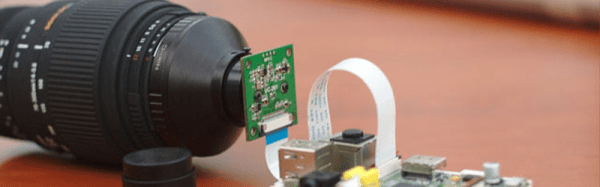
The Raspberry Pi camera is about on par with a cheap cell phone camera. [Martijn Braam] has a Nikon camera, and he noticed that he could get a Raspberry Pi camera with a C-mount for lenses. He picked up a C to F adapter and proceeded to experiment with Nikon DSLR lenses on the Raspberry Pi camera.

Continue reading “Hacking A Pi Camera With A Nikon Lens”

3D Printed Battery Forms

What’s the worst thing that can happen when you are trying to show off a project? Dead batteries might not be the absolute worst thing, but it is pretty close to the top of the list. [KermMartian] has this problem every year at World Maker Faire with demos based around calculators. At first, he tried wedging power supply wires into the calculator using dead batteries to hold the wires in place. However, it didn’t take much wear and tear before the wires would pull out.

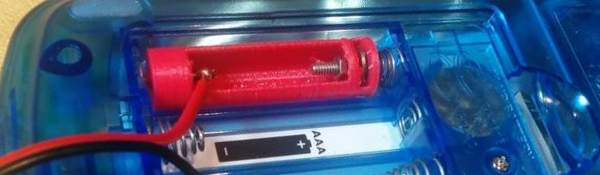
The solution? A 3D printed battery form that accepts metal hardware that can connect to the external power supply. The AAA-sized plastic batteries insert into the calculator’s battery compartment and the small machine screws and washers form the connection points.

Continue reading “3D Printed Battery Forms”