Circuit Sculpture Lamp Is A Colorful Cube Companion

Circuit sculpture is engineering and art all at play together. One must combine the functional with the aesthetically appealing. [EdwardA61] did just that with this enchanting lamp build.

Like many other circuit sculptures, the build relies on the aesthetic qualities of brass, though [EdwardA61] notes that copper wire can be used as well. Four WS2812B LEDs, in their bare PCB-mount form, are soldered into a circuit using the brass to carry the power and data signals as needed.

A Seeduino Xiao microcontroller is responsible for controlling the show, though relies on a typical PCB rather than a circuit sculpture in and of itself. It does provide for easy powering and programming however, with the benefit of its USB-C connector.

It’s a simple skeleton design, as so many circuit sculptures are, but it’s a form that we’ve come to love and appreciate. [EdwardA61] did a great job of photographing the build, too, showing how the colors on each LED interplay with each other as they’re cast on the table.

It’s a lamp we’d love to build ourselves, and we hope that [EdwardA61] follows through on plans to cast a similar design in clear resin, as well. If you’ve built your own artistically electrical sculptures, be sure to let us know!

Bluetooth RC Car Packs In A Few Sensors

Have you ever been walking around the house, desperate to know the ambient temperature, humidity, and barometric pressure? Have you ever wanted to capture that data with a small remote-controlled platform? If so, this project from [TUENHIDIY] will be exactly what you’ve been looking for. 

The little remote-control car is built around a Seeed Wio Terminal. This is a microcontroller platform that comes with a screen already attached, along with wireless hardware baked in and Grove connectors for hooking up external modules. Thus, the car adds a DHT11 temperature and humidity sensor, along with a BMP280 air pressure sensor using the Grove connectors.

Driving the car is done via a Blynk smartphone app that communicates with the Wio Terminal. Small DC motors at each wheel are driven via a DFRobot quad-motor shield. With the built-in screen, the RC car displays commands received from the smartphone app, as well as the temperature, humidity and pressure in the immediate environment.

We really like the simple PVC-based chassis design, and it’s a straightforward project that demonstrates how to build a Bluetooth-controlled car. Data collected by the sensors is also visible on the smartphone app, so if you need to sample conditions in the next room without getting off the couch, you could do that pretty easily.

Projects like these are a good way to get familiar with working with motors and sensors. It’d be a great base for simple robotics development, too. We’ve featured builds from [TUENHIDIY] before, too, like this great rotary plotter that can draw on bottles. Video after the break.

Continue reading “Bluetooth RC Car Packs In A Few Sensors”

Using VHDL To Generate Discrete Logic PCB Designs

VHDL and Verilog are hardware description languages, used to describe and define logic circuits. They’re typically used to design ASICs and to program FPGAs, essentially using software to define hardware. However, [Tim] has done something altogether quite creative, creating tools to take VHDL and Verilog and spit out PCB designs for discrete logic. 

Yes, you read that correctly. The basic idea is to take VHDL source code, and then make a PCB layout that implements the desired logic using resistor-transistor logic. From there, the PCB design files can be shipped off to a manufacturer for pick-and-place assembly at a fraction of the cost of producing a bespoke ASIC.

The drawbacks are obvious; tons of individual discrete parts are required, the size penalty is hilariously bad, and power usage is almost certainly orders of magnitude higher than doing the same logic on an ASIC or even FPGA. Oh, and everything’s much slower, too.

However, as an academic exercise or simply for fun, it’s an awesome bit of work. The idea that one can define a complicated logic circuit and have a PCB implementing the logic whipped up by automated tools is amazing, and we absolutely want to see more of this type of thing.

We’ve seen similar work done with VHDL synthesis into 74-series logic design. If you’ve been developing your own fancy digital-logic-fu, be sure to drop us a line!

[Thanks to Yann Guidon for the tip!]

A Guide To Designing A Custom RC Controller

These days, there are tons of RC controllers out there of all shapes and sizes. However, if you want to build something with just the right amount of buttons and sticks for your application, you might want to design something yourself. That’s precisely what [Sebastian] did. 

The project actually began some time ago, with [Sebastian] sharing his process for building a custom ergonomic enclosure through the use of clay and photogrammetry, which we’ve covered before.

Inside that shapely housing, the build relies on a STM32 microcontroller, hooked up to a series of potentiometers, buttons, and a thumbstick (more potentiometers). A NRF24L01 module is used to handle the radio transmission side of things.

Overall, [Sebastian] has produced a great guide to designing a custom RC controller from the ground up, rather than simply instructing one how to replicate his own build. Armed with these skills, any maker should be able to whip up their own entirely bespoke controllers. Video after the break.

Continue reading “A Guide To Designing A Custom RC Controller”

Centaur Costume Features Drinks Cooler And Walking Legs

Let’s say it’s Halloween, and you’re a big fan of centaurs. At the same time, you want to be easily able to store your drinks on ice and always have them to hand. Well, this costume from [David Yakos] might be the one for you.

Construction is simple. Two small bike wheels were fitted to the cooler using bits of a broken chair, and the other end of the cooler is simply fitted around the wearer’s waist with a strap.

The rear centaur legs are carved out of foam board, and attached to the rear wheels with a bolt through the spokes. The top of each leg is attached to a rod, which slides into the frame holding the wheels on. It keeps the top of the legs roughly where they should be but lets them move, allowing the legs to “walk” as the wheels rotate.

It’s not exactly an advanced build, but we simply love the idea of costumes that keep drinks cold all night. Hiding the cooler as a centaur’s body is really just the icing on the cake. Of course, if you’ve got your own costume design for keeping your beverages chilled and frosty, do let us know. Video after the break.

Continue reading “Centaur Costume Features Drinks Cooler And Walking Legs”

Automated Air Cannon Shoots Smoke Rings

Air cannons are fun, and became a part of mainstream culture with the popular Airzooka toy. Of course, cocking and firing the Airzooka gets tiring after a while, and they’re kind of a little small. This build from [1alembic] delivers on both those counts. 

Cool, huh?

The result is a bigger air cannon that repeatedly fires all by itself. The cannon itself is built out of a trash can with the bottom cut out. It’s then fitted with a diaphragm made out of a heavy-duty trash bag covered in duct tape for added strength. Latex hose is then installed inside the trash can, attached to the diaphragm. Thus, the diaphragm can be pulled back, and when released, it’s pulled forward, creating a rush of air through the trash can which generates a vortex ring just like the smaller Airzooka.

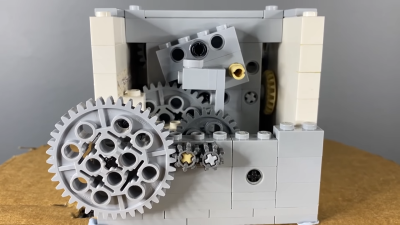
The automation of the cannon is beautifully simple. A string is attached to the back of the diaphragm, and wrapped around a rod so it can be wound up. This allows a wiper motor to turn the rod via a set of gears, pulling the diaphragm back.

However, the drive gear on the wiper motor has half its teeth missing. The system is then set up so that once the diaphragm is pulled right back, the drive gear gets to the missing teeth, allowing the winder rod to spin back freely as the diaphragm shoots forward, firing the air cannon. The cycle then repeats as the drive gear re-engages the winding mechanism.

Paired with a smoke machine, the air cannon will whirr away, firing beautiful smoke rings at regular intervals until it’s switched off. It’s an elegant thing that we’d love to leave set up at a party to add some atmosphere. We’ve seen other air cannons built with some real fire-power, too. Video after the break.

Continue reading “Automated Air Cannon Shoots Smoke Rings”

LEDBOY Is A Retro-Modern Handheld Game

Back in the 1970s, there were a few LED-based games on the market that were quickly superseded by the rise of LCDs and other fancier technologies. However, [grossofabian] wanted to recreate that classic style of game but with more modern hardware. The result is the LEDBOY, a colorful handheld game built in tribute to that era.

The handheld is based around the ATtiny 1614 microcontroller, driving a 10×10 array of NeoPixel Nano 2427 LEDs, named for their small 2.4 mm x 2.7 mm form factor. They’re RGB, too, so there’s lots of wonderful colors to play with.

Wrapped up in a neat enclosure with a rechargeable 130 mAh lithium-ion battery and some simple tactile buttons, it’s a tidy little handheld game console. Add in the CH340C chip for USB to serial duties, and it’s easy to program with the Arduino IDE, too.

Code is available on Github for those keen to take a closer look. Amusingly, the project bears a striking resemblance to a similarly-named build we featured just under 12 years ago. Time is a flat circle, and the video, my friends, is after the break.

Continue reading “LEDBOY Is A Retro-Modern Handheld Game”