Motion Tracking Face Really Does Follow You Around The Room

Many of us have had the experience of viewing an artwork in a gallery, in which the eyes appear to follow one around the room. In our high-technology work, this no longer need be achieved with artistic skill. You can just build something that actually moves instead.

Chartreuse is the creation of [alynton], and has a personality all its own. A face was created out of laser cut wood, and assembled layer by layer. It was then given glowing LED eyes, and mounted on a rotating plate. Combined with an Arduino and an ultrasonic sensor, it’s capable of tracking targets moving within its field of view, and rotating to follow them. Chartreuse’s expression changes as well, with from happy to forlorn, depending on the situation.

It’s a great example of the artistic results that can be achieved by layering lasercut materials, as well as how art can be brought to life with simple maker staples like servos and microcontrollers. Motion tracking has plenty of useful applications, too – like aiming heat directly at cold humans. Video after the break.

Continue reading “Motion Tracking Face Really Does Follow You Around The Room” →
Yet Another Robotic Rubik’s Solver

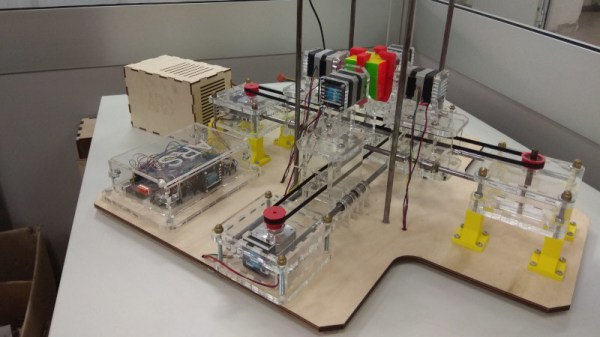
The Rubik’s Cube was a smash hit when it came out in 1974, and continues to maintain a following to this day. It can be difficult to solve, but many take up the challenge. The Arduino Rubik’s Solver is a robot that uses electronics and maths to get the job done.

The system consists of computer-based software and a hardware system working in concert to solve the cube. Webcam images are processed on a computer which determines the current state of the cube, and the necessary moves required to solve it. The solving rig is constructed from steel rods, lasercut acrylic, and 3D printed parts, along with an Arduino and six stepper motors. The Arduino receives instructions from the solving computer over USB serial link. These are then used to command the stepper motors to manipulate the cube in the correct fashion.

It’s no speed demon, but the contraption is capable of solving a cube without any problems. Manipulation of the cube is reliable and smooth, and the build is neat and tidy thanks to its carefully designed components. Of course, there are now even Rubik’s Cubes that can solve themselves. Video after the break.

Continue reading “Yet Another Robotic Rubik’s Solver” →

Artistic Attempt To Send Digital Signals Via Fungus

Art projects can fundamentally be anything you like, as long as you say they’re art at the end of it all. They don’t always work, or work well, but they often explore new ideas. Often, artists working on installations fall back on similar tools and techniques used by the maker community. [Julian] is no exception, and his Biotic Explorers work has many touchstones that will be familiar to the Hackaday set.

The device attempted to send signals via Mycellium fungus.

The Biotic Explorers Research Group is a broad art project, involving the creation of a fictitious scientific association. [Julian] created imaginary scientists, reports, and research to flesh out this world. The project culminates in the development of a prototype communications system, which uses pH sensors at either end of a fungal network in soil to send messages.

Liquids are applied to change the pH of the system, which can be picked up at the other end of the soil bed. The pH levels are read as digital signals, with pH levels either side of neutral reading as high and low bits. pH sensors can be expensive, so [Julian] chose the cheapest available, and tapped into their LCD display lines to read their output into an microcontroller. The system displays data using commonly available OLED displays, and hobby servo motors are used to control the dispensing of liquid.

Due to time constraints, [Julian] was unable to get the system fully functional. Sending data as pH levels through fungus proved unreliable and slow, but we suspect with further development, the system could be improved. Regardless, the project serves as an excellent example of the work that goes into a functional art installation. The thesis sheds further detail on the development of the project.

We’re no strangers to an art installation here – whether it’s Markov chains or glowing balloons.

Animated Pixel Lamp Is A Must For Any Chiptuner’s Bedroom

Lamps are quite often simple things, designed to light an area and perhaps add a touch of style to a room. Of course, it’s 2019 now, and we don’t need to settle for just that. We can have wildly colored animated lamps if we want to! (French Youtube link, embedded below.)

The lamp in question is the work of [Heliox], who knows her way around an LED or two (hundred). In this build, a string of WS2812 addressable RGB LEDs are hooked up to an Arduino Mega brain. The LEDs are fitted into a round lamp body, with a rectangular diffuser for each one. This creates an attractive pixellated effect and gives the animations a charming 8-bit quality. A thin outer shell is 3D printed in white plastic to further diffuse the light. The top of the lamp rotates an internal potentiometer to control mode selection. There’s also a brightness knob on the bottom if things get a touch too intense.

It’s a tidy build that uses 3D printing and addressable LEDs to quickly and easily create a lamp with a fun retro aesthetic. We could imagine this making a great piece for a hip sitcom apartment. We fully expect to see similar lamps on sale in the next couple of years. Video after the break.

Continue reading “Animated Pixel Lamp Is A Must For Any Chiptuner’s Bedroom” →

3D Printed Knife Sharpening Tool Makes The Job Easy

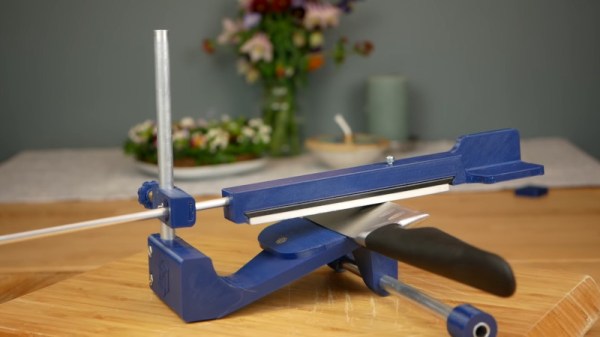
A sharp knife is a joy to use, but many of us are guilty of buying the cheapest kitchen tools available and rarely maintaining them. Keeping knives sharp is key to working with them both safely and effectively, but to sharpen by hand requires patience and skill. [CNC Kitchen] instead decided to use technology to get around the problem, designing a 3D-printed tool to make the job easy (Youtube video, embedded below).

The knife sharpener is a straightforward build, requiring a few simple 3D printed parts in combination with some nuts, bolts, and aluminum rods. It’s designed to use commonly sized whetstones, which makes procurement easy. The design has undergone refinement over the years, with [CNC Kitchen] adding pockets for the magnets and a spherical bearing which reduces slop in the movement.

[CNC Kitchen] reports that the tool works wonderfully, allowing even a novice to sharpen knives well. Parts are available on Thingiverse for those who wish to print their own. If however, you insist on doing things the old-fashioned way, you can get an electronic coach to help improve your technique. Video after the break.

Continue reading “3D Printed Knife Sharpening Tool Makes The Job Easy” →

Simulated Newton’s Cradle Makes A Flashy Desk Toy

Newton’s Cradle was once upon a time, a popular desk toy in offices around the world. For [TecnoProfesor], however, it wasn’t quite flashy enough. Instead, they built a simulated version with flashing LEDs. As you do.

Rather than relying on the basic principles of the cradle to make it work, this relies on two servo motors to move the balls on the ends, with the ones in the middle remaining stationary. Each ball is fitted with an RGB LED, which flashes with the simulated “motion” of the cradle. By using ping pong balls, the light from the LEDs is nicely diffused. The frame is built from wooden dowels, metal rods, and acrylic.

It’s a project that is sure to confuse at first glance, but it’s a great way to learn basic microcontroller skills like interfacing with LEDs and servomotors. We’d love to see a version that works like a real Newton’s Cradle, flashing the LEDs as they are hit by their neighbours. We’ve even seen them automated, for the truly lazy among us.  Alternatively, one could go completely ridiculous and have such a device tweet on every hit, though you might run afoul of the API’s spam restrictions. If you give it a go, drop us a line.

A Briefcase Computer For Your Hacking Needs

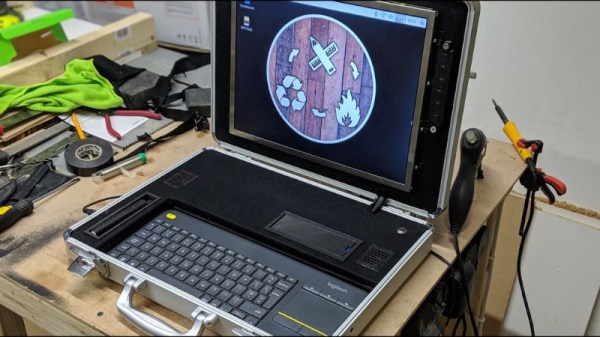
Decent laptop computers have been available for decades now. Despite this, there’s still something charming and enigmatic about a computer hidden within a briefcase. [MakeFailRepeat] wanted just such a rig, so did the maker thing and built one.

The project began when [MakeFailRepeat] was donated a 15″ monitor that ran on 12V. Naturally, it needed to be used in an awesome project, and the build began. MDF panels were cut to mount the screen inside an aluminium briefcase, and covered in black felt for a pleasing look and feel. A Logitech wireless keyboard and touchpad combo is used for input. The brains of the operation is a Raspberry Pi, equipped with a UPS HAT to handle battery and mains power, and an Adafruit Speaker Bonnet for sound.

The project was inspired by the classic video game Captive, released on Amiga, Atari, and MS-DOS platforms way back in 1990. While we’re pretty sure [MakeFailRepeat] isn’t trapped on a space station, his briefcase computer should nonetheless prove useful. A computer isn’t the only thing you can build into a briefcase, though. Video after the break.

Continue reading “A Briefcase Computer For Your Hacking Needs” →