Hash And Roll Your Way To Secure Passwords

In the electronic battlefield that is 2019, the realm of password security is fraught with dangers. Websites from companies big and small leak like sieves, storing user data in completely unsecure ways. Just about the worst thing you can do is use the same password across several services, meaning that an attack on one gives entry to multiple accounts. The challenge is to generate a unique and secure password for each and every application, and [Ilia]’s way of doing that is called HashDice.

No, it’s not a password manager, or an app – it’s a simple method that can be readily applied by anyone with the right tools. A simple dice is used to create random numbers, which are used to select words from a list to form the basic secret phrase. This is then combined with the name of the service or application to be accessed, the date, and a salt, before hashing using the SHA256 algorithm. The final hash is then truncated to create the password. You can do it all on a device that’s airgapped from the world, ensuring your core secret is never exposed, thus maintaining security.

There are some pitfalls to this method, of course. Many websites make things harder by requiring special characters or enforcing length limits on passwords. [Ilia] helpfully suggests several workarounds for this, but admits that no system is perfect in the face of these obstacles.

If you’re now wondering if your current password is safe, there are ways to investigate that, too.
 

Emergency Neighbourhood Communications Courtesy Of HELPER

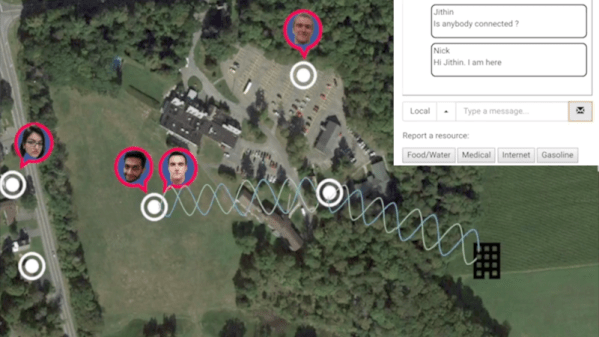
For many people, phone and Internet connectivity are omnipresent and always available. It’s possible to upload selfies from a Chinese subway, and search for restaurant reviews in most highway towns, all thanks to modern cellular connectivity. However, in emergencies, we’re not always so lucky. If towers fail or user demand grows too large, things can collapse all too quickly. It’s in these situations that HELPER aims to flourish.

HELPER stands for Heterogeneous Efficient Low Power Radio. It’s a radio system designed to operate in the absence of any infrastructure, creating a pop-up network to serve community needs in disaster areas. Users can share information about available resources, like water, gasoline and food, while emergency workers can coordinate their response and direct aid to those who need it.

It’s a system built around commonly available parts. Raspberry Pis run the back end software and communicate with individuals over WiFi, with LoRa radios handling the longer-range communication from node to node. Combining this communication ability with GPS location and stored map data allows users to more easily find resources and assistance when things go wrong. The journal article is freely available for those wishing to learn more about the project.

It’s a project which aims to keep people safe when conventional networks go down. The key is to remember that once disaster strikes, it’s usually too late to start distributing radio hardware – emergency gear should be in place well before things start to go south. Of course, there’s also the government side of the equation – in the USA, the Emergency Broadcast System is a great example of emergency communications done right. Video after the break.

Continue reading “Emergency Neighbourhood Communications Courtesy Of HELPER” →

Creating 8-bit Games With The Multi Platform Arcade Game Designer

Creating a game from scratch can be hard work. There are concepts to be designed, coding to be done, and art to be created to make it all happen. However, it doesn’t always have to be quite so difficult. There are a variety of development tools that allow budding game designers to get started with a point-and-click approach. [Jonathan Cauldwell] has come up with just such a tool that lets you do just that, for a variety of 8-bit platforms.

[Jonathan]’s project is called the Multi Platform Arcade Game Designer, so named for its ability to create games for several 8-bit systems of yesteryear. Currently, the Spectrum, Amstrad CPC, and Acorn Atom are all supported, with plans to add more down the track.

Creating a game is a simple affair, which [Jonathan] explores in a video tutorial series. Sprite and background editors are built into the software. Scripts can be automatically generated to create a wide variety of basic game types, from scrolling shoot-em-ups to classic platformers. There’s also functionality that allows advanced users to add further functionality by supplying some of their own code.

If point-and-click isn’t for you, you can always forge your ZX Spectrum games the classic way, with assembly and BASIC. Video after the break.

Continue reading “Creating 8-bit Games With The Multi Platform Arcade Game Designer” →

Writing A Very Tiny Chess Program

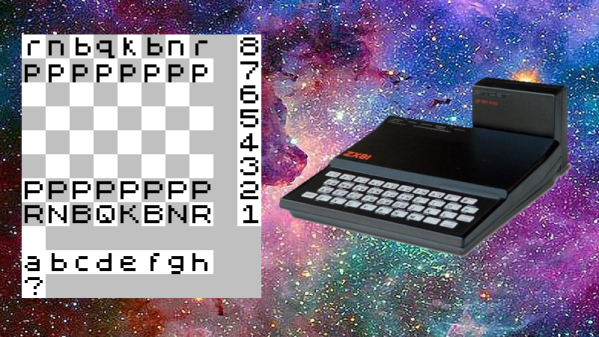
When programming for modern platforms, the restraints are different to those of 30 years ago. Back in the dawn of the microcomputer age, storage and RAM were measured in kilobytes. It simply wasn’t possible to store large amounts of graphical data, and even code had to be pared back at times. [reeabgo] found out some of these limitations first hand, when coding a tiny chess program for the Sinclair ZX81.

[reeabgo]’s project goes by the name ChesSkelet, and is truly tiny. Measuring in at just 377 bytes in its smallest version, the entire program takes up less space than this very article describing it. To achieve these feat requires certain sacrifices, of course. The tiniest edition contains no graphics whatsoever, representing the game state with simple characters and featuring no adornments whatsoever. The full-fat version comes in at 477 bytes and adds quite a lot of functionality. There’s a proper checkerboard, along with move legality checks and pawn promotion.

Unfortunately, advanced chess play isn’t quite possible – castling is not implemented, and the AI doesn’t yet handle check situations properly. Despite this, it’s a solid approximation of the real game, all packed into an impressively small space.

We see plenty of chess hacks around these parts – including the robotic variety.

Reverse Engineering A Modern IP Camera

Security cameras used to be analog devices feeding back into a room full of tiny screens and commercial grade VCRs. As technology moved forward, IP cameras began to proliferate. Early models simply presented a video stream and configuration page to the local network. Modern models aimed at the home market differ however. More often than not, configuration is through a strange smartphone app, and video is accessed through third-party servers. It’s all a bit oblique, and so [Alex] decided to take a look under the hood. 

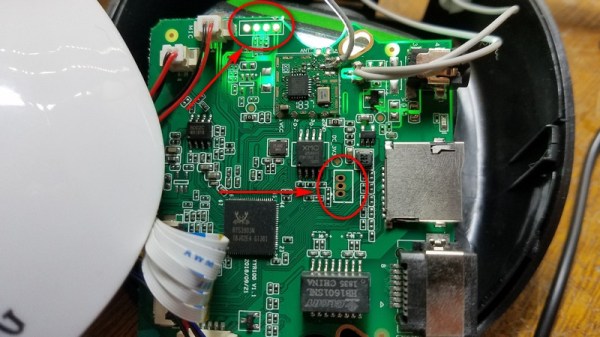
The exploration begins externally, with [Alex] capturing data sent to and from the camera with Wireshark. Straight away, red flags are raised. For as yet unknown reasons, the camera attempts to resolve Google, Facebook and Alibaba servers over DNS. Disassembly then follows, revealing that a serial terminal with root access is available. [Alex] uses this to probe around, uncovering the firmware update script and a way to decrypt said updates.

The work thus is a great example of how to approach hacking a given device from first principles. The overall goal is to find a way to gain complete control over the camera, reprogramming it to serve up video as [Alex] wishes, rather than to a distant third party server. It’s not the first time we’ve seen an IP camera hacked, and we doubt it will be the last. If you’ve got one cracked, be sure to let us know.

An Air Quality Monitor That Leverages The Cloud

Air quality has become an increasing concern in many urban areas, due to congestion and our ever-increasing energy use. While there are many organisations that task themselves with monitoring such data, it’s also something anyone should be able to take on  at home. [Chrisys] is doing just that, with some impressive logging to boot.

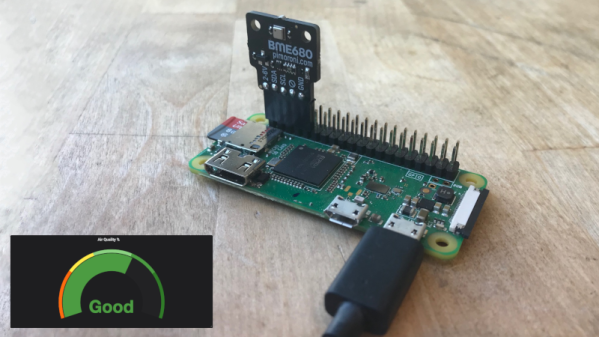
The build starts with a Raspberry Pi Zero W, which offers the requisite computing power and Internet connectivity in a compact low-power package. For determining air quality, the Bosch BME680 sensor is used. This offers temperature, pressure, and humidity readings, along with the ability to sense the presence of volatile organic compounds, or VOCs. These can be harmful to human health, so it’s useful to have an idea of the levels in your home.

The hardware is incredibly refined. It’s simple enough for the newbie, but just begs for the more experienced hacker to expand on.

On the software side, data is accessible through the Balena cloud service. Sensor readings are stored in an InfluxDB instance, with Grafana providing the visually attractive graphs and monitoring. It’s all very slick and Web 2.0, and can be accessed from anywhere through a web browser.

The project is a great example of combining a basic DIY Raspberry Pi setup with the right software tools to create a polished and effective end product. Of course, if you’re looking for something more portable, this project might be more your style. 

Casting Car Emblems Via 3D Printing

Casting is a process that can be quite demanding for the first timer, but highly rewarding once the basic techniques are mastered. It then becomes possible to quickly and reliably produce metal parts en masse, and with impressive tolerances if the right method is chosen. [VegOilGuy] has been experimenting with lost PLA casting, and decided to see if it could be applied to car emblems. 

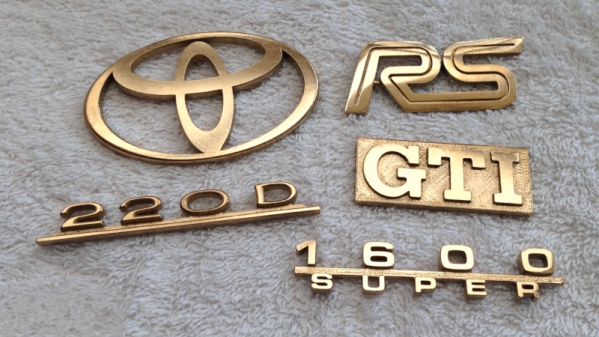
The process begins with 3D models of various car emblems, primarily sourced from Thingiverse. These are printed in PLA, with sprues added to assist with the casting process. The parts are sanded to avoid unsightly print lines on the finished product, and any voids filled with wax. The various emblems are then assembled onto a casting tree, with extra sprues added to improve metal flow with wax and further PLA parts.

The investment mold is then created with plaster, and baked to remove water and melt out the PLA. This is crucial, as any water left in the mold can react explosively with the molten aluminium bronze.  The mold is then filled with metal and then allowed to cool. The plaster mold is destroyed, and the parts can then be removed. Final processing involves a trip through a rock tumbler before final polish with sandpaper.

[VegOilGuy] gets impressive results, with the parts looking excellent in their bronze colour. This is an unconventional color for a car emblem, but it’s noted that this material is an excellent candidate for chrome plating to get a more OEM finish.

You might find your lost PLA casting experiments could benefit from the help of a microwave, too. Video after the break.

Continue reading “Casting Car Emblems Via 3D Printing” →