Making A Hammer With Beautiful Engravings

Tools are a key part of any maker’s pursuit of their work. For most of us, our tools come from the local hardware store or are purchased online. Some prefer to craft their own, however, and [Uri Tuchman] is just one such person.

[Uri] starts at the absolute beginning, with a piece of unfinished rectangular stock. The workpiece is marked up, and the shape of the hammer head meticulously filed out by hand. The wooden handle is similarly prepared from raw stock with a combination of planes, chisels and files.

It may not be the fastest way to work, but careful hand craftsmanship is always impressive to watch. The build also showcases [Uri]’s talent at engraving, with the complex designs all carved out of the surface a millimeter at a time. [Uri] recommends enamel paint to highlight such works, for its rich color and the ease of removing excess paint.

Where [Uri] has built a beautiful piece of art that moonlights as a hammer, it’s possible to go in completely the opposite direction with a build. Video after the break.

[Thanks to BrightBlueJim for the tip!] Continue reading “Making A Hammer With Beautiful Engravings” →

Corn Starch Fixes A Game Boy Screen

Nintendo’s Game Boy was the handheld of the 1990s. Like many of their products, it was famous for its ability to stand up to punishment from angry children and military strikes alike. Its biggest weakness is perhaps its unbacklit LCD screen. Retrogamers and chiptuners alike find themselves modifying and replacing these regularly.

A common problem during these swaps is “Newton rings” – an issue where the polarizer comes into contact with the LCD glass, causing unsightly visual artifacts. Thankfully, there is a simple fix. It’s possible to keep the two separated with the application of microscopic particles, too small to see. [esotericsean] uses cornstarch, while [bogamanz] favors diatomaceous earth. For best results, a makeup brush can be used to apply a fine coating, and compressed air used to clean out the Game Boy and remove any excess.

It’s rare to fix a delicate screen problem with a household staple, but gratifying when it works. The results are hard to see on camera, but many report this fixing the frustrating issue. So, if you’re planning to backlight your Game Boy, keep this in your bag of tricks. It’ll allow you to get the best possible result, and may be useful on other old-school LCDs as well. Video after the break.

Continue reading “Corn Starch Fixes A Game Boy Screen” →

PrintRite Uses TensorFlow To Avoid Printing Catastrophies

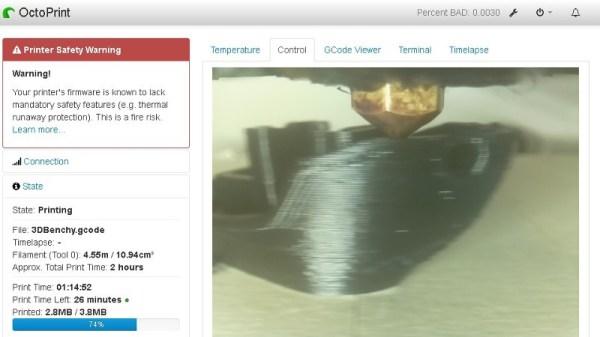
TensorFlow is a popular machine learning package, that among other things, is particularly adept at image recognition. If you want to use a webcam to monitor cats on your lawn or alert you to visitors, TensorFlow can help you achieve this with a bunch of pre-baked libraries. [Eric] took a different tack with PrintRite – using TensorFlow to monitor his 3D printer and warn him of prints gone bad – or worse.

The project relies on training TensorFlow to recognize images of 3D prints gone bad. If layers are separated, or the nozzle is covered in melted goo, it’s probably a good idea to stop the print. Worst case, your printer could begin smoking or catch fire – in that case, [Eric] has the system configured to shut the printer off using a TP-Link Wi-Fi enabled power socket.

Currently, the project exists as a plugin for OctoPrint and relies on two Raspberry Pis – a Zero to handle the camera, and a 3B+to handle OctoPrint and the TensorFlow software. It’s in an early stage of development and is likely not quite ready to replace human supervision. Still, this is a project that holds a lot of promise, and we’re eager to see further development in this area.

There’s a lot of development happening to improve the reliability of 3D printers – we’ve even seen a trick device for resuming failed prints.

Digital Protractor Makes Angular Measurements A Snap

Old school vernier calipers served engineers and machinists well for a long time — and did a perfectly good job. Digital models then came along and were easier to read. They now rule the roost, despite their thirst for batteries. Humans are naturally wired to make the least effort possible at all times. That’s why you always drive to the store that’s only a few blocks from your doorstep. In this vein, you may find a digital protractor preferable to the classic printed type.

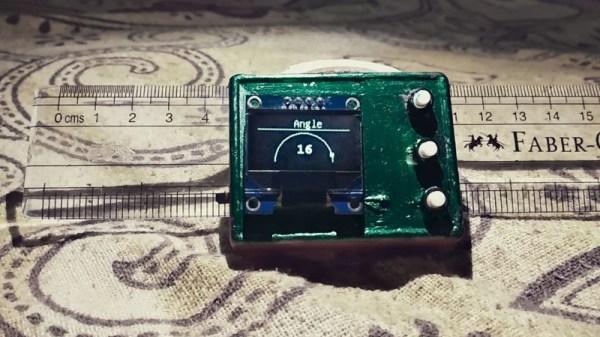
[Nirav Jadav]’s project is a simple one but serves as a good learning experience for those getting to grips with microcontrollers. An Arduino Pro Mini serves as the brains, reading signals from an MPU6050 gyroscope. Measured angles are displayed on a small OLED screen.

To use the protractor, first the reference button must be pressed, then the device may be rotated to measure the angle. Relying on a gyroscope means that it’s likely less accurate than a printed device, particularly if it isn’t recalibrated every few measurements to account for drift.

However, like many projects to grace these pages, its value lies not in its usability, but in the journey of creation. To build such a device requires programming ability, an understanding of interfacing with external peripheral devices, as well as how to drive a graphical display. These skills are highly useful in a wide variety of projects, and they’ll serve [Nirav] well in projects to come.

Once you’ve built your digital protractor, why not have a stab at building a digital measuring tape?

[Thanks to Baldpower for the tip!]

Paper Cup Mic Is Fun And Functional

Any studio operator worth their Protools subscription will have a wide array of microphones to cover any conceivable situation. SM57s to cover guitar cabs, fancy gilded ribbon mics for vocal takes, and a variety of condensers to round out the selection. That’s all well and good for high-fidelity recording, but what if you want to go the other way? [LeoMakes] has just the thing, with his sub-$10 paper cup mic.

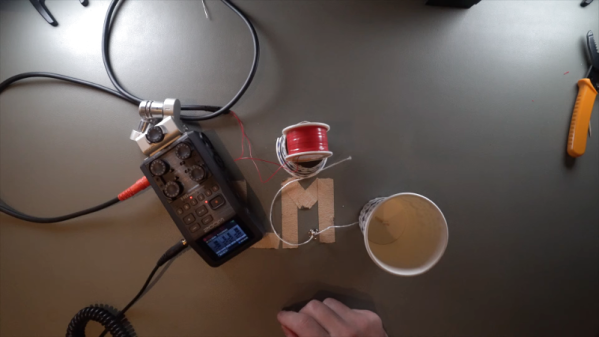
The basic concept is that of a dynamic microphone. A paper cup is attached to a taut string, upon which a magnet is affixed. Sound waves hitting the paper cup cause the string, and thus the magnet, to vibrate. The magnet is located within a coil, created from thin insulated wire wrapped around an old solder spool. This induces a current, creating the audio signal.

Results are as lo-fi as you’d expect, with the exact character of the sound changing depending on the tension of the string and the exact materials used. It’s a fun project that can be tackled with cheap materials, and there’s scope to create all manner of wacky mics by varying the parameters of the build. If you’re doing this more than once, however, you might want some help winding the coils — let this project be an inspiration. Video after the break.

Continue reading “Paper Cup Mic Is Fun And Functional” →

An Epic Mech Cockpit Build For Steel Battalion

Steel Battalion was released for the Xbox in 2002, and remains one of the most hardcore mech simulators of all time. It became legendary for its huge twin-stick controller covered in buttons, and for deleting your save game if you failed to eject in time. It took giant robot gaming to a new level, but fundamentally, you were still playing in front of a TV at home. Things really got serious in 2015, with the completion of the Big Steel Battalion Box – the battlemech cockpit of your dreams.

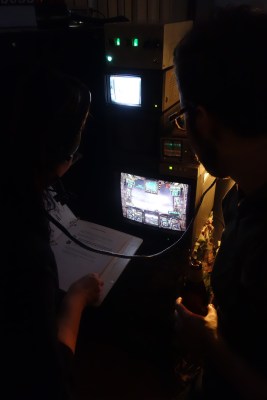
Coaching the player is a key part of BSBB gameplay, with a manual created specifically for this purpose.

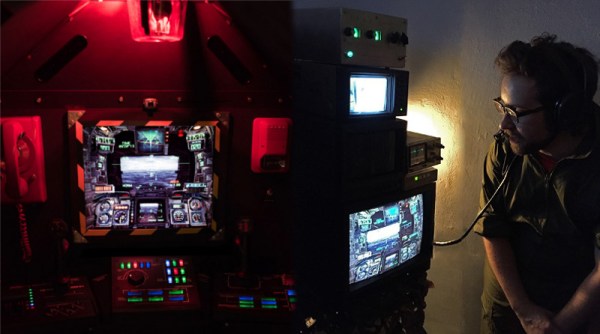
If you’re thinking this is just a television in a dark room with some stickers, you’d be very wrong. The Imgur thread covers the build process, and it’s one heck of a ride. Things started with a custom cabinet being built, intentionally sized to induce claustrophobia. There’s a swivelling seat with a 4-point harness, and a hatch to seal the player inside. During initial testing of the box to determine how dark it was, one of the makers was trapped inside and had to call for help. That should highlight how serious the build really is.

The controller was modified and hooked up to custom electronics to add realistic effects. Get hit? Feel the seat rumble thanks to motors and a subwoofer in the base. Mech terminally damaged? The entire cockpit is bathed in flashing red light. There’s even smoke effects rigged up to make things even more stressful during battle.

The entire setup is connected to the outside world, where a coach can view the action inside through a video feed from the Xbox and several internal cameras. A basic manual is provided to help the coach keep the player alive during their first moments of combat. This is courtesy of a custom intercom setup, built using surplus Chinese aviation headsets. There’s even a red telephone to give that authentic military feel.

It’s a build that covers just about every detail you could think of. If you’re keen to try it out, it’s on permanent loan to The Museum of Art And Digital Entertainment in Oakland, California. It recalls memories of a similar build created to play Artemis. Video after the break.

Continue reading “An Epic Mech Cockpit Build For Steel Battalion” →

WiFi Makes The Heart Glow Fonder

It’s more than a little too late for Valentine’s Day this year, but if you start now, you’re sure to be looking good next February. Print something that truly conveys how you feel, through the magic of wireless communication and RGB LEDs (Youtube, French).

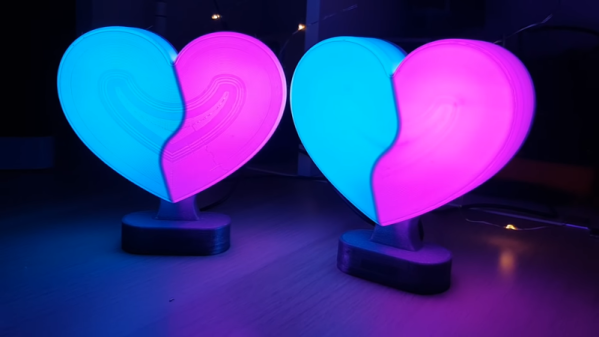
Yes, [Heliox] has built a Valentine’s day project, and the presentation is top notch as always. A heart is 3D printed in white filament, with two chambers separated by a thick wall. Each chamber features five NeoPixel LEDs, controlled by an ESP8266 in the base.  The color of each chamber can be controlled through the Blynk smartphone app, allowing you to choose the exact colors that best represent your relationship.

The 3D printed heart does a good job of diffusing the LEDs, with the device showing a rich and consistent glow without any unattractive hotspots. It’s a fun holiday build, and if you’re quick, you might just have time to print one yourself if you start right away.

[Heliox] has good form when it comes to LED projects – her infinity cube is particularly impressive. Video after the break.

Continue reading “WiFi Makes The Heart Glow Fonder” →