Build Your Own Rowing Machine, Now With Digital Readout!

An ergometer is a fancy fitness word for a rowing machine, a device which can be used to work out the muscles used in rowing. It’s an excellent cardio workout that can also build upper body strength, and resistance can be varied depending on the individual’s fitness goals. But perhaps you need to measure your workout to see your progress – in which case, [Dave]’s instrumentation package might be right up your alley.

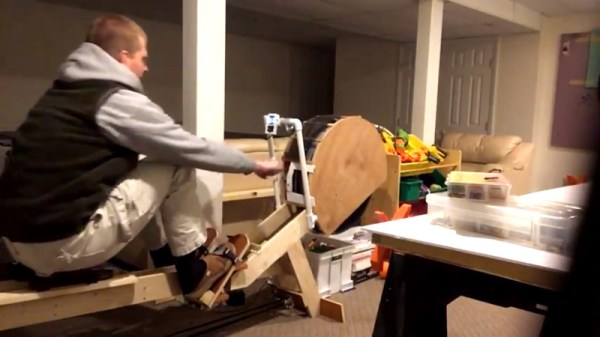
The basic mechanical build involves a wooden frame, fitted with a rowing setup built around a modified bicycle wheel. The wheel has vanes attached, made of what appears to be cut sections of PVC pipe. These act essentially as dampers, using the air to create the resistance for the rower to work against.

The wheel is instrumented with a chopper wheel and an IR optical switch, which measures the rotational speed of the wheel during rowing. This signal is fed into an ATMega328 which runs the calculations on the rower’s performance. It’s all fed to a Nokia 5110 screen for display, which makes a lovely throwback for those that remember the brick fondly.

[Dave] touches not only on the electronic aspects of the build, but also does an excellent job of breaking down the mathematics behind rowing performance. It’s a great resource that builds on top of the excellent work by the OpenErgo project.

If we’ve whet your thirst for exercise machine hacks, you’d better check out this treadmill to belt grinder mod.


Roboshield Helps Your Robot Walk And Talk

The joy of building robots comes from being able to imbue them with as much or as little personality and functionality as you wish during the design and build process. While creative flair and originality is always a good thing, there’s a lot of basic needs many robots have in common with each other, so where possible it’s good to avoid reinventing the wheel so more time can be spent on more advanced features. Roboshield aims to help make the basics easy so you can let your robot freak flag fly!

At its core, it’s an Arduino shield that packs in a host of hardware to get your robot up and running. As far as motion is concerned, a PCA9685 module is used to allow the control of 8 servos, plus there’s a TB6621FNG dual motor speed controller that offers both speed control and forward/reverse. That’s enough to get your electronic buddy scooting about the floor and waving its arms in the air.

The party piece, however, is the Vstamp text-to-speech module. This device produces a beautiful cliche electronic voice, which your robot is legally required to use to recite Asimov’s Laws of Robotics. Overall, it’s a tidy project that can take the hassle out of getting your robot design up and running, leaving you to focus on the fun bits like death rays and tractor beams. We can’t wait to see it powering the next wave of sassy DIY robots.

OpenDeck Makes Spinning Your Own MIDI Controller Easy

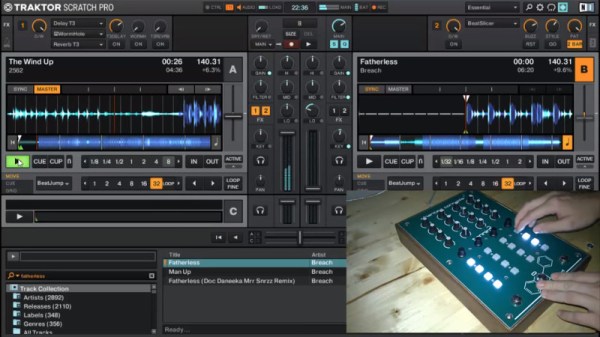
These days, MIDI controllers are just plain cool. There are a million of them out there, and they’re all dressed to the nines in flashing LEDs and sporting swag like USB MIDI interfaces and sliders that just feel right. With our italics budget running out, I should get to the point – you can make your own, and the OpenDeck platform makes it easy.

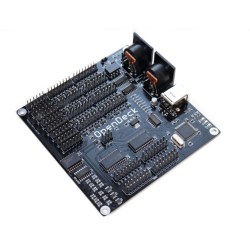
The OpenDeck board. Readily apparent is the fact that it has tons of IO.

In its most refined form, the OpenDeck is a board covered in pin headers. To these, you may connect an absolute truckload of buttons, encoders, sliders, and LEDs. The OpenDeck handles all of the inputs and outputs, while you get to have fun attaching your various gizmos to the control surface/keytar/birthday cake you happen to be building. It saves you reinventing the wheel as far as reading switches and potentiometers goes, allowing you to focus on the creative side of your project. All configuration is handled through a simple web interface.

Boards are available on Tindie,  but it’s also possible to take the code and run it on various Arduinos and the like, as it’s wonderfully opensource. This gives you the power to take things to a higher level once you’re good and ready.

We’ve seen a rather cool OpenDeck build already, and if you’ve got more, you know where to reach us.


Furniture And Motors Make A Strange Bedfellow

Beds! They don’t move around enough, so the young people say. They need more motors, more horsepower, more self-driving smarts – right? Honestly, we’re not sure, but if that’s the question being asked, [randofo] has the answer.

Aptly named, Bedfellow is an art project that sought to create a bed that could explore and socialise with occupants aboard. The core principle was not just to create a bed that could move under its own power, but one that could intelligently drive around and avoid obstacles, too. This is achieved through the use of ultrasonic sensors, with an Arduino Mega as the brains. The bed chooses a random direction in which to move, checking for obstacles on the way. It’s pretty basic as far as “self-driving” technology goes, but it gets the job done.

Far from being a lightweight artistic statement, the bed has some serious performance credentials. The drivetrain is a couple of 4 horsepower DC motors with speed controllers cribbed from a golf cart. These are fed through a 20:1 gear reduction to boost torque and avoid the bed moving too quickly. [Randofo] reports it can comfortably haul 12 people without slowing down, and we don’t doubt it. With that much power, your average flatback bed would be ripped to pieces, but never fear for this one – there’s plenty of heavy engineering holding it together.

It’s refreshing to see an art project executed with both elegant aesthetics and brutally powerful hardware. Sure, it might not be much good for sleeping unless you live in a loft with a concrete floor, but hey – they’re awfully popular these days. Now all it needs are some ground effects.

Heartwatch Monitors Your Ticker

The heart! A pump of the most fantastical kind, it is capable of operating for decades without rest. It’s responsible for supplying vital oxygen to the body’s subsystems, and can be readily monitored with modern technology. [Dave Vernooy] wanted to build a watch that could take heartrate and blood oxygen measurements – so he did.

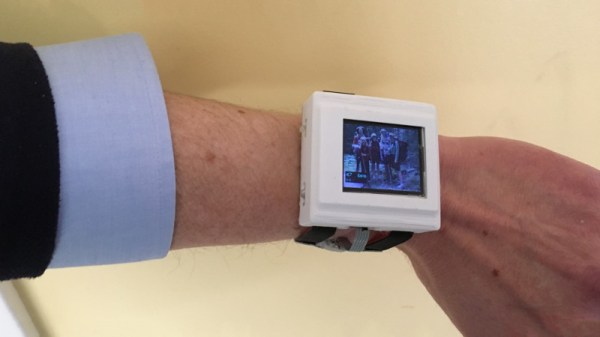
Named Heartwatch, the device is a DIY smartwatch build with a bunch of exciting features. Heart monitoring is taken care of by the MAX30102 sensor which integrates all the hardware to sense heart rate and oxygen saturation into a single tiny plastic package. There’s then an assortment of accelerometers, gyros and even a color LCD to display all the wonderful information.

It’s all wrapped up in a 3D printed case, with an ATMEGA1284 running the show. The project just goes to show how much can be achieved with an 8-bit processor – there’s not always a need to run a high-powered ARM chip for an embedded project.

There are a fair few DIY smartwatch builds out there – like this classy unit with an OLED screen.

DDL-4 Is A Visually Pleasing Modular CPU

Today’s CPUs are so advanced that they might as well be indistinguishable from magic, right? Wrong! Fundamentally, modern CPUs can be understood logically like any other technology, it’s just that they’re very fast, very small, and very complex, which makes it hard to get to grips with their inner workings. We’ve come a long way from the dawn of the home computer in the 80s, but what if there was something even simpler again, built in such a way as to be easily understandable? Enter the DDL-4-CPU, courtesy of [Dave’s Dev Lab].

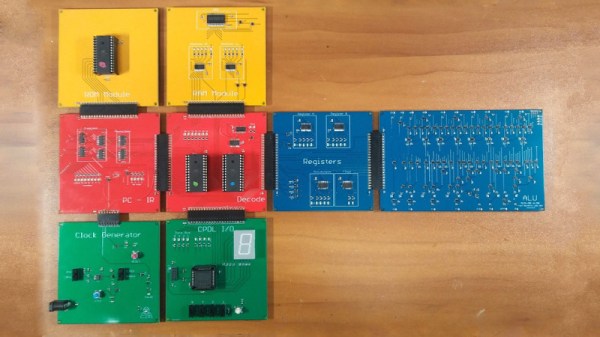
The DDL-4 is a project to build a modular 4-bit CPU using bitslice methods. This is where computations are broken down into simple operations with two-bit inputs, which are executed with basic logic gates like NOR and XOR. This is great for building a CPU from individual parts, as logic chips are readily available and their operation is readily understood. That’s what’s used here – good old 74-series logic, which you can find just about anywhere!

The build consists of a series of modules, each on its own colourful PCB and labeled on the silkscreen. These modules can then be configured and plugged together with edge connectors to build the CPU. The work builds upon [Dave]’s earlier work on the Mega-One-8-One, a recreation of the 74181 Arithmetic Logic Unit for educational purposes.

If you’re learning about computing in a bare-metal sense, projects like these that create CPUs from the ground up are a great way to get to grips with the basic concepts of computation. Once you’ve tried this, you could always graduate to building a 6502 in Minecraft.

DEXTER Has The Precision To Get The Job Done

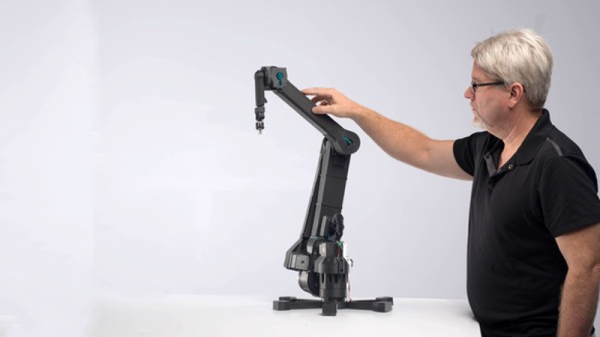
Robotic arms – they’re useful, a key part of our modern manufacturing economy, and can also be charming under the right circumstances. But above all, they are prized for being able to undertake complex tasks repeatedly and in a highly precise manner. Delivering on all counts is DEXTER, an open-source 5-axis robotic arm with incredible precision.

DEXTER is built out of 3D printed parts, combined with off-the-shelf carbon fiber sections to add strength. Control is through five NEMA 17 stepper motors which are connected to harmonic drives to step the output down at a ratio of 52:1. Each motor is fitted with an optical encoder which provides feedback to control the end effector position.

Unlike many simpler projects, DEXTER doesn’t play in the paddling pool with 8-bit micros or even an ARM chip – an FPGA lends the brainpower to DEXTER’s operations. This gives DEXTER broad capabilities for configuration and expansion. Additionally, it allows plenty of horsepower for the development of features like training modes, where the robot is stepped manually through movements and they are recorded for performance later.

It’s a project that is both high performing and open-source, which is always nice to see. We look forward to seeing how this one develops further!