The Coolest Hat At The Hacker Camp

People in hotter parts of the world may permit themselves a grin at this, but Europeans have recently been suffering under an unseasonal June heatwave. Most of us have been cowering inside with our air conditioners, but not [Making Stuff With Mike]. He’s adapting a safety helmet with a Noctua fan for only slightly uncool on-the-go cooling.

Continue reading “The Coolest Hat At The Hacker Camp”

Hackaday Links Column Banner

Hackaday Links: July 5, 2026

Happy belated July 4th to all the readers from the United States — hopefully you aren’t reading this from a hospital bed after losing a hand or burning off your eyebrows. While we suspect amateur firework shows and their related injuries will be around for many years to come, we did note that many major cities switched over to drone shows this year.

At least on paper, the appeal is obvious. Beyond the fact that drones are safer and quieter than pyrotechnics, they’re also capable of far more complex displays. Good luck trying to draw George Washington’s face in the sky with exploding rockets. But even if it’s a little more than nostalgia, there’s still something about the sights and sounds of fireworks that enthrall audiences. For many, the whole “rockets’ red glare” thing is a bit more meaningful than the “drones’ red LEDs.”

Earlier this week, we brought you news that Sony would stop producing physical PlayStation discs in January 2028. Many gamers are understandably concerned about the long-term implications such a move will have for software ownership, and while the negative reactions online haven’t bothered Sony enough to get them to amend their plans, they have clarified the situation with developers by explaining that games published before the cutoff date aren’t impacted. So if a developer has a hit title that drops in the summer of 2027 and they want to keep cranking out discs, additional orders can still be placed. Not much of a reprieve, but it will give the community a little more time to figure out what comes next.

Continue reading “Hackaday Links: July 5, 2026”

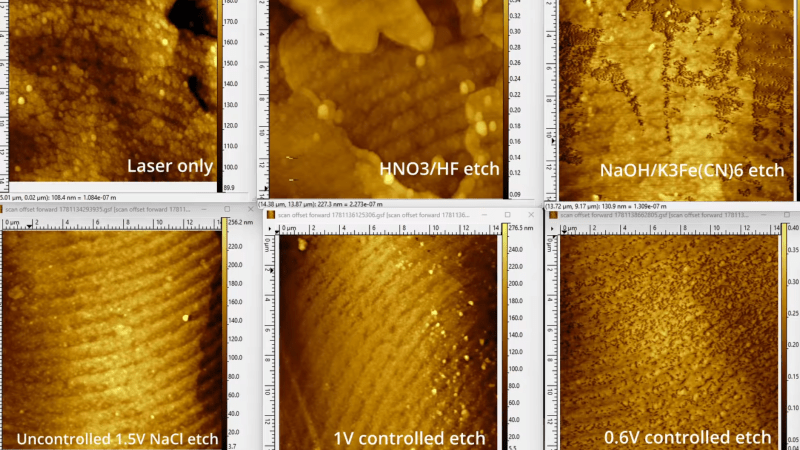
A series of six sepia-tinted micrographs is shown. The images show the surface of a piece of steel after various etching treatments.

Seeing Bacteria, Nanoprisms, And More With An Atomic Force Microscope

Unlike almost every other kind of microscope, atomic-force microscopes (AFMs) don’t use any kind of optical beam to image their subjects. Instead, they physically detect the subject’s surface with a tiny probe, repeating this thousands of times to build up a height map of the subject, sometimes with a resolution below a single nanometer. [Ben Krasnow] got to use an AFM in an investigation of one of his projects, and shared some unusual uses of it in his latest video.

Continue reading “Seeing Bacteria, Nanoprisms, And More With An Atomic Force Microscope”

Demonstrating LFP Battery Safety In Case Of BMS Failure

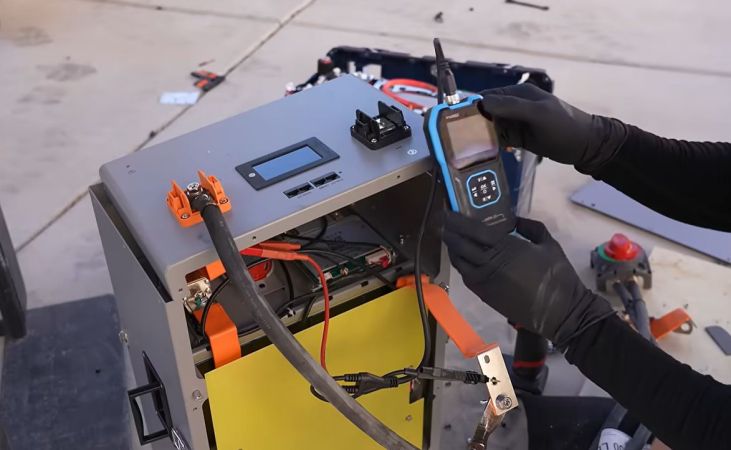
Generally, LiFePO4 (LFP) batteries are quite safe and stable, but it’s still possible for something to go wrong, even something catastrophic, like the battery management system (BMS) developing a direct short. This is one of the tests required to be certified for the UL 2054 standard that targets household and portable battery safety. In a recent series of videos, [Will Prowse] demonstrates how a series of commercial batteries pass these tests, and how some still fail.

Continue reading “Demonstrating LFP Battery Safety In Case Of BMS Failure”

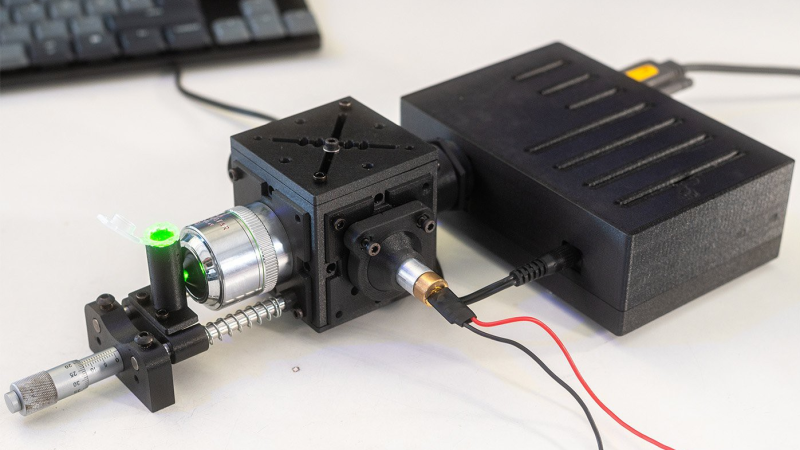
A black plastic cube is shown in front of another, larger rectangular black plastic box. The plastic cube has a silver microscope objective protruding from one side, with green light being emitted from it into a small plastic tube held on a positioning stage.

2026 Frikkin Lasers Challenge: A 3D-Printed Raman Spectrometer

When light reflects off a surface, not all of it reflects off at the same wavelength; some photons impart a portion of their energy to raising the vibrational energy of the surface’s molecules, and are thus scattered away at a lower energy and longer wavelength. This is called Raman scattering, and the precise wavelength shifts are characteristic of the particular molecule being illuminated. It can therefore be used in Raman spectroscopy to identify molecules; these spectrometers are normally elaborate, expensive instruments, but [Allegedly Science] was able to build a simple system with surprising sensitivity.

Continue reading “2026 Frikkin Lasers Challenge: A 3D-Printed Raman Spectrometer”

Old Midi Instruments Don’t Like Modern Midi. What’s To Be Done?

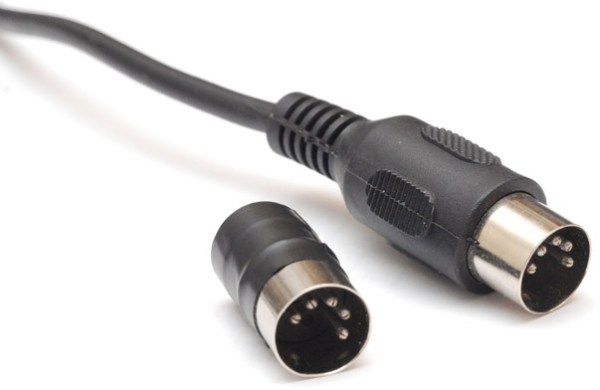
In theory, MIDI is an electrical and protocol standard that allows any such equipped instrument or computer to talk to any other. But as the wonderfully named [Knob Monster] will tell you, when the computer is new, and the instrument is old, it ain’t that simple.

They specialise in using the Web MIDI interface to allow browser control of an instrument. This might typically be done with a USB to MIDI interface, but in this lies a problem. The 8-bit microprocessor on a 1983 synth has problems keeping up with the rapid-fire data that spews relentlessly from the supercomputer-grade machine controlling it, and bad things happen as a result.

Expensive MIDI interfaces have a buffer built in, but a better solution lies in the Web MIDI code itself. They detail how to use the Web MIDI API’s built-in packet scheduler to slow things down a little and let your Yamaha DX7 chill a bit.

Meanwhile, if you need a USB to MIDI interface, we’ve covered one in the past.

Homelab Gets Linksys Themed Aesthetic

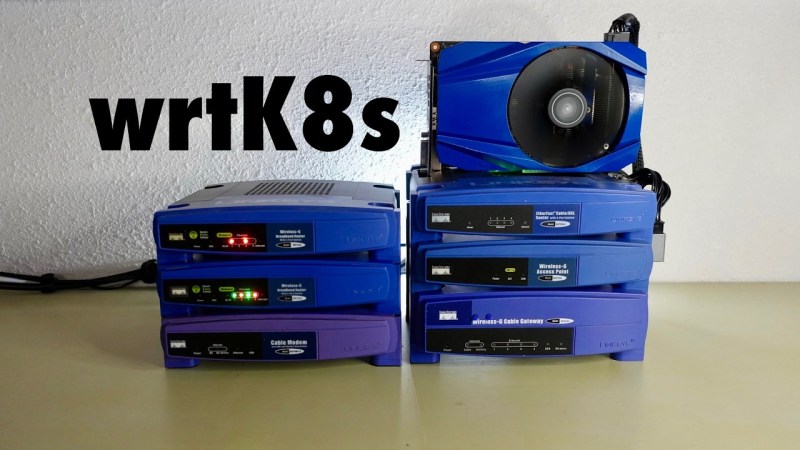
If you’re building a homelab rig, you could just use off-the-shelf hardware in standard cases and slap it all in a rack like the normies do. Or, you could follow the example of [Justin Garrison] and build a more oddball setup.

This particular homelab is, at its heart, built from familiar components. There are two Raspberry Pi 5s, two Raspberry Pi 4s, a GMKtec NucBox M6 Mini with an ASUS GeForce RT 2060 GPU, a LattePanda IOTA, an NVidia DGX Spark, and an HP Z4 G4 mini PC. These machines are all laced together with a TP-Link LS108GB PoE switch. [Justin] has the mini PC running the control plane components, with the rig as a whole running Talos and Kubernetes workloads. What makes this build particularly appealing, though, is the aesthetics of the rig. [Justin] documents how he hacked this hardware to fit into a bunch of old Linksys router cases, which provides a pleasant early 2000s look to the build. This included a bit of hackery to get status LEDs flickering as they should be. [Justin] also took the time to make the power buttons accessible.

If you want to stunt on your friends with a rad homelab, you either have to go for maximum power, or maximum style. This build would be the latter. Video after the break.

Continue reading “Homelab Gets Linksys Themed Aesthetic”