
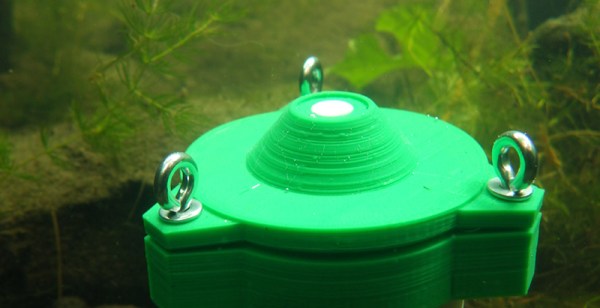
The goal for the Citizen Science portion of the Hackaday Prize is to empower people to create their own devices to perform their own analyses For [Adam]’s project, he’s designing a device that measures the health of waterways simply by looking at the light availability through the water column. It’s called PULSE, the Profiling Underwater Light SEnsor, and is able to monitor changes that are caused by algal blooms, suspended sediments, or sewer runoff.
The design of PULSE is a small electronic depth charge that can be lowered into a water column from anything between a research vessel to a kayak. On the top of this sinkable tube is a sensor to measure photosynthetically active radiation (PAR). This sensor provides data on light irradiance through the water column and gives a great insight into the health of photosynthesis, marine plant life, and ultimately the health of any aquatic environment.
Measuring the light available for photosynthesis through a water column is great, but PULSE isn’t a one trick pony. On the bottom of the aquatic probe are three sensors designed to measure photosynthesis, dissolved organic matter, and turbidity. These sensors are really just a few LEDs and photodiodes, proving just how much science you can do with simple tools.
The goal of the Citizen Science portion of the Hackaday Prize is to put scientific discovery in the hands of everyone. PULSE is a great example of this: it’s a relatively simple device that can be thrown over the side of a boat, lowered to the bottom or a lake, and hoisted back up again. It’s inexpensive to build, but still provides great data. That’s remarkable, and an excellent example of what we’re looking for in the Hackaday Prize.




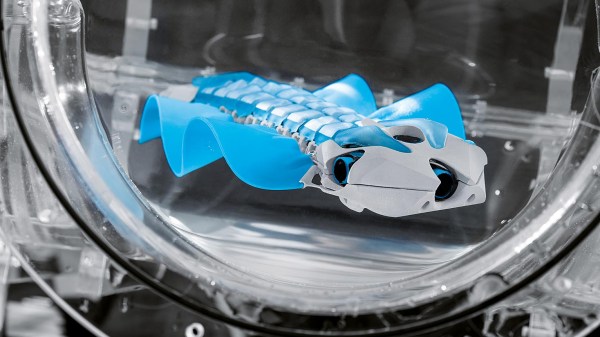
 What was their elegant solution for making the fins undulate? Nine lever arms are attached to each fin. Those lever arms are controlled by two crankshafts which extend from the front of the body to the rear, one for each side. A servo motor then turns each crankshaft. Since the crankshafts are independent, that means each fin operates independently. This allows for turning by having one fin move faster than the other. A third motor in the head flexes the body, causing the robot to swim up or down.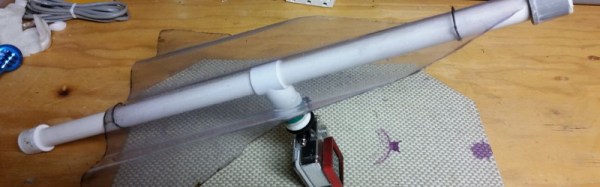
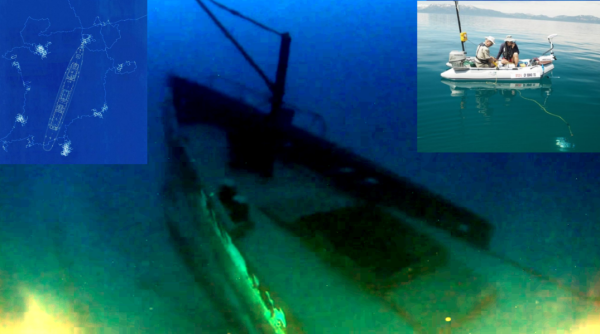
![DIY Research Vessel in use, while ROV is busy below. [Source: NYT]](https://hackaday.com/wp-content/uploads/2016/07/openrov-top-end2.jpg?w=250)









