Disposable Rocket Stove Keeps You Fueled In The Wild

Don’t know about you, but we can’t start the day without coffee and a shower. If you were to drag us on some overnight trip into the wilderness, we could probably forego the shower for a day, but we will be a grumpy trail mate without some kind coffee, even instant.

Yes, if you were to get us on an overnight outdoor adventure, we would insist on bringing along a couple of these little disposable, self-destructing rocket stoves, if for no other reason than that we can have some coffee without having to forage for a bunch of firewood and build a whole regular-sized campfire. Don’t worry — we’ll share the water because there’s plenty of time built in. Per [smogdog], these Swedish torches will boil water in 20 minutes and burn for 60 — that’s enough time to make a coffee, a bowl of soup, and toast a single marshmallow before the fire consumes the scrap wood.

We love the use of bike chain as a burner to raise up the pot for fire ventilation. But our favorite bit has to be the dual-purpose packaging. It’s nice-looking, it’s informative, and it’s paper, so you can use it as a fire starter. Failing that, [smogdog] has a backup fire starter system — rubbing alcohol in a small spray bottle. Unwrap a protein bar and check out the demo video after the break.

Tired of the same old, boring trail foods? How about flat-pack pasta that morphs into fun shapes when you boil it?

Continue reading “Disposable Rocket Stove Keeps You Fueled In The Wild”
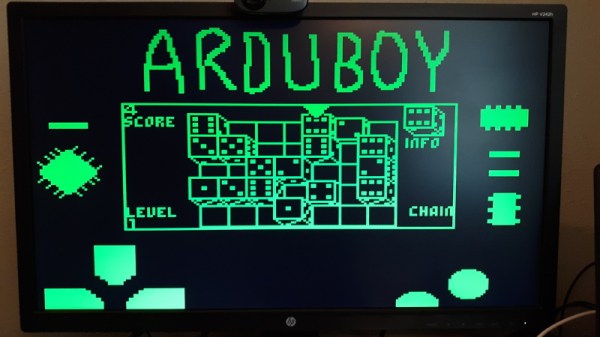
Arduboy On The Big Screen

We’re big fans of the Arduboy here at Hackaday, but we’ll admit its tiny screen isn’t exactly ideal for long gaming sessions. There are some DIY builds of the open source handheld that use a larger SPI OLED display, though you’re relatively limited on what kind of changes can be made to the hardware before the games start balking. But as [Nick Bild] shows with his Arduboy home console, hacking the core system library opens up a lot of interesting possibilities.

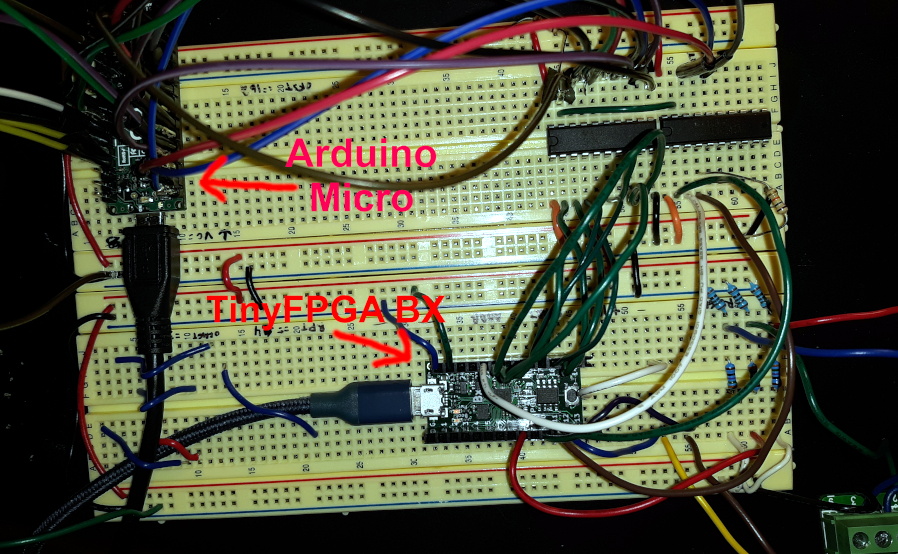
Games written for the Arduboy make use of a common library that handles all the low-level hardware stuff, which includes a display() function to push the graphical data out to an SPI-connected OLED display. What [Nick] has done is re-write that function to instead output to a custom VGA generator running on the TinyFPGA BX. He had to delete support for the Arduboy’s RGB LEDs because he needed the extra pins, but that shouldn’t cause much of a problem in terms of software support.

This does mean that games need to be recompiled against the modified library to work on his hardware, but as the vast majority of Arduboy software is open source anyway, that’s not much of a problem. We particularly like the Super Game Boy style border  you get around the display at no extra cost.

At this point the hardware looks less like a console and more like a breadboard filled with jumpers, so we’re interested in seeing this project taken to its logical conclusion. A custom PCB, enclosure, and possibly even support for using the original NES controllers would turn this into proper system worthy of any hacker’s game room. You could even put the games on custom cartridges if you wanted, though a flash chip that holds the system’s entire library would be quite a bit more convenient.

Anti-Gravity, Time Travel, And Teleportation: Dr. Hamming Gives Advice

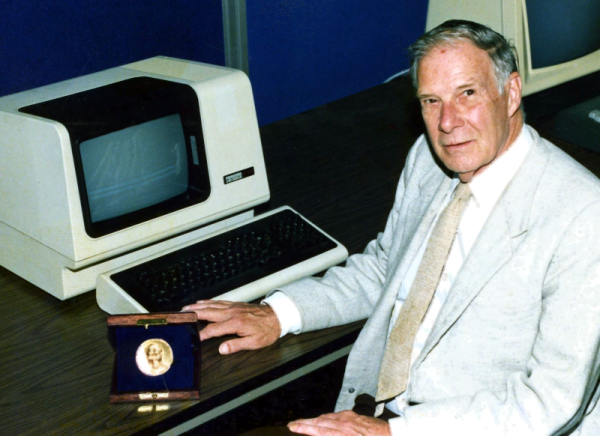
You may not know the name [Richard Hamming], but you definitely use some of his work. While working for Bell Labs, he developed Hamming codes — the parent of a class of codes that detect, and sometimes correct, errors in everything from error-correcting memory to hard drives. He also worked on the Manhattan Project and was a lecturer at the Naval Postgraduate school.

Turns out [Hamming] has an entire class from the 1990s on YouTube and if you are interested in coding theory or several other topics, you could do worse than watch some of them. However, those videos aren’t what attracted me to the lectures. As the last lecture of his course, [Hamming] used to give a talk called “You and Your Research” and you can see one of the times he delivered it in the video below. You might think that it won’t apply to you because you aren’t a professional academic or researcher, but don’t be too quick to judge.

Turns out, [Hamming’s] advice — even by his own admission — is pretty general purpose for your career or even your life. His premise: As far as we know, you have one life to live, so why shouldn’t it be a worthwhile one by your definition of worthwhile.

Along the way, he has an odd combination of personal philosophy, advice for approaching technical problems, and survival skills for working with others. If you are in the field, you’ll probably recognize at least some of the names he drops and you’ll find some of this technical advice useful. But even if you aren’t, you’ll come away with something. Some of it seems like common sense, but it is different, somehow, to hear it spoken out loud. For example:

If you don’t work on important problems, it’s not likely that you’ll do important work.

One piece of technical advice? Don’t waste time working on problems you have no way to attack. He points out that anti-gravity, time travel, and teleportation would be very lucrative. But why work on them when there appears to be no way to even remotely accomplish them today. Well, at least when he said that. There has been a little progress on a form of teleportation, but that wasn’t what he was talking about anyway.

While not a hack in the traditional sense, examining your life, career, and technical research to improve your own effectiveness is something to take seriously. We were hoping he would throw in a joke about error-correcting your career, but unless we blinked, no such luck.

Hamming’s work on block codes was followed about ten years later by the Reed-Solomon code which is found nearly everywhere now. Hamming is also associated with the term “hamming distance,” something we talked about when discussing Gray code.

Continue reading “Anti-Gravity, Time Travel, And Teleportation: Dr. Hamming Gives Advice”

Satellite Communications Hack Chat

Join us on Wednesday, June 2 at noon Pacific for the Satellite Comms Hack Chat with Paul Marsh!

All things considered, space isn’t that far away; you could drive the equivalent distance in an hour or two, with time for a couple of stops on the way. Of course, getting to space isn’t as simple as a Sunday drive, and yet despite the expense and trouble, we’ve still managed to fill our little corner of the solar system with an astonishing number of satellites.

Almost every single one of the spacecraft we’ve put in orbit represents a huge capital investment, both in terms of building something that can withstand the extreme environment up there and as far as the expense involved in getting it there. So once it gets there, it needs to start producing results, and for the most part that means sending some kind of messages back down to Earth. And those communications can be tempting indeed to hardware hackers.

Monitoring messages from on high is what the satcom radio hobby is all about. Learning how to do it properly can be tricky, though. What frequencies does one use? What are the modulation schemes? What kind of antennas would someone need? And what about tracking these birds as they whizz overhead?

To answer these questions and more, Paul Marsh from UHF-Satcom will stop by the Hack Chat. Paul has been interested in satellites since the early 1990s and coupled with his background in infosec and pentesting, he has uncovered a lot about the ins and outs of satellite snooping. Stop by the Hack Chat and learn how to sniff in on what’s going on upstairs.

join-hack-chatOur Hack Chats are live community events in the Hackaday.io Hack Chat group messaging. This week we’ll be sitting down on Wednesday, June 2 at 12:00 PM Pacific time. If time zones have you tied up, we have a handy time zone converter.

Click that speech bubble to the right, and you’ll be taken directly to the Hack Chat group on Hackaday.io. You don’t have to wait until Wednesday; join whenever you want and you can see what the community is talking about.

Trippy Tripteron Kinematics Brainteaser

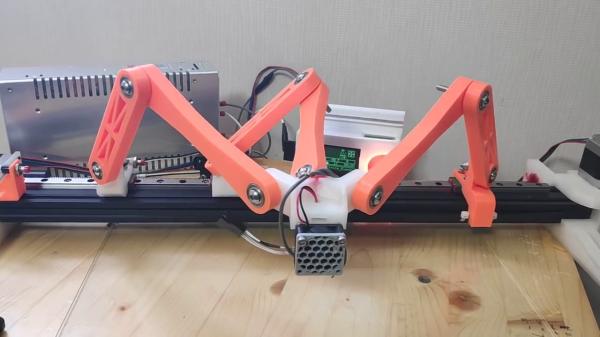
[JK Lee] has been experimenting with a monorail tripteron motion control system (video, embedded below) and trying to improve performance with varying tweaks to the design and with varying degrees of success. But [JK] is enjoying this project — he was inspired by an idea that maker [Nicholas Seward] proposed — building a tripteron on two rails (video), or even building one on a single rail (video). He is making good progress, most recently working on solving a vertical bounce issue. He is focusing on the middle arm, as this arm carries most of the weight. You can see a brief video explanation of the kinematics of the monorail tripteron that [JK] made (he warns us that English is not his native language, so focus on the equations and diagrams and not the grammar).

If you’re not familiar with the tripteron, it was conceived, along with the quadrupteron, at the Robotics Laboratory at Université Laval in Canada and patented by their researchers back in 2004. We wrote about an early implementation of a tripteron by [Apsu] back in 2016. These recent experiments, reducing the mechanism down to a single or double rail, are interesting.

Other than cool projects for makers like [Nicholas] and [JK] who enjoy tinkering, are there any applications of tripterons and/or quatrupterons in the real world? Let us know in the comments below. Thanks to [Littlejohn] for sending in the tip.

Continue reading “Trippy Tripteron Kinematics Brainteaser”

Virgin Galactic’s Long Road To Commercial Spaceflight

To hear founder Richard Branson tell it, the first operational flight of Virgin Galactic’s SpaceShipTwo has been 18 months out since at least 2008. But a series of delays, technical glitches, and several tragic accidents have continually pushed the date back to the point that many have wondered if it will ever happen at all. The company’s glacial pace has only been made more obvious when compared with their rivals in the commercial spaceflight field such as SpaceX and Blue Origin, which have made incredible leaps in bounds in the last decade.

Richard Branson watching Unity’s test flight.

But now, at long last, it seems like Branson’s suborbital spaceplane might finally start generating some income for the fledgling company. Their recent successful test flight, while technically the company’s third to reach space, represents an important milestone on the road to commercial service. Not only did it prove that changes made to Virgin Space Ship (VSS) Unity in response to issues identified during last year’s aborted flight were successful, but it was the first full duration mission to fly from Spaceport America, the company’s new operational base in New Mexico.

The data collected from this flight, which took pilots Frederick “CJ” Sturckow and Dave Mackay to an altitude of 89.23 kilometers (55.45 miles), will be thoroughly reviewed by the Federal Aviation Administration as part of the process to get the vehicle licensed for commercial service. The next flight will have four Virgin Galactic employees join the pilots, to test the craft’s performance when loaded with passengers. Finally, Branson himself will ride to the edge of space on Unity’s final test flight as a public demonstration of his faith in the vehicle.

If all goes according to plan, the whole process should be wrapped up before the end of the year. At that point, between the government contracts Virgin Galactic has secured for testing equipment and training astronauts in a weightless environment, and the backlog of more than 600 paying passengers, the company should be bringing in millions of dollars in revenue with each flight.

Continue reading “Virgin Galactic’s Long Road To Commercial Spaceflight”

Not All SpaceX Software Goes To Space

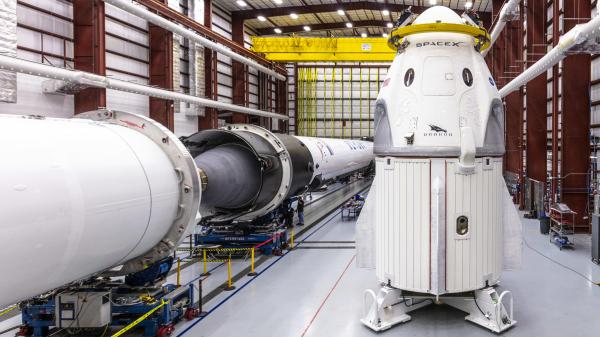
SpaceX has always been willing to break from aerospace tradition if they feel there’s a more pragmatic solution. Today this is most visible in their use of standard construction equipment like cranes in their Starship development facility. But the same focus on problem solving can also be found in their software parts we don’t see. Recently we got two different views behind the scenes. First, a four-part series about “software in space” published by StackOverflow blog, followed quickly by an Ask Me Anything (AMA) session on SpaceX Reddit.

Some of the StackOverflow series cover ground that has been previously discussed. Mostly in the first part dealing with their workhorse Falcon and Dragon vehicles, and some in the second part discussing Starlink whose beta program is reaching more and more people. Both confirmed that spaceflight software has to meet very stringent requirements and are mostly close to the metal bespoke C++ code. But we receive fascinating new information in part three, which focuses on code verification and testing. Here they leverage a lot of open source infrastructure more common to software startups than aerospace companies. The fourth and final component of this series covers software to support SpaceX hardware manufacturing, which had been rarely discussed before this point. (Unfortunately, there was nothing about how often SpaceX software developers copy and paste code from StackOverflow.)

The recent Reddit AMA likewise had some overlap with the SpaceX software AMA a year ago, but there were new information about SpaceX work within the past year. There was Crew Dragon’s transition from a test to an operational vehicle, and the aforementioned Starship development program. Our comments section had a lot of discussion about the practicality of touchscreen interfaces in real spacecraft, and here we learn SpaceX put a lot of study into building something functional and effective.

It also showed us that essentially every Sci-Fi Movie Interface was unrealistic and would be unreadable under extreme conditions.

In the course of this research, they learned a lot of pitfalls about fictional touch interfaces. Though to be fair, movie and television spacecraft UI are more concerned about looking cool than being useful.

If the standard AMA format is not to your liking, one of the contributors compiled all SpaceX answers alongside their related questions in a much more readable form here. And even though there’s an obvious recruiting side to these events, we’re happy to learn more about how SpaceX have continued to focus on getting the job done instead of rigidly conforming to aerospace tradition. An attitude that goes all the way back to the beginning of this company.