Partsbox.io Wants To Organize Your Junk Box

There are many ways to divide the hacker community into groups. Tubes vs transistors. Emacs vs VI, microcontroller vs discrete component designers. However, one of the more fundamental divisions in the community is how you organize your parts. We’ve seen giant warehouses with carefully organized bins and cabinets full of components, and we’ve seen storage crates with tangles of wires and bits of electron-bending components scattered among the wires.

dbIf you are in the former camp, you’d probably enjoy partsbox.io (see image, right). If you are in the latter group, you probably need to check it out even more than the other people. The idea is simple: an online place to keep an inventory of your electronic parts. The implementation is not as simple, though. The web application will work on a mobile device or just about anywhere. You can view your components by type, by location (the shoe box under the bed vs the parts bin in the closet), or by a project’s bill of materials. You can use “known” parts or create private parts for things no one else has (for example, your custom PC boards, or those 3D printed brackets you made to hold a microswitch). If you add data for a component you can make it available to other users.

Continue reading “Partsbox.io Wants To Organize Your Junk Box”

3D Printering: Smartphone Resin Printers Actually Work

Last spring, the world saw something amazing. It was a device that would revolutionize the planet, save the world, and turn your smartphone into a 3D printer. Kickstarters aren’t known for selling themselves short. I speak, of course, of the OLO 3D printer, later renamed the ONO 3D printer, ostensibly because of a trademark dispute.

While filament-based 3D printers are extremely capable and slicing software is only getting better, resin-based printers are able to produce prints of nearly unparalleled quality. If you want high-resolution objects and fine detail, a resin printer is the way to go. These resin printers, however, are a bit more expensive than your traditional filament printers. A few hundred dollars will buy you a serviceable i3 clone, and less than a thousand will get you a real Prusa capable of printing in four colors. The premier desktop resin printer, the Form 2 from Form Labs, starts at $3500 USD.
Continue reading “3D Printering: Smartphone Resin Printers Actually Work”

Vintage Computer Festival Switzerland This Weekend

This weekend marks the Vintage Computer Festival Europe – Switzerland, a two-day extravaganza of vintage hardware held in Zurich, Switzerland.

Of interest for this VCF will be an LGP-30 replica (a computer without RAM or ROM released in 1956), an IBM System/360 front panel, lots of blinkenlights, Swiss computers, and [Oscarv], creator of the very successful PiDP-8/I project on Hackaday.io, will be there with his minified PiDP-11/70. If you don’t have one of [Oscar]’s PiDP8 machines sitting on your desk yet, don’t worry — the 11/70 is the one you really want. It is beautiful.

As you would expect from a Vintage Computer Festival, all the standards will be there. The flea market is open, soldering stations are present, talks will be held, and very old and very rare hardware will be blinking. From our experience with Vintage Computer Festivals, Europe does it right. Last year’s festival in Munich was a blast, and this year’s celebration in Zurich looks like it will be as well.

Roll Your Own 64GB SD Card From An EMMC Chip

It’s well-known that buying Flash storage devices from cheap online retailers is fraught with danger. Stories abound of multi-gigabyte drives that turn out to be multi-megabyte ones engineered to falsely report their capacity. So when [Jason Gin] found a source of 64GB Toshiba eMMC chips for only $6 per device he bought a few, but was prepared for disappointment.

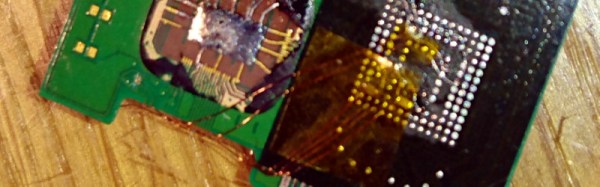
To test them, he decided to use an SD card interface. There are minor differences between eMMC and SD, but the interfaces are electrically the same and in most cases an SD controller will happily do business with an eMMC. It was not however an easy task to connect the two — these eMMCs were in BGA packages, hardly the easiest ones to work with. He resorted to dead-bug soldering the relevant interface wires to SD lines, and connecting up his computer.

His first attempt was something of a failure, wiring the chip to the PCB of a cheap USB-to-SD adaptor. This did not put him off though, he followed it up by cracking open a very old 2GB SD card that contained a PCB instead of being potted, and soldering his eMMC in place of its Flash and controller. This even fit in the original SD housing, and met with success when plugged into more reliable SD card readers. He was thus able to confirm the capacity of his chips.

His blog post is worth a read for more than just the very fine soldering involved. He takes us through some of the intricacies of SD interfacing, as well as talking at length about the decoupling and termination required to make a reliable connection. We particularly like his use of an area of unconnected BGA balls as prototyping space for decouplers.

If you marvel at the exceptional dexterity required for hand BGA work, we’ve a couple of other treats for you. There is this TI infra-red sensor BGA soldered to a piece of stripboard, and this wafer-level chip package soldered to an SOIC prototyping board.

The BASIC Issue With Retro Computers

If you are interested in how a computer works at the hardware grass-roots level, past all the hardware and software abstractions intended to make them easier to use, you can sometimes find yourself frustrated in your investigations. Desktop and laptop computers are black boxes both physically and figuratively, and microcontrollers have retreated into their packages behind all the built-in peripherals that make them into systems-on-chips.
Continue reading “The BASIC Issue With Retro Computers”

Think Your Way To Work In A Mind-Controlled Tesla

When you own an $80,000 car, a normal person might be inclined to never take it out of the garage. But normal often isn’t what we do around here, so seeing a Tesla S driven by mind control is only slightly shocking.

[Casey_S] appears to be the owner of the Tesla S in question, but if he’s not he’ll have some ‘splaining to do. He took the gigantic battery and computer in a car-shaped case luxury car to a hackathon in Berkley last week and promptly fitted it with the gear needed to drive the car remotely. Yes, the Model S has steering motors built in, but Tesla hasn’t been forthcoming with an API to access such functions. So [Casey_S] and his team had to cobble together a steering servo from a windshield wiper motor and a potentiometer mounted to a frame made of 2x4s. Linear actuators attach to the brake and accelerator pedals, and everything talks to an Arduino.

The really interesting part is that the whole thing is controlled by an electroencephalography helmet and a machine learning algorithm that detects when the driver thinks “forward” or “turn right.” It translates those thoughts to variables that drive the actuators. Unfortunately, space constraints kept [Casey_S] from really putting the rig through its paces, but the video after the break shows that the system worked well enough to move the car forward and steer a little.

There haven’t been too many thought-controlled cars featured here before, but we have covered a wheelchair with an EEG interface.

Continue reading “Think Your Way To Work In A Mind-Controlled Tesla”

IPhone NVMe Chip Reversed With Custom Breakout Boards

Ever so slowly, the main storage in our computers has been moving from spinning disks, to SSDs over SATA, to Flash drives connected to a PCI something or other. The latest technology is NVMe — Non-Volitile Memory Express — a horribly named technology that puts a memory controller right on the chip. Intel has a PCI-based NVMe drive out, Samsung recently released an M.2 NVMe drive, and the iPhone 6S and 6S Plus are built around this storage technology.

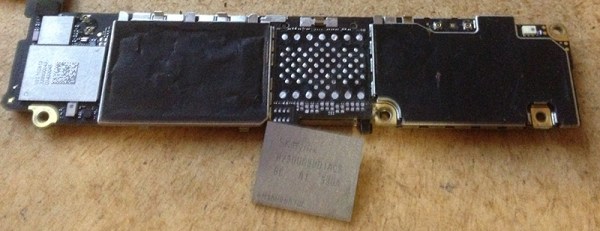
New chips demand a reverse engineering session, and that’s exactly what [Ramtin Amin] did (Internet Archive). He took a few of these chips out of an iPhone, created a board that will read them, and managed to analyze the firmware.

Any reverse engineering will begin with desoldering the chip. This is easy enough, with the real trick being getting it working again outside whatever system it was removed from. For this, [Ramtin] built his own PCIe card with a ZIF socket. This socket was custom-made, but the good news is you can buy one from ITEAD. Yes, it is expensive — that’s what you get with a custom-made ZIF socket.

With the chip extracted, a custom PCIe card, and a bit of work with the NVMe implementation for Linux, [Ramtin] had just about everything working. Eventually, he was able to dump the entire file system on the chip, allowing anyone to theoretically back up the data on their iPhone or MacBook Air. Of course, and especially for the iPhone, this data is encrypted. It’s not possible to clone an iPhone using this method, but it is a remarkably deep dive into the hardware that makes our storage tick.