A few days ago we learned chip maker FTDI was doing some rather shady things with a new driver released on Windows Update. The new driver worked perfectly for real FTDI chips, but for counterfeit chips – and there are a lot of them – the USB PID was set to 0, rendering them inoperable with any computer. Now, a few days later, we know exactly what happened, and FTDI is backing down; the driver has been removed from Windows Update, and an updated driver will be released next week. A PC won’t be able to communicate with a counterfeit chip with the new driver, but at least it won’t soft-brick the chip.
Microsoft has since released a statement and rolled back two versions of the FTDI driver to prevent counterfeit chips from being bricked. The affected versions of the FTDI driver are 2.11.0 and 2.12.0, released on August 26, 2014. The latest version of the driver that does not have this chip bricking functionality is 2.10.0.0, released on January 27th. If you’re affected by the latest driver, rolling back the driver through the Device Manager to 2.10.0.0 will prevent counterfeit chips from being bricked. You might want to find a copy of the 2.10.0 driver; this will likely be the last version of the FTDI driver to work with counterfeit chips.
Thanks to the efforts of [marcan] over on the EEVblog forums, we know exactly how the earlier FTDI driver worked to brick counterfeit devices:
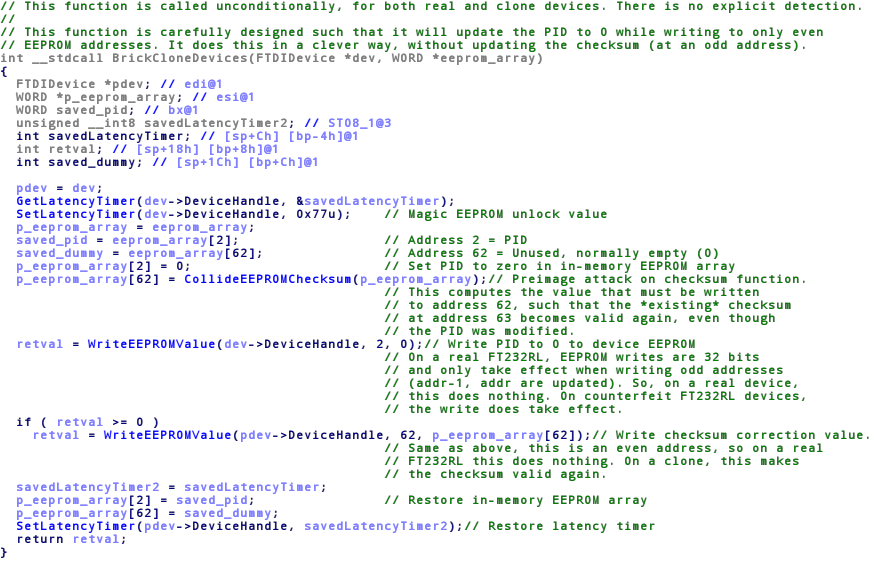
[marcan] disassembled the FTDI driver and found the source of the brick and some clever coding. The coding exploits differences found in the silicon of counterfeit chips compared to the legit ones. In the small snippet of code decompiled by [marcan], the FTDI driver does nothing for legit chips, but writes 0 and value to make the EEPROM checksum match to counterfeit chips. It’s an extremely clever bit of code, but also clear evidence FTDI is intentionally bricking counterfeit devices.
A new FTDI driver, presumably one that will tell you a chip is fake without bricking it, will be released next week. While not an ideal outcome for everyone, at least the problem of drivers intentionally bricking devices is behind us.
 Three days ago on October 21, 2014 it was announced to the world the Back to the Future hoverboard was real. It’s a Kickstarter, of course, and it’s trending towards a $5 Million dollar payday for the creator. Surprisingly for a project with this much marketing genius, it’s a real, existing device
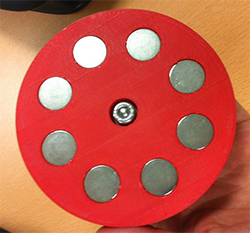
  Like the Kickstarter hoverboard, [jelly] is using an array of magnets rotating in a frame above a non-ferrous metal. For the initial test, eight neodymium magnets were arranged in a frame, suspended over 3/4″ aluminum plate, and spun up with a drill. With just this simple test, [jelly] was able to achieve 2kg of lift at 1cm and 1kg of lift at 1 inch of separation. This test also provided some valuable insight on what the magnets do to the aluminum or copper; the 3kg aluminum plate was nearly spinning, meaning if this device were to be used on small plates, counter-rotating pairs of magnetic lifters would need to be used.