Interpreting Brainf*#k On An AVR

We won’t call it useless, but we will ask why [Dan] wrote a brainfuck interpreter for the AVR

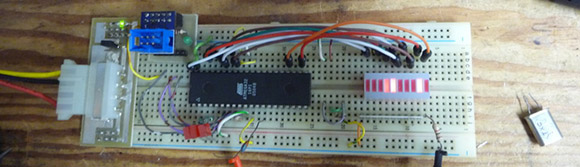
It’s not generating code for the AVR; think of it more as a bootloader. To run a brainfuck program, [Dan] uploads it to the EEPROM inside his ATMega32, after which the microcontroller takes over and starts performing whatever instruction the brainfuck program tells it to do. Because the whole thing runs off the EEPROM, the code size is limited to 1022 bytes. Enough for any brainfuck program written by a human, we think.

As for why [Dan] would want an AVR to build an interpreter for a language that is nearly unreadable by humans, we honestly have no idea other than the common, ‘because it’s there’ sentiment. There are some pretty cool projects out there that use brainfuck, including this genetic algorithm software developer. Right now, though, blinkey LEDs are enough to keep us happy, so you can see a video of brainfuck doing its thing on a LED bar display after the break.

Continue reading “Interpreting Brainf*#k On An AVR” →

Hacking A Radio Controlled Spy Device For Overly Attached Girlfriend.

This is the first in our series of videos meant to spread the hacking goodness far and wide on the net. As you can see, it is a pretty silly video, hopefully you enjoyed the humor.  This wouldn’t be hackaday without an appropriate writeup though!

Initially the idea was to make this as a device that my boss could deploy from his Tesla Model S. Ultimately, we missed the release of SkyFall, so the whole 007 theme seemed a little flat. However, we did just happen to have a wonderful woman in the office that agreed to be an “overly attached girlfriend”. Here’s a link to the meme for those who are unfamiliar. Even though we made her look like a crazy person, she was a great sport about it (Thanks [Stephanie]!).

The Goal was to have a radio controlled device that would send live video and audio to someone and had the ability to plant a small GPS tracker on the undercarriage of a car.

Continue reading “Hacking A Radio Controlled Spy Device For Overly Attached Girlfriend.” →

Making A Violin Mold With A 3D Printer

IMG104

Some people see 3D printers as expensive and slow devices for replicating bracelets, whistles, and Yoda heads. Until the world transitions to a plastic octopus-based economy, those of us with 3D printers will have to find something useful for these tools. Bayesian Empiritheurgy out of Halifax, Nova Scotia wanted to do something useful with their 3D printer for the large-scale, distributed hackerspace competition, The Deconstruction. They ended up using their printer to make molds for a paper mache violin, and ended up being fairly successful at it.

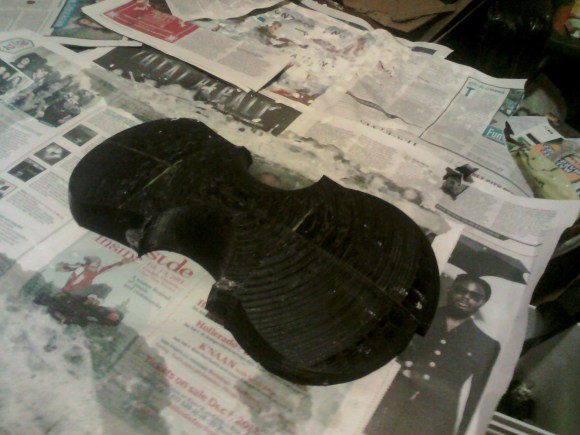
The basic idea behind their paper mache violin was to create a plastic mold for exactly half a violin body. This block was covered in newspaper drenched in wheat paste. Once the paste was dry, the violin half was pulled off the mold and another half was created. These were stitched and glued together, resulting in a violin body.

The bridge, tailpiece, tuners, and fingerboard were 3D pprinted and held together with epoxy. The epoxy flexed a lot, so every time a string was tuned it threw out the tuning of the other three strings. In the video after the break, you can check out the paper mache and plastic violin being played. It’s not much for the eyes or ears, but everyone had fun, and the team completed the proof of concept for a fiberglass or carbon fiber violin we’d suggest they try next.

Continue reading “Making A Violin Mold With A 3D Printer” →

The Coolest Homebrew Computer Gets Its Own Case

SONY DSC

When you’re building one of the best homebrew computers ever created, you’ll also want a great case for it. This was [Simon]’s task when he went about building an enclosure for his Kiwi microcomputer.

We were introduced to the Kiwi last year as the end result of [Simon] designing the ultimate computer from the early to mid-1980s. Inside is a 68008 CPU, similar to the processor found in early Macs and Amigas, two SID chips taken from a Commodore 64, Ethernet, support for IDE hard drives and floppy disks, and a video display processor capable of delivering VGA resolution video at 32-bit color depth. Basically, if this computer existed in 1982, it would either be hideously expensive or extraordinarily popular. Probably both, now that I think about it.

The case for the Kiwi was carefully cut from ABS sheets, glued together with acetone, and painted with auto body paint by a friend. It’s a great piece of work, but the effort may be for naught; [Simon] is reworking the design of his Kiwi computer, and hopefully he’ll be spinning a few extra boards for everyone else that wants a piece of the Kiwi.

NSL Takes Their Propeller Driven Car To The Drive Through

nsl-propeller-driven-land-vehicle

So what’s the first thing you do after completing your propeller driven land tricycle build? Head on over to the Starbucks drive through and see what kind of response you get from the workers. That’s exactly what the guys from North Street Labs did. You can see the response in the clip after the jump.

Having three wheels and being moved by an electric motor with a propeller led to the name TriFly. The build is their entry in The Deconstruction, a build contest which includes other entries like the Beer pouring machine we featured on Monday. Aside from the fun with the final project, NSL’s well-produced video includes a quick trip through the fabrication process. They did a great job making the machine about 40% street legal and it’s obvious they had a blast while doing so.

Continue reading “NSL Takes Their Propeller Driven Car To The Drive Through” →

Mac EFI PIN Lock Brute Force Attack (unsuccessful)

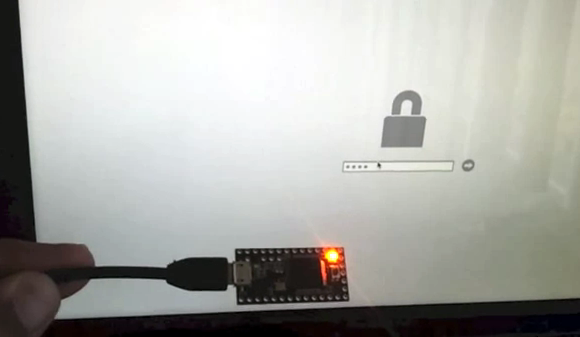
[Oliver] wiped the hard drive from a Macbook Pro using the ‘dd’ command on another machine. This does a great job of getting everything off the drive, but he was still faced with the EFI PIN lock protection when he tried to put it back into the Mac. You used to be able to clear the NVRAM to get around this issue, but that exploit has now been patched. So [Oliver] set out to use a microcontroller to brute-force the EFI PIN.

You can read his back story at the link above. He had the chance to enter a 4-digit pin before the format process. Now that he’s wiped the drive the code is at least 6 characters long, which is a lot more possibilities (at least it’s numeric characters only!). To automate the process he programmed this Teensy board to try every possible combination. It worked great on a text editor but sometimes the characters, or the enter command wouldn’t register. He guesses this was some type of protection against automated attackers. To get around the issue he added different delays between the key presses, and between entering each code. This fixed the issue, as you can see in the clip after the break. Unfortunately after two 48-hour runs that tried every code he still hasn’t gained access!

Continue reading “Mac EFI PIN Lock Brute Force Attack (unsuccessful)” →

Simple To Build Programmable Foot Switches

programmable-footswitches

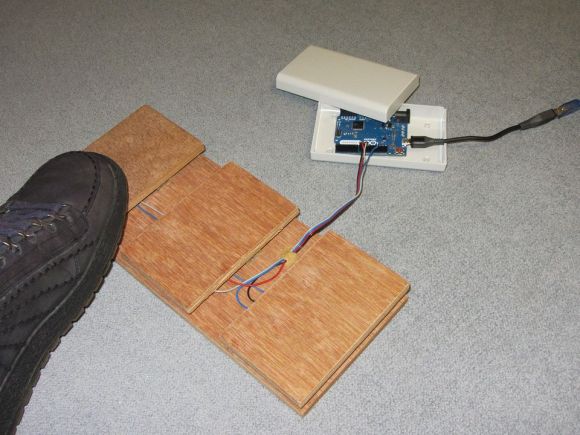
Your hands do a lot of work between the keyboard and the mouse, why the heck are you letting your feet be so lazy? [Dossier van D.] is putting an end to the podiatric sloth. He built this set of three foot pedals which have gone through two versions of functionality.

The buttons themselves are made from a base plate of plywood with a smaller piece on top for each ‘key’. The two parts are separated with some foam carpet pad, with a tactile push button in between to register a click. The only thing we’d change about this is adding a couple of wooden spacers next to the switch so that accidentally sanding on a button doesn’t break that electronic component.

Originally each button was soldered to a gaming controller. This worked just fine using button mapping, but recently [Dossier] made the switch to using an Arduino Leonardo. This is a perfect choice. Unlike input devices made with older Arduino versions the Leonardo board can natively register as a keyboard, making it a snap to programmatically map any key to the switches.

If you like this project you should check out [Dossier’s] foot mouse as well.