Putting 300 Watts Of LEDs On An RC Plane

Being a member of the FPVlab forums, [HugeOne] is really in to strapping a video camera to RC airplanes and flying around by the seat of his pants. He’s also in to flying his plane at night. Combine these two interests, and you’ve got 300 watts of LEDs flying around at night, most likely causing a spike in UFO reports in [HugeOne]’s native Quebec.

The main issue with putting 16 CREE XM-L LEDs in such a confined space is the issue of heat; even though these LEDs are amazingly efficient, they still produce a good amount of heat. [HugeOne] solved this problem by soldering these LEDs to a piece of copper pipe and connecting two radiators to his plane for liquid cooling.

The result is a small, lightweight LED array capable of producing more than 20,000 lumens flying around the wilds of Quebec. This greatly improves [HugeOne]’s night flying ability (video after the break), and has surely annoyed the local police department with an increase in UFO reports.

Does anyone know how bright the nav and landing lights on single-engine passenger airplanes are?

Continue reading “Putting 300 Watts Of LEDs On An RC Plane”

Programming A Propeller On An ARM

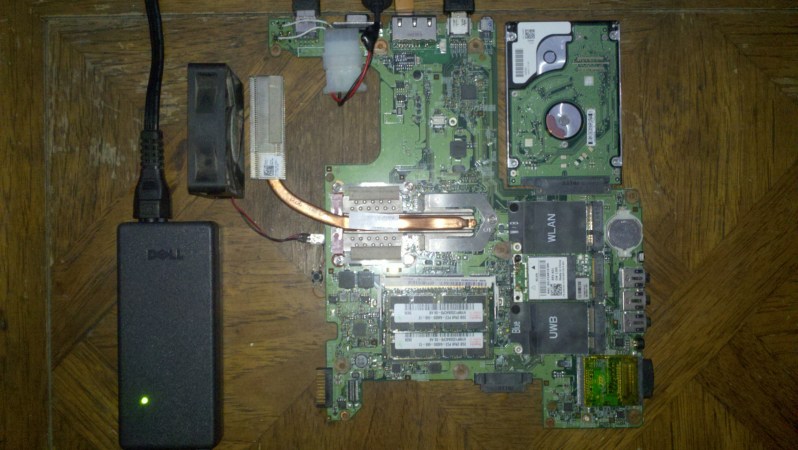
[Stefan] uses a small ARM-powered netbook for his development work, so when he tried to play around with the Parallax Propeller he ran into a few problems. The official tools from Parallax are Windows only, and the available 3rd party dev tools are only compiled for x86. After a lot of futzing about, [Stefan] was able to develop on his ARM netbook and wrote in to tell us how it’s done.

Luckily, Parallax released a GCC port for the Propeller, but unfortunately isn’t completely portable to ARM. The Propeller loader for this architecture ambivalent build uses a little bit of SPIN code, which can only be compiled on Intel machines.

To get around this problem, [Stefan] wrote an installer script to gather all the necessary bits of code to his computer. His ARM/Linux toolchain consists of the Propeller GCC, an open source SPIN compiler, and a Python script used to load code [Stefan] found on the Propeller forums.

Now that [Stefan] has a complete toolchain for programming the Propeller on an ARM device, it’s possible to develop for this very cool multi-core microcontroller on his netbook or even the Raspberry Pi.

Hackaday Links: September 7, 2012

MakerSlide, European edition

We’re all familiar with the MakerSlide, right? The linear bearing system that has been turned into everything from motorized camera mounts to 3D printers is apparently very hard to source in Europe. A few folks from the ShapeOko forum have teamed up to produce the MakerSlide in the UK. They’re running a crowdsourced project on Ulule, and the prices for the rewards seem very reasonable; €65/£73 for enough extrusion, v-wheels, and spacers to make an awesome CNC router.

Kerf bending and math

A few days ago, I made an offhand remark asking for an engineering analysis of kerf bending. [Patrick Fenner] of the Liverpool hackerspace DoES already had a blog post covering this, and goes over the theory, equations, and practical examples of bending acrylic with a laser cutter. Thanks for finding this [Adrian].

276 hours well spent

[Dave Langkamp] got his hands on a Makerbot Replicator, one thing led to another, and now he has a 1/6 scale model electric car made nearly entirely out of 3D printed parts. No, the batteries don’t hold a charge, and the motor doesn’t have any metal in it, but we’ve got to admire the dedication that went in to this project.

It was thiiiiiiis big

If you’ve ever tried to demonstrate the size of an object with a photograph, you’ve probably placed a coin of other standard object in the frame. Here’s something a little more useful created by [Phil]. His International Object Sizing Tool is the size of a credit card, has inch and cm markings, as well as pictures of a US quarter, a British pound coin, and a one Euro coin. If you want to print one-off for yourself, here’s the PDF.

Want some documentation on your TV tuner SDR?

The full documentation for the E4000/RTL2832U chipset found in those USB TV tuner dongles is up on reddit. Even though these chips are now out of production (if you haven’t bought a proper tuner dongle yet, you might want to…), maybe a someone looking to replicate this really cool device will find it useful.

Electronic Beer Pong Removes Beer From The Equation

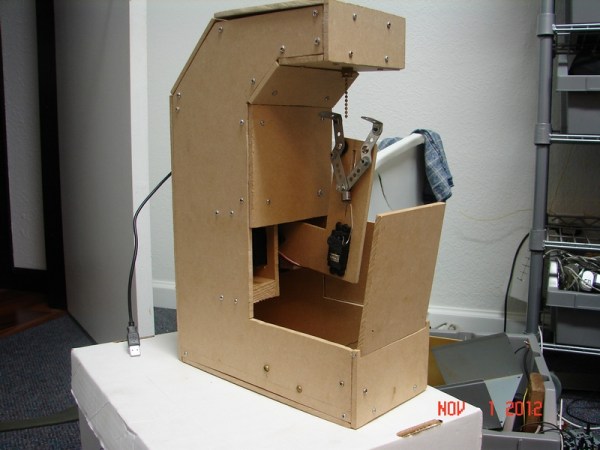
You can take the guy out of the frat house, but you can’t take the frat house out of the guy. [Evan Flint] proves this with his incessant need to have a beer pong game at all of his parties. But now that he’s growing up, and living in nicer places, he doesn’t necessarily want to have the oft-messy game in his home. So he found an electronic solution to his problem. Electropong is like an electronic dart board for playing beer pong. You won’t find beer in the cups, but you’ll still find plenty of fun.

The game includes the triangle of cups that makes up a traditional playing area. In the bottom of each cup is an RGB LED that will keep track of each player’s hits by lighting the cup in that team’s color. Illuminated buttons provide a way to control the game, with an LED marquee to read out the score.

[Evan] mentions some difficulty in recreating the physics of a cup full of beer. He says he overcame the challenge, but alas, there are no details on how. We’ve asked him to update his post so check back for more info.

ProtoSynth, The Prototyping Synthesizer

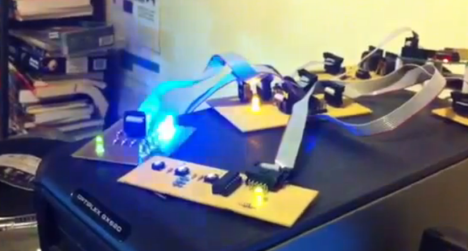
This project isn’t really a prototype, but a tool for prototyping. [Tymkrs] came up with a unique way to build this synthesizer prototyping tool. They actually patched into the underside of the breadboards in order to keep all of the permanent bits nice and tidy.

In the clip after the break you’ll see all of the build photos that lead up to this point. After cutting out and assembling the wooden pieces for the case they grab a soldering iron and get to work. Two octaves worth of keys were pulled out of an electric keyboard. Ribbon cable is soldered onto each key’s electrical connection, with an SIL pin header as a connector. This mates with another ribbon cable with a SIL socket on one end, and an IDC connector on the other. The real trick is getting that IDC connected to the breadboard. They cut back the adhesive tape on the underside of the board and soldered a surface mount pin header onto it. This way the inputs from the keys, as well as a few 1/4″ jacks from the back of the case are always available in a tidy way on the breadboards. The video goes on to show preliminary synthesizer work on the device.

Continue reading “ProtoSynth, The Prototyping Synthesizer”

2012 Open 7400 Logic Competition

The Open 7400 Logic Competition is being held again this year. Start thinking about your entries, they’ll need to be finished and submitted by October 31st. As motivation, Digilent has put up two of their Analog Discovery kits as prizes. They can be used as a dual channel oscilloscope, function generator, or 16-channel logic analyzer. Last year was the first time the competition was held. As hype for the event built, more and more prize sponsors signed on and we hope to see the same thing happen this year.

Your entry can be just about anything as long as you show your schematic, explain the project, and use logic. It can be 7400 TTL, 4000 CMOS, discrete gates, or even a CPLD. Last year’s entries spanned a wide range of themes from LED blinkers, to unorthodox 74xx chip hacking, to boards packed full of chips. Good luck and don’t forget to tip us off about your work!

[Thanks Adrian]

DIY ARM Prototyping Board

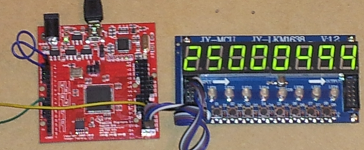
We’re impressed by the ARM prototyping board which [Danjovic] is showing off. He proves that in this day of ever shrinking packages it’s still possible to make your own development tools with protoboard and a soldering iron.

To tell you the truth, if he had designed and etched his own board we probably wouldn’t have featured it. But he didn’t need to spend time on the layout, etching, and reflow. Instead it’s just some enamel wire and a lot of patience. The patience is because the NXP ARM Cortex-M0 chip comes in a HVQFN package. We’re not entirely sure about the HV part (the package alphabet was not entirely clear on this) but QFN means Quad Flat No-Lead. That means no legs on the chip. So [Danjovic] glued it upside down and soldered point-to-point to break out all of the pins.

The top side of the board has a bootloader button, reset button, power regulation, and a crystal oscillator. He doesn’t mention what bootloader he’s using, but a Nokia USB cable gives him the connectivity to push his programs onto the chip.