Wall-wart Retrofitted With A High-power LED Supply Circuit

high-power-LED-wall-wart-supply

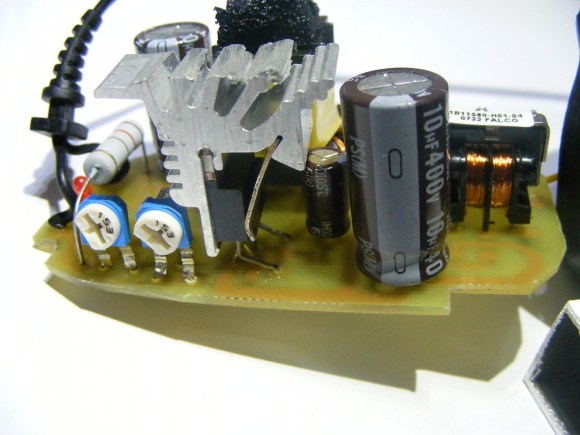
This custom circuit board picks up some of the pieces from a wall wart to drive a high-power LED.  The basic concept is to keep the high-voltage components and swap out the low voltage ones for parts that will be able to drive the 10W load.

The PCB is custom designed, but you can see that it was shaped to match the wall wort’s original board. To the right is the original 500mA transformer. The low-voltage side uses an LM393 because of its dual-comparators. This provides feedback for both current and voltage and is a perfect compliment for the TOP242. We haven’t seen that part before, but [Mincior] says that it’s nice for this application as it has safety features that lock down the chip if power or temperature are above spec. Once the replacement is nestled inside of the plastic case it looks stock and makes sure that your custom LED fixtures will stand the test of time safely.

X-Labs Hackerspace Completes A Big 2-year Tesla Coil Build

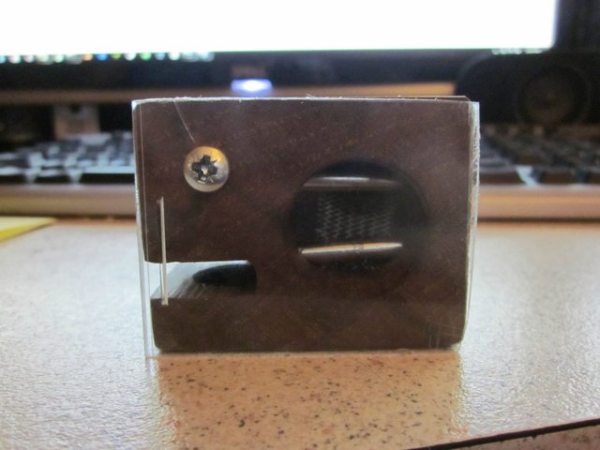
It’s a bit difficult to estimate the size of the Tesla coil from this picture, but look closely at the hand rail on the red-orange wall to the left and that helps. The 10-foot tall musical Tesla Coil project has been on-going for about two years. But the team at X-Labs — a hackerspace affiliated with the University of South Florida — finished it just in time for the University’s engineering expo later in the month. There’s some information about it to be found in the recent student newspaper article on the project. A lot more build details are found on the groups website, although that post is quite old.

You can’t call it a musical coil unless there’s a demo video, and that can be seen after the jump. What better to test the thing than by playing the Super Mario Bros. theme? We’re actually more partial to the Imperial March (it’s also fun to hear played on stepper motors).

Continue reading “X-Labs Hackerspace Completes A Big 2-year Tesla Coil Build” →

How To Make A Vaporizer For Smoking Medical Marijuana

Here’s a home made vaporizer we can really get behind.

Lets just take a second to be completely honest here. There’s no point in suggesting that this is possibly for smoking tobacco.  Medical marijuana is legal (well, not federally), in several states, and we’re sure there are hackers there that would really enjoy making something of their own instead of just buying something.

We’ve covered a few below and they always seemed to have something in common. They use soldering irons for heat. Inevitably someone points out what a bad idea this is.

Continue reading “How To Make A Vaporizer For Smoking Medical Marijuana” →

Building A Six-channel Floppy Drive Synth From Start To Finish

floppy

We’ve seen scores of floppy drives play music, but never before have we seen a project as clean as [Rupert]’s Moppyduino. It’s an Arduino-based board that controls the stepper motors in six separate floppy drives, coaxing them in to playing music from a MIDI file.

The Moppyduino is more than just a convenient way to control the stepper motors in six floppy drives. It’s also a great example of what can be done with home PCB fabrication; the entire project was designed and constructed in [Rupert]’s workshop.

After designing the circuit, [Rupert] printed it out on a laser printer onto a plastic transparency sheet. This was transferred over to a copper clad board, etched, and drilled. After assembly, [Rupert] attached a USB FTDI controller to receive data converted from MIDI data with a Java app.

The end result – housed in a custom Corian enclosure – is one of the best looking floppy drive synths we’ve ever seen. You can check out the process of building this awesome instrument after the break.

Continue reading “Building A Six-channel Floppy Drive Synth From Start To Finish” →

Wireless Light Bulbs With A Slayer Exciter

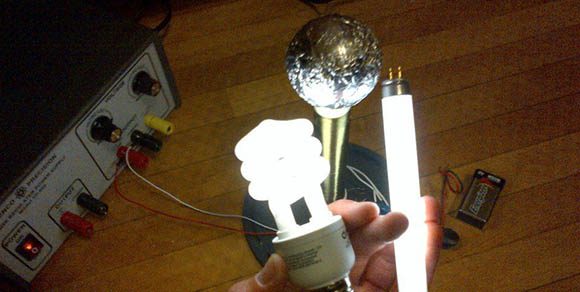
slayer rocksWhile playing chiptunes, creating lightning, and illuminating fluorescent tubes with a homebrew Tesla coil is awesome, they’re not exactly the safest electrical devices around, and certainly aren’t easy or cheap to build. There’s another option open if you’d like to play with strong electromagnetic fields; it’s called the Slayer exciter and is simple enough to light a few fluorescent bulbs wirelessly off a pair of 9 Volt batteries.

The circuit for the Slayer exciter is extremely simple – just a single power transistor, a few diodes, and a couple of resistors. The real power for this build comes from the custom-wound transformer made from more than 100 feet of magnet wire. After plugging the driver circuit into the transformer’s primary winding and connecting a metal ball (in this case a wooden ball covered in aluminum foil), it’s possible to light up a four Watt fluorescent tube with a pair of 9 Volts.

You can check out a video of the Slayer exciter after the break.

Continue reading “Wireless Light Bulbs With A Slayer Exciter” →

Roomba Becomes Data Center Robot

robot

Running a data center takes a lot of work, and even making sure the ambient temperature for hundreds of boxes is in the proper range is an arduous task. When faced with the prospect of installing hundreds of temperature sensors in an EMC data center, [Vivek] had a better idea: put just a few sensors on a robot and drive around the racks. With the right software, it’s a breeze to automate the process and build a near real-time temperature monitoring solution for a huge data center.

The data center robot is based on a iRobot Create, basically a Roomba without a vacuum. Attached to the robot is a netbook, Arduino, and a PVC mast housing three temperature sensors and a USB webcam.

Using the floor of the data center for navigation, the robot canvasses the racks sending temperature data back to a server via WiFi. From there, the temperatures can be graphed to make sure the racks aren’t too hot or too cold.

You can check out a video of the robot in action after the break.

Continue reading “Roomba Becomes Data Center Robot” →

A Table Saw To Cut Solar Panels

saw

Steampunker extraordinaire [Jake von Slatt] loves the idea of solar-powered garden lights soaking up the sun’s rays during the day and powering a LED in the evening. Commercially available solar lanterns, as [Jake], you, me, and everyone else on the planet have discovered, are universally terrible and either don’t have solar panels large enough to charge a battery, or only last a year or so. [Jake]’s solution was to make his own solar lanterns and in the process he came up with a great way of cutting his own solar panels.

[Jake] turned to ebay to source 100 3″ x 6″ solar panels for about $30. These are broken panels, factory rejects, but still are able to produce the 0.5 Volts they should. Since these are rather large panels for a solar lantern, [Jake] needed a way to cut these panels into manageable sizes.

To cut the panels, [Jake] made a box to fit a Dremel with a right angle attachment and a port for a vacuum cleaner. There’s a sled for the panels with markings at 40, 80, 75, and 150 mm so the panels can be quickly cut to size with a diamond cutting wheel.

After the boards are cut, [Jake] checks them out with a multimeter to be sure they’re producing the half volt they should. After that, it’s a simple matter of soldering them together and adding them to his solar lanterns.