Ask Hackaday: Building Nano Scale Antennas

As an RF engineering student, [Camerin] is usually tasked with pointless yet educational endeavors by his advisor and professors. Most of the time (we hope) he sees the task through and ends up pulling something out of his hat, but a few days ago a professor dropped a bombshell on him. After reading this article on nano scale antenna fabrication, a professor asked [Camerin] if it was possible to build a 3D inkjet printer with a ludicrous amount of accuracy and precision.

The full article, Conformal Printing of Electrically Small Antennas on Three-Dimensional Surfaces, was recently published in Advanced Materials and is available via Google Scholar. The jist of the article is that three-dimensional antennas printed on a sphere approach the physical limits of how good an antenna can be. To test out these small, spherical antennas, the authors of the paper built an extremely high-precision 3D inkjet printer that draws antenna traces on a glass sphere with conductive ink.

The positional accuracy of this printer is 50 nanometers, or about half the size of an HIV virus. The conductive silver ink is delivered by a nozzle with a diameter of 100 to 30 µm and prints onto a glass sphere about 6 mm in diameter. This is a level of precision that companies and research institutions pay top dollar for, so we’re left wondering how the authors built this thing.

We’re turning this question over to the astute readers of Hackaday: how exactly would you build a 3D inkjet printer with this much accuracy and precision? Would it even need to be that precise? Post your answer in the comments.

Building The Worst Linux PC Ever

Linux is generally considered the go-to OS for under powered computers. Wanting to challenge the preconceived notion that Linux requires ‘a computer made in the last 20 years,’ [Dmitry] built the worst Linux PC ever around a simple 8-bit microcontroller.

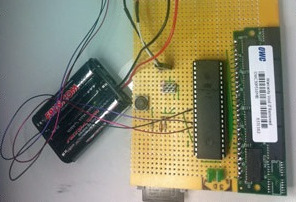
The ATMega1284p [Dmitry] used doesn’t have a lot to offer as far as RAM and storage goes; just 16 kilobytes of SRAM and a paltry 128 kilobytes of Flash storage. While this may be voluminous in the embedded world, it’s peanuts compared to the gigabytes of RAM and hard drive space on even a low-end netbook. To solve this problem, [Dmitry] threw an antique 30-pin RAM SIMM at the problem. It’s wired up directly to the microcontroller, as is the 1 Gigabyte SD card that serves as the PC’s hard drive.

Linux requires a 32-bit CPU and a memory management unit, something the puny microcontroller doesn’t have. For [Dmitry], the best course of action was emulating an ARM processor on an AVR. We’re not sure if we’re dealing with genius or madness here, but it did prove to be a valuable learning exercise in writing a modular ARM emulator.

How fast is it? [Dmitry] tells us it takes two hours to boot up to a bash prompt, and four more to load up Ubuntu and login. If you want a Megahertz rating, good luck; the effective clock speed is about 6.5 kilohertz. While the worst Linux PC ever won’t win any races, its simple construction puts it within the reach of even the klutziest of hardware builders; the entire device is just a microcontroller, RAM, SD card, a few resistors, and some wire.

If you’d like to build your own worst Linux PC, [Dmitry] has the firmware and disk image available to download. If you want to watch the time-lapse of this thing booting, check out the video after the break.

Continue reading “Building The Worst Linux PC Ever”

Riding Rockets And Jets Around The Frozen Wastes Of Sweden

An attentive reader tipped us off to the guys at Mobacken Racing (translation), a group of Swedes dedicated to the art and craft of putting jet and rocket engines on go karts and snowmobiles.

One of the simpler builds is a pulse jet sled. Pulse jets are extremely simple devices – just a few stainless steel tubes welded together and started with a leaf blower. The simplicity of a pulse jet lends itself to running very hot and very loudly; the perfect engine for putting the fear of a Norse god into the hearts of racing opponents.

Pulse jets are a bit too simple for [Johansson], so he dedicates his time towards building a jet turbine engine. Right now it’s only on a test stand, but there’s still an awesome amount of thrust coming out of that thing, as shown in the video after the break.

In our humble opinion, the most interesting build is the 1000 Newton liquid fuel rocket engine. The liquid-cooled engine guzzles NOX and methanol, and bears a striking resemblance to liquid fuel engines we’ve seen before. Sadly, there are no videos of this engine being fired (only pics of it strapped to a go-kart), but sit back and watch a couple other hilariously overpowered engines disturbing a tranquil sylvan winter after the break.

Edit: [Linus Nilsson] wrote in to tell us while the guys at Mobacken Racing are good friends, [Linus], his brother, and third guy (his words) are responsible for the pulse jet sled. The pulse jet is actually ‘valved’ and not as simple as a few stainless steel tubes. The pulse jet isn’t started by a leaf blower, either, but a four kilowatt fan. [Linus]’ crew call themselves Svarthalet racing, and you can check out the Google translation here.

Continue reading “Riding Rockets And Jets Around The Frozen Wastes Of Sweden”

Piano Box Is A Digital Synthesizer Made Of Paper

We love the look of this papercraft piano which [Catarina] built along with some friends at NYC Resistor, a hackerspace in the big apple. It starts off as a cubic black box with a white top. But just lift that top as [Catarina] does in the video after the break and three of the sides fall flat to reveal a pair of speakers and the single-octave keyboard.

The key’s don’t move when you press them. Instead, she decided to use the CapSense Arduino library to implement touch sensitive keys. Each key is made up of a plane of copper foil tape, with a strip of tape running back to the center of the box where it is interfaced with an Arduino Mega hidden there. The Tone library produces the waveforms which are played by the speakers, and a set of LEDs on the upright side of the box illuminate the keyboard diagram as you press each key. You can see that there are short white bars on that display which correspond to the black keys on the keyboard.

If you take a look at the code, you’ll see the libraries really make the code for the project simple.

Continue reading “Piano Box Is A Digital Synthesizer Made Of Paper”

Polish Your Understanding Of Capacitors By Building This Meter

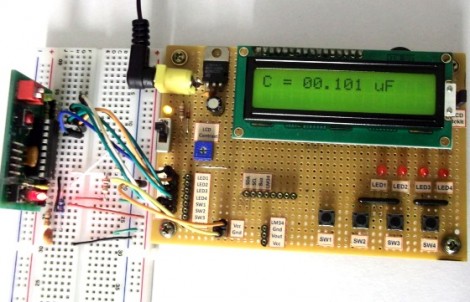
Building a capacitance meter is a great exercise. If you’re feeling quite safe in your digital-circuit-only life, this will push just far enough out of the comfort zone for you to see there’s nothing to fear in adding analog circuits to your designs. Here, [Raj] compares a voltage divider and RC timer to calculate the value of a capacitor. The project is aimed at teaching the concepts, and will be easy to follow for anyone who has at least a bit of experience working with a programmable microcontroller.

The meter is based on an established equation that uses are starting and ending voltage, as well as the time it took to transition between the two, to calculate capacitance. The capacitor will be charged from 0 volts to 0.5 volts. Using the built-in analog comparator is the easiest way to do this. [Raj] breadboarded a voltage divider to establish a 0.5V reference on one of the comparator’s pins. The other input comes from a circuit that places a resistor in line with the capacitor being tested. When that reading rises above the 0.5 volt reference the comparator match will be tripped, stopping a timer that had been running during the charge cycle. From there it’s just a matter of using the timer value in the calculation.

Resurrecting A Cellphone With Blown USB Circuitry

[Script] is pretty lucky. One of the engineers who designed his cellphone included over-voltage protection in the circuit. Of course you probably wouldn’t know about this if there wasn’t a service schematic available. But a bit of searching around let him resurrect the fried USB segment of his Nokia N900.

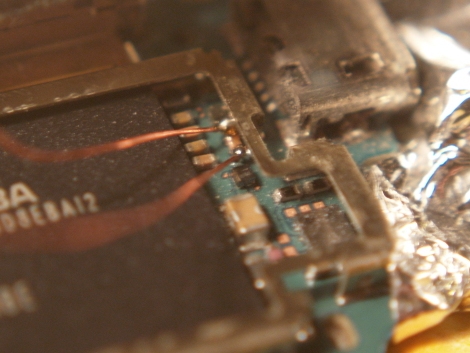
Now [Script] has been experimenting with portable solar power like the system featured at 25C3 a few years back. Unfortunately he made an error which routed 12V into the USB connector’s 5V rail. After this unfortunate mistake the phone would not longer connect via USB, or charge the battery. Luickly the N900 is a favorite with the hacker community (you can see all kinds of N900 related projects here at Hackaday) and [Script] found his way to their N900 Schematic page. Digging into page four he found part F5300 which is labeled 2.0A. He removed the PCB and shielding, and tested the part with a multimeter to confirm it was blown. A quick wire bridge got the phone charging again, but [Script] plans to position a new fuse as soon as he can source the part.

Who says these devices aren’t user serviceable? If we could just get our hands on more service schematics perhaps our gear would last longer.

Collecting Radon Data In The Name Of Science And Safety

radon-data-collector

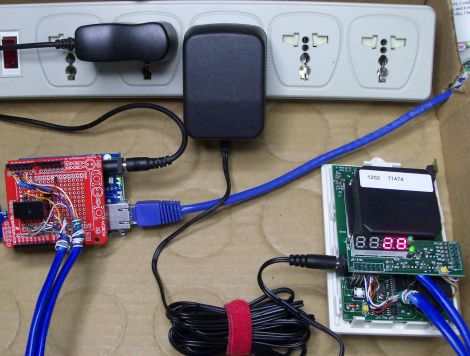
When [Chris Nafis] built an addition onto his historical home he found that a Radon problem, previously mitigated with plenty of concrete, seemed to rear its ugly head yet again. He eventually resigned himself to installing a Radon fan and detector – the latter of which offered no way to store measurement data. He wanted to get a better feel for the short and long-term Radon measurements in his house, in hopes of finding some correlation between temperature, moisture levels, and the total amount of Radon emitted from the ground.

To do this, he disassembled a pair of Radon detectors located in different parts of his house, each of which he wired up to an Arduino. Using his oscilloscope to determine which PCB leads controlled the different LED segments on the displays, he quickly had the Arduinos scraping measurement data from the sensors. [Chris] figured the best way to keep track of his data was to do it online, so he interfaced the microcontrollers with Pachube, where he can easily analyze his historical readings.

An additional goal he set for himself is to trigger the Radon fan only when levels start rising in order to save a little on his electric bill. With his data logging operation in full swing, we think it should be a easy task to accomplish.