Playing Snake With A TV Remote

[vinod] sent in his replica of a Snake game, the game to play on old Nokia dumb phones.

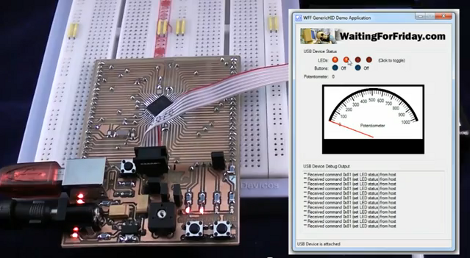
The build is based on a PIC16F877 microcontroller just like previous Snake builds we’ve seen, but [vinod] didn’t use physical buttons in his build. Instead, he used a Philips infrared TV remote to control the game. The infrared controller only takes up one pin on the microcontroller, as opposed to the 4 pins of the easiest four button setup. [vinod] also threw in a simple one-transistor level converter so Snake can be played with a PC via RS-232. With the PIC code included in the build, it’s a great build that reminds us of a more civilized age.

The video of [vinod]’s snake game in action is posted after the break, but we noticed that the snake is allowed to ‘warp around’ the sides of the LED matrix. Some people might consider that cheating but that can be fixed by changing a few lines of code.

Continue reading “Playing Snake With A TV Remote”

Engine Hacks: Snow Chucking — Because Snow Blowing Is For Commoners

Engine Hacks Theme banner

Winter’s coming, and you don’t want to be outdone by your neighbor’s new snow blower. We think it’s pretty safe to say you’ll be the envy of gearheads throughout the neighborhood if you can build your own snow blower around a V8 engine. [Kai Grundt] is a metal fabricator by day and a horror movie prop yard implement builder by night. He pulled the engine out of his Chevy truck and then filled in parts around it to make this 412 HP snow blower.

The tank treads that it rides are each have their own dedicated hydraulic pump, making it easy to drive and steer this 800 pound whale. One of the first orders of business for the beast was to throw snow from two houses away, burying his buddy’s car. That’s the price you pay for laughing in a guy’s face when he describes his next project. It sounds like [Kai] was planning on selling kits so you could more easily replicate the build, but we couldn’t find any additional info on that. If you’ve got the details, please let us know by leaving a comment.

[Thanks Danman1453]

La Crosse Weather Station Wireless Data Acquisition

hacking_wireless_data_transfer_lacross_ws2305

Hackaday reader [equinoxefr] posted some images to our flickr pool showing off some modifications he made (Google Translation) to his La Crosse WS2305 weather station. Having built other router-based weather stations in the past, [equinoxefr] was looking for a better way to gather weather data after one of the routers gave up the ghost.

With a brand new La Crosse WS2305 in hand, his goal was to feed the Lacross’ data to his HTPC which runs XBMC. He pulled the weather station apart and probed around with an oscilloscope until he could find the TTL Tx and Rx pins required to retrieve data from the unit. He hooked the data pins to an XBee wireless transmitter, which he then tucked away in the station’s battery compartment.

Another XBee unit was connected to his computer via an XBee Explorer board, and he was reading data from his weather station in no time.

While his isn’t the first La Crosse weather station hack we’ve seen around here, we like how simple and clean it is. If you’re interested, be sure to check out his flickr stream to see more images of the hacking process.

Want To Learn Artificial Intelligence? Good.

In a little more than a month, tens of thousands of people around the world will attend a class on Artificial Intelligence at Stanford. Registration for this class is still open for both class ‘tracks’. The “basic” track is simply watching lectures and answering quizzes, or a slightly more advanced version of MIT OpenCourseware or Khan Academy. The “advanced” track is the full class, requires homework and exams, and aspires to Stanford difficulty.

With thousands of people taking this class, there’s bound to be a few study groups popping up around the web. The largest ones we’ve seen are /r/aiclass on Reddit and the stack overflow style aiqus. The most common reply to ‘what language should I learn from this class?’ is Python, although there’s an online code repo that has the text’s working code in Lisp, Java, C++ and C#.

If AI doesn’t float your boat, there are two more classes being taught from Stanford this fall: machine learning and introduction to databases. Any way you look at it, you’re getting to take a class from one of the preeminent instructors in the field for free. Do yourself a favor and sign up.

Thanks to everyone who sent this in. You can stop now.

Czech-ing Out The View From 31 Kilometers

The team at czANZO, the Czech Amateur Near-Space Object group, sent up one of the best high-altitude balloons we’ve ever seen last weekend and the resulting video is remarkable.

The team’s build blog (Google Translate link for everyone without Chrome) goes through the design and construction of their payload. Like every other balloon build we’ve seen, a styrofoam cooler is used for the enclosure, but there’s a lot of really neat additions that make this build special.

The team included a cut down device in the event the balloon gets caught in the jet stream. Without this cut-down device the balloon could end up hundreds of miles away from the launch point. That’s the reason for the cut-down device they’ve given, although we suspect it’s an excuse to play around with pyrotechnic rope cutting. The optical and audible alarm is something we haven’t seen on many high-altitude balloon launches, which is odd because it made ground recovery much easier.

The team has a lot of video from the flight that [Pavel Richter] dumped onto Vimeo. We really like the footage showing all of Prague, you can check that out after the break.

Continue reading “Czech-ing Out The View From 31 Kilometers”

The Partyscroller LED Display

As [Plasma2002] put it, “Those jumbo screens at concerts that display your text messages can be a lot of fun. Wouldn’t it be great if you could have the same thing for your own parties or social gatherings?” The answer to this question came in the form of this hack, a scrolling marquee sign that guests simply had to text to get it to display messages. Apparently guests at the party loved the device, and who wouldn’t?

More importantly for [HAD] though, is that [Plasma2002] decided to show everyone how it’s done. He gives us an overview of the process via a nicely illustrated block diagram, then breaks everything down into the actual code used. A Google voice account is used as the dial-in number and everything is kept anonymous. A “bad-word” filter is used to keep everything semi-appropriate.

Really a cool device, and one that we hope will show up at hacker’s parties everywhere. Who knows, maybe something like this could enjoy mainstream success as well. Check out the video after the break to see this device in action! Continue reading “The Partyscroller LED Display”

Upgrading RAM In An Arduino Mega

[Andy] stuffed some more RAM onto an Arduino Mega and his three-part walk through on the design, construction, and software is a great read and one of the more ‘hard core’ Arduino builds we’ve seen.

The build is centered around a 512K × 8 SRAM module [PDF warning]. Because the RAM is divided up into about 512,000 chunks of 8 bits, the Arduino has to access the RAM through 16 ‘address lines’, then send the data through 8 ‘data lines’. [Andy] didn’t want to use up 24 pins on his Arduino, so he used a latch to multiplex the lowest 8 address lines and the data lines together. With the 512KB RAM expansion installed, the Mega is able to address a whopping 520 Kilobytes.

We’ve seen a few builds that have been limited by the amount of RAM available in the Arduino, like capturing video and some robot hacks, and adding some more RAM to those builds would be great. Multiplexing data and address lines using a latch can be expanded even further, but 520KB ought to be enough for anybody.