Creating Music From GPU Noise

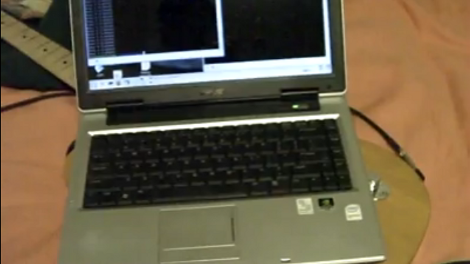
Yep, that’s a picture of a Laptop rocking out on an electric guitar. In what can only be described as a truly bizarre hack [CNLohr] discovered that the RF noise from the computer can be used to play music through the guitar’s pickup.

Check out the clip after the break to hear an annoying, but very discernible rendition of Jingle Bells. Once [CNLohr] stumbled onto the fact that changes in what the graphic processing unit is doing was affecting the pitch detected by the pickup he started writing some code. Now he’s got a program that automatically calculates the size of the window, and produces a white square on a black background to dial in the GPU at the right frequencies.

He mentions in the notes accompanying his video that he had to turn off Vsync to get this to work right. We don’t understand why but we’d love to hear what you think in the comments.

Continue reading “Creating Music From GPU Noise”

Cypherbot Uses Older UC And Retro-controller

[PJ Allen] has been working on a little robot which he calls Cypherbot. The control circuitry is quite familiar; a Board of Education which features the Basic Stamp 2 microcontroller. This is an older and slower microprocessor, but it works quite well for this application since there’s no need for speed or heavy number crunching. The wheels of the bot are made out of plastic lids (we’re thinking peanut butter jars) with rubber bands for traction that are each driven by a servo motor. The third wheel is tiny and swivels as needed.

The front of the bot has a PING ultrasonic sensor mounted on a servo motor which lets the bot scan back and forth for a wider obstacle avoidance angle. In addition to the autonomous mode there’s an Xbee remote control. [PJ] picked up an Atari keyboard and is using that as the user input. Check out the little guy driving around the house in the video after the break.

Continue reading “Cypherbot Uses Older UC And Retro-controller”

The Firebird32, A New Dev Board On The Block

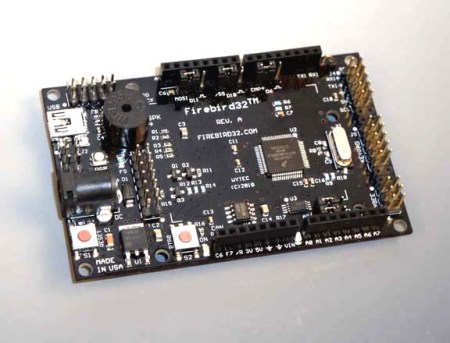
Here is yet another development board to add to your list (If you are into keeping lists), introducing the Firebird32. There seems to be no end to the production of new development boards, following the current style the Firebird32 comes in the familiar Arduino form factor to fit all of your Arduino shields.

The Firebird32 from [Wytec] is build around the 32bit Freescale Flexis MCU [MCF51JM128] running the Coldfire V1 core commonly found in industrial and medical equipment. We were kindly donated a board before release, the first thing that we noticed was  the onboard 8×2 segment LCD which makes the perfect debuging tool. The board along with fitting standard Arduino shields has extra input headers for a keypad, an accelerometer and an extra communication header (IC2/SPI/SCI). It’s also sporting 8 x 12bit analogue inputs, external 32k EEPROM, an RGB LED, a buzzer and an extra push button. The Flexis chip along with the beefy 32bit processor can run at a clock rate up to 48Mhz using PLL and has an integrated USB port, all of this for under $30.

Continue reading “The Firebird32, A New Dev Board On The Block”

Frustrating Fun With Magnetic Levitation

[Andrey Mikhalchuk] built his own magnetic levitation device and you can too… if you have the patience. He’s not using electromagnets, like the Arduino levitator or the floating globe. Instead, a pair of ceramic ring magnets and a few hours are all it takes.

The base of his device is a couple of very large ring magnets that would most often be used in speakers. It’s hard to see them in the image above because there’s an inverted plastic container obscuring them. A second (or third depending on how you’re counting) ring magnet is selected because it is smaller than the circular void in the magnetic base. It’s impossible to simply balance the magnet in the air, but spinning it is a different story. By creating a perfectly balance magnetic top, then spinning it inside the magnetic field of the base, you can leave it floating in mid-air.

Check out the video after the break. It’s a neat effect, but you really do have to have a perfect setup for it to work. [Andrey] mentions that it takes a couple of hours to fine-tune. And if the ambient conditions change slightly, it throws the whole thing off.

Continue reading “Frustrating Fun With Magnetic Levitation”

Apple Laptop Batteries Vulnerable To Firmware Hack

dead_and_busted_macbook_batteries

When you think about hacking laptops, it’s highly unlikely that you would ever consider the battery as a viable attack vector. Security researcher [Charlie Miller] however, has been hard at work showing just how big a vulnerability they can be.

As we have been discussing recently, the care and feeding of many batteries, big and small, is handled by some sort of microcontroller. [Charlie] found that a 2009 update issued by Apple to fix some lingering MacBook power issues used one of two passwords to write data to the battery controllers. From what he has seen, it seems these same passwords have been used on all batteries manufactured since that time as well. Using this data, he was subsequently able to gain access to the chips, allowing him to remotely brick the batteries, falsify data sent to the OS, and completely replace the stock firmware with that of his own.

He says that it would be possible for an attacker to inject malware into the battery itself, which would covertly re-infect the machine, despite all traditional removal attempts. Of course, replacing the battery would rectify the issue in these situations, but he says that it would likely be the last thing anyone would suspect as the source of infection. While using the battery to proliferate malware or cause irreversible damage to the computer would take quite a bit of work, [Charlie] claims that either scenario is completely plausible.

He plans on presenting his research at this year’s Black Hat security conference in August, but in the meantime he has created a utility that generates a completely random password for your Mac’s battery. He says that he has already contacted Apple to in order to help them construct a permanent fix for the issue, so an official patch may be available in the near future.

[Thanks, Sergio]

Radio Shack Will Now Stock Cellphones, Cellphone Accessories, Arduinos

A few months ago, we covered Radio Shack’s efforts to suck less, and the Radio Shack DIY team has now come back with the top ten suggestions submitted. Of course Arduinos make the list at number 1, which we somewhat expected for beginner projects.  Here’s the entire list in order:

  1. Arduino
  2. More kits and project suggestions
  3. More introduction/instructional books
  4. Larger LED selection
  5. Larger resistor selection
  6. TONS more capacitors
  7. DIY audio and speaker equipment
  8. HAM radio gear
  9. More competitive pricing
  10. Stronger sales force

Adding Video Out To The Open Pandora

There’s very few users out there who actually have their hands on an Open Pandora Console. But the ones who do might find this hack useful for getting TV out up and running. It’s actually not hard at all, but if you don’t want to alter the hardware on the device you’ll first have to find a cable plug that will fit the EXT jack. This proved more difficult than it needed to be, since TI carries the connector but only sells them in multiples of 2200. A group buy was organized and we’d bet you can still get in on that action.

The connector in question carries TVout1 and TVout2 conductors. These correspond to the Luminance and Chrominance signals needed for the S-video protocol. But [MarkoeZ] wanted to use a composite connection. Turns out that’s not hard either, he hooked up the ground from the plug to the ground of the RCA jack, then connected both video lines to the center conductor, making sure to add an inline 470pf capacitor on the Chrominance side. Check out the demo video embedded after the break to see the final product.

Continue reading “Adding Video Out To The Open Pandora”