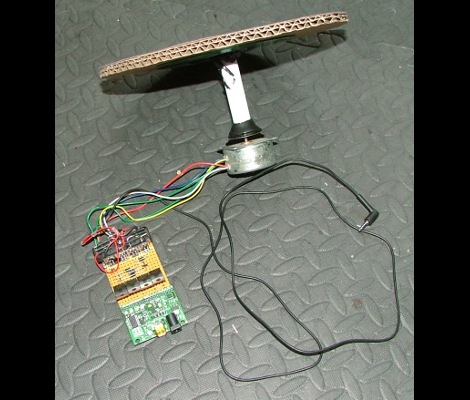
Photo Hardware That Automatically Produces Rotating GIFs

[Fergus Kendall’s] company is making development and breakout boards targeting electronic hobbyists. As with any endeavor that involves selling something, they need marketing. It sounds like [Fergus] was put in charge of getting some nice animated 360 degree images of each component. Instead of going through the drudgery of snapping frames by hand in a stop-motion-style, he whipped up a rotating platform that does the work for him.

The brain of the operation is a Boobie Board, a microcontroller breakout board that is one of their products. It controls a stepper motor attached to the cardboard platform via a quartet of power transistors. [Fergus] mentions in passing that their digital camera didn’t have a connection for a shutter trigger attachment. But they modded it to make things work. There’s no detail on that part of the hack but we’d wager that they soldered a transistor to the contacts for the shutter button.

The stepper motor has 48 steps, so the hardware is programmed to take 48 pictures which become the frames of an animated GIF – embedded after the break – to show off the product.

Continue reading “Photo Hardware That Automatically Produces Rotating GIFs” →

Twitter Notifier Lets Us Know How Awesome We Are

twitter_notifier

Let’s admit it, you’re just a little bit vain. Heck, we’re all just a little bit vain when you really think about it. Instructables user [pdxnat] was self-absorbed enough that he constructed an LED “mood light” that alerts him each time someone mentions his user name on Twitter.

The build is pretty simple, with most of the work being done on his PC. His Arduino is wired to a simple RGB LED that calmly cycles through various colors until someone mentions his name on Twitter. At that point, the client software running on his PC passes a message to the Arduino over a serial interface, causing it to wildly pulse the LED. Once it catches his eye, he stops the alert cycle with the press of the reset button, returning the LED to its previous state. As a bonus, he decided to write the Twitter-polling application in both Processing and Python, enabling fans of either language to easily replicate his work.

It’s a pretty cool idea, and it would be great to see someone expand it to include other online services to provide a greater overall feel for how awesome they really are.

Keep reading to see a quick video of the notifier in action.

Continue reading “Twitter Notifier Lets Us Know How Awesome We Are” →

Making Airsoft Guns Far More Potent

airsoft_laser_rifle

[Drake] wrote in to share his recent project, which involves repurposing an Airsoft rifle that was sitting around, collecting dust. Airsoft guns as a whole are not all that impressive, but convert your Airsoft gun into a laser rifle, and we’re all ears.

His laser blaster is honestly pretty straightforward as far as laser projects go, but we just couldn’t resist. He pulled apart the Airsoft gun, removing all of the “airy” bits, leaving just the trigger behind. He added a 9v battery and a linear power supply to the gun, wiring them up to a 700mW laser diode from what we hope was a broken Blu-ray burner.

In the obligatory “look at what I can destroy with my laser gun” video embedded below, [Drake] shows off his gun’s potency at various ranges, popping balloons from 35 feet away. He even shows off the laser’s usefulness as a light pen for glow in the dark surfaces.

While his modifications are nothing we haven’t seen before, his gun is far more accessible than others we have featured.

Have any cool high-powered laser projects of your own? Share them with us in the comments.

Continue reading “Making Airsoft Guns Far More Potent” →

The Engineering Guy Explains Fiber Optics

engineering_guy_fiber_optics

[Bill the “Engineer Guy” Hammack] is back with another lesson in the science behind the technology we know and love, but might not fully understand. This time around he discusses fiber optic cabling and how it is used to relay data across distances both small and large.

He starts off by showing how laser light can be easily transmitted from one end of an audio-grade fiber optic cable to the other. To show us how this is accomplished, he sets up a simple table top demonstration involving a bucket, some propylene glycol, and a green laser pointer. The bucket has been modified to include a clear window at one side and a spout at the other. The laser is carefully lined up, and when the spout is unplugged, a steady stream of propylene glycol is released into a second bucket. As [Bill] explains, the laser stays within the stream of fluid due to total internal reflection, and can be seen shining in the second bucket.

[Bill] also discusses how fiber optics were employed in the first transatlantic telecommunications cable, as well as how pulse code modulation was used to send analog voice data over the undersea digital link.

As always, [Bill’s] video is as entertaining as it is enlightening, so be sure to check it out below.

Continue reading “The Engineering Guy Explains Fiber Optics” →

Photographing Near-space Objects We’re Not Supposed To Know About

[Thierry Legault] doesn’t just look up at the stars, the uses a motorized telescope base of his own making to track and photograph secret objects orbiting the earth. What do we mean by ‘secret objects’? Spy stuff, of course.

Last month he captured some video of the X-37B, an unmanned and secretive reusable spacecraft (read: spy shuttle) which is operated by the United States Air Force. That was back on the 21st of May but a few nights later he also saw the USA-186, an optical reconnaissance (Keyhole) satellite.

After trying to cope with manual tracking using the RC control seen above [Thierry] set out to upgrade his equipment. He ended up designing his own software package (and then released it as freeware) to automatically track the trajectory of orbiting objects. He uses a second telescope to locate the object, then dials it in with the bigger telescope. Once in frame, the software takes over.

[Wired via Dangerous Prototypes]

Quadbike: Smaller Is Faster

After three huge mutant vehicle builds, [Tom Wilson] thought: “why not build another?” This time he decided to weld together a (comparatively) smaller more agile two-seater he calls the Boxer. We covered [Tom]’s previous quadbike, Big Dog, which features a similar tube frame, full suspension, and the familiar culvert pipe wheels.  This time around [Tom] actually built an extensive jig out of plywood to ease in the build process.  The Boxer is much lighter than its predecessor, weighing in at 125lbs Vs the Big Dog’s 490lbs, and about four feet shorter.  The shorter lighter vehicle makes for a much more agile ride.  If you are interested in building your own quadbike [Tom]’s site is a really good resource with tons of detail.

We really look forward to seeing this latest creation at burning man, check out a video of the (comparatively speedy) Boxer in action after the jump!

Continue reading “Quadbike: Smaller Is Faster” →

Roomba Shares All Of Its Daily Activity On The Web

tweeting_roomba

Instructables user [matchlighter] wanted to see what he could program his Roomba to do, so he decided he would make his little cleaning machine report its status on Twitter whenever something happened.

He popped open the Roomba’s case to access its serial connector, crafting a simple interface cable from some spare Cat5 he had sitting around. He added a small voltage regulator between the Roomba and his Arduino in order to protect it from the high power output present while the Roomba is charging. Once the proper bits were in place, he hooked the Roomba’s serial interface to the Arduino and attached a SparkFun WiFly shield to allow for wireless communications. After a bit of coding, the Roomba was sharing its activities with the entire world on Twitter.

Not only did he want the Roomba to tweet, but he decided that he also wanted the ability to control it from the web. He created a simple interface using a handy library he found online and was sending cleaning commands to the Roomba in short order.

While there is no video of the Roomba in action, you can check out what it is up to here, and there’s plenty of code to be had on his Instructables page.