Kids Type With Their Eyes, Robot Arm Prints Their Words

F.A.T. took it to the next level, combining a couple of their projects for the Cinekid festival. This contraption lets kids write their names with their eyes for printing by a robot arm. The first part is a glasses-free version of the EyeWriter, originally developed as an assistive technology. The system uses some IR LEDs to generate a reflection on your eye that a PS3 camera can pick up and use to precisely track your gaze. Just look at each key on a virtual keyboard to spell out your message. From there, a robot arm used previously in the Robotagger project prints out the name on a big sheet of paper the kids can take home. This is cool, but more importantly it’s a great way to inspire the next generation of hackers and engineers. Check out the video after the break.

Continue reading “Kids Type With Their Eyes, Robot Arm Prints Their Words” →

RC Plane Built Using Pieces Of An RC Car

This hack’s old as dirt to be sure, but new to us and a great accomplishment. The plane above, which is meant to fly without an operator, has been given RC control thanks to parts from that little car. The transmitter and receiver pair are the obvious transplant, but how do you add steering to a $7 plane that wasn’t manufactured to have that feature? The tail was cut and reconnected with mylar hinges to turn it into a rudder. A rare earth magnet and a coil are also thrown into the mix to provide movement. Basically this is a simple solenoid where the coil pushes against the magnet when energized, actuating the rudder. This in combination with an upgraded motor allows for both speed control and yaw. It doesn’t look like you can control roll and pitch but what more can you really expect?

This would be a nice first step on that path to building an epic flying camera rig.

[Thanks Rob]

Using Analog Voltage References With Arduino

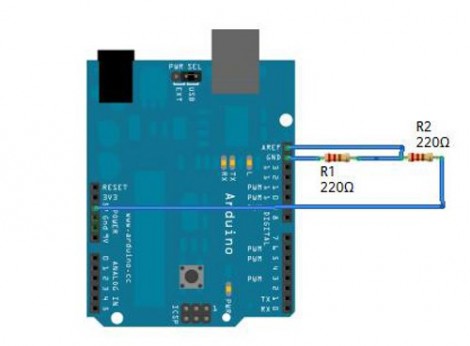
Little Bird Electronics posted an article about using an analog voltage reference with Arduino. This is a tool available when using an analog-to-digital converter. By setting up either an internal or external AREF, you can better use the ADC considering its resolution limitations. For instance, if you are measuring a signal that you know will always be below 2V, an external circuit, such as a voltage divider or an adjustable regulator, can give you a reference voltage just above that upper limit; say 2.5V. This way the 1024 divisions of resolution will be spread across your signal’s range, rather than just the lower half of the ADC readings.

Analog references are common to microcontrollers that have ADCs. Even if you’re not working with an Arduino, read through the article and use what you learn with your uC of choice.

Using A Chicken As A Steadicam

This has been circulating around the net for a bit. For those that haven’t seen it, let me just give you a quick rundown of what is happening. This guy strapped a camera to a chicken’s head. No really, that’s it. There’s some interesting science behind it though. He’s taking advantage of the Vestibulo-Ocular Reflex in the chicken.  It is basically the reflex that we use to keep our eyes firmly focused on something while our head is moving. In a chicken however, they move their entire head. This means that he can strap a camera to the chicken’s head and have an instant steadicam. At least that is the theory. As you can see in the video after the break, the harder part is getting the chicken to look at what you want it to look at. We also found a conversation about it with the creator,[MrPennywhistle] in some reddit comments.

Continue reading “Using A Chicken As A Steadicam” →

Kindle Terminal With Secret Key-press Activation

[Luigi Rizzo] has been working on some hacks for his 3rd generation Kindle. There is already a Python based terminal emulator called AjaxTerm but he wanted a lightweight standalone so he reimplemented the program in C. The 100k binary monitors the keyboard, launching the terminal emulator when it detects a Shift-T sequence. It also uses alternative key mapping to fill in for some of the keys the Kindle’s keyboard is missing.

We haven’t seen a whole lot of Kindle hacking since it was hacked to run Ubuntu. Seems like this terminal emulator is a useful and unobtrusive hack to try out on the beloved reader.

Bluetooth Temperature Module

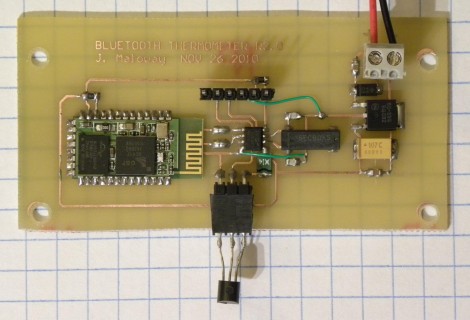
Wanting to know the outside temperature, [Jamie Maloway] built his own temperature sensor that can be read with a Bluetooth device. Let’s take a tour of the hardware above from right to left. There’s a linear voltage regulator with two filtering caps and a terminal block to attach a 9V battery or other power source. Next there’s an 8 MHz crystal and it’s capacitors, followed by a programming header on top and a 1-wire temperature IC, the DS18B20 we’re all familiar with hanging off the bottom. These both connect to the 8-pin PIC 12F675 that drives the system, and transmits using a Bluetooth module from Sure Electronics. Since this is using a serial protocol and transmitting ASCII data, it can be read using an automated script, or simply by using a terminal program.

Now, who’s going to be the first to get rid of the battery and leech off of the mains through inductance?

Segfault: Balancing Transport Using A Dozen Op-amps

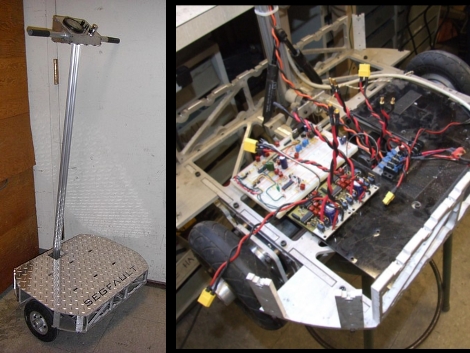
The Segfault is a balancing transport similar to a Segway, but it uses analog comparators instead of digital circuitry. On board you’ll find no less than twelve LMC6484 op amps. They take signals from the gyroscope and the accelerometer, balance and filter them, then drive the motor h-bridges accordingly.

[Charles], the guy behind the Segfault, is also the one responsible for DeathBlades. As with that project he does just as well at documenting as he does at fabrication. Take some time to enjoy his posts associated with this two-wheeled-wonder (especially the build process) and then watch in the video after the break.

Continue reading “Segfault: Balancing Transport Using A Dozen Op-amps” →