Direct To PCB Inkjet Printing

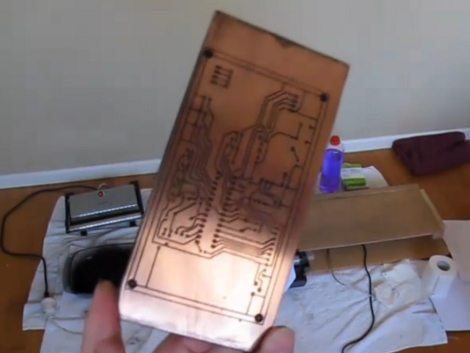
[Rhys Goodwin] has been working on a system to print resist onto copper clad using an inkjet printer. This is a toner transfer alternative as it still uses toner, just not quite as you’d expect. The first step is to modify an inkjet printer, separating the carriage from the feed rollers in order to increase the clearance for the substrate. Instead of printing with etch resistant ink, as we’ve seen before, [Rhys] prints with black ink and then covers the board (ink still wet) in laser toner. Once there’s good adhesion he blows off the excess and bakes the board in a sandwich press, with spacers to keep the iron from touching the surface of the copper clad. This cooks the resist into a hard plastic layer and the board is ready for the acid. Watch him walk you through the process after the break.

[Rhys] uses the same method for silk screen, printing in red and baking the ink onto the substrate without added toner. This produces a nice looking board but it’s still quite a bit of work. It certainly sheds more light on the process than that laser-printer method from back in May. We hope you’ve been inspired by this and come up with the next innovation that makes this process easier.
Continue reading “Direct To PCB Inkjet Printing” →

Pulito: The LEGO Roomba

When [Dave] installed hardwood flooring in his house, he needed a solution to help automate the monotonous task of routine sweeping. Rather than go out and buy one of the many existing automated sweep robots out there, he decided to use his passion for LEGO Robotics to design and build a NXT based Swifferbot he calls Pulito. His version implements all the important features such as object avoidance using bump sensors, an IR beacon used to automatically return to the charging station, and a photoresistor to monitor the charge of the battery. [Dave] also includes a nifty LEGO sensor multiplexor, allowing him to save on I/O ports, which is almost worth sharing by itself.

Videos after the break.

Continue reading “Pulito: The LEGO Roomba” →

Renesas RX Design Contest: $110K+ Of Cash And Prizes

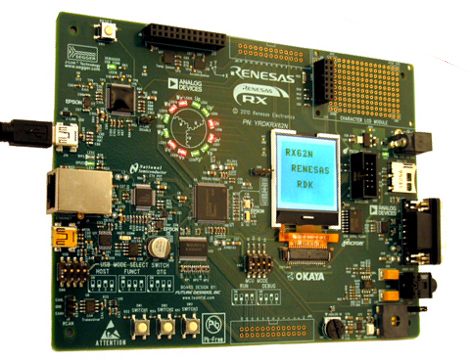
It seems that we have caught Design Contest Fever here at Hackaday. After covering some other design contests, and asking readers to send in more, we heard from a couple tippers about Renesas’ challenge. Like many of the other contests, entrants can submit their ideas, and possibly receive a free development board to get them started. Unlike the other contests though, Renesas board (possibly) free development board is everything but the kitchen sink. Designed with RTOS’s in mind, rather than the normal microcontroller tasks, this board has an astounding number of capabilities.

On top of the excellent development kit, the contest is also offering books, software, and cash prizes to the winners. So get out there, design something amazing, and make Hackaday proud.

Debug Mode Lurking Inside AMD Chips

Looks like some hardware enthusiasts have worked out a method to enable debug mode within AMD processors. The original site isn’t loading for us, but the text has been mirrored in this comment. Getting the chip into debug mode requires access passwords on four control registers. We’ve read through the writeup and it means very little to us but we didn’t pull out a datasheet to help make sense of the registers being manipulated. It shouldn’t be hard to find an old AMD system to try this out on. We’d love to hear about anything you do with this debug system.

[via Slashdot]

Final Take On The Machine: Winners

It’s finally here, the last episode of Scion’s Take on the Machine with Mitch Altman. In this episode all the teams are given a recap over their success and failures, and the clear winner is placed on top. We’re not ones to spoil the surprise so you’ll just have to click the link and watch to find out.

But lets take a moment to remember each team, The Transistor and their live action zombie game. Crash Space and their musical building. Pumping Station: One and their ice cream maker. Artisans Asylum and their breakfast machine. And lastly, NYC Resistor and their drink mixing slot machine.

Who’s ready for next season? There isn’t a next season you say? Perhaps a new influx of sponsored hackerspace competitions will spring up, or the whole concept will die out as quickly as it came. Either way, it’s all about the money fun and educating experience, right? And that’s all that matters.

[Thanks Deven, sorry you guys didn’t win.]

Kinect And TISCH Combined For Multitouch

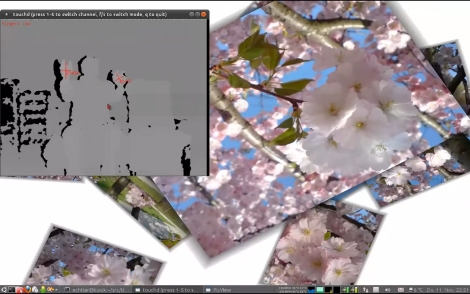
[Florian] sent a link to his proof of concept in creating a multitouch display using the Kinect. He’s the one behind the libTISCH multitouch package and that’s what he used to get this working along with the recently released Kinect drivers. He did this on an Ubuntu machine and, although it’s not a turnkey solution he was kind enough to share some rough directions on accomplishing it yourself. Join us after the break for his instructions and some embedded video.

Continue reading “Kinect And TISCH Combined For Multitouch” →

Lots Of Spinning POV Goodness

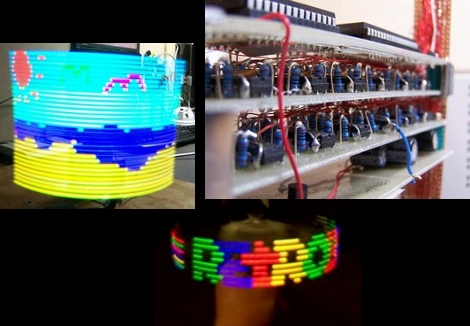
[Retrobrad’s] spinning POV display has long been our favorite. When it popped up on our radar again this morning we were surprise to see we never ran a feature on it! But now there’s so much more to share. Hit the projects icon at the top of his page and you’ll not only get the 8×85 RGB display’s build instructions, but he’s also built a 32×64 pixel spinning display.

Even if you’re not going to make one of these, he explains some pixel-graphics techniques that are useful in other instances. Check out his video on using spreadsheets for creating the hex arrays necessary for each frame the 8×85 display. It’s embedded after the break along with demos of the two displays.

Continue reading “Lots Of Spinning POV Goodness” →