Replacement Speedometer

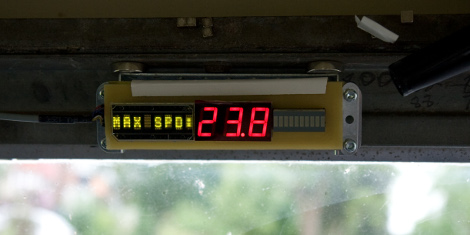
[Howard] built his own replacement speedometer for his truck after the original speedometer cable broke. He’s using surface mount components and produced a two-board design that is quite nice. When he tipped us off he mentioned that this is Arduino powered and uses a hall effect sensor. There’s not talk of this in his writeup but we gather that he’s just using the bootloader on an AVR chip and that he hall effect sensor measures the rotation of one of the wheels. When the vehicle isn’t moving the board alternates between max speed and trip distance. Once he’s on the roll it shows current speed.
Building A Cluster Of IPaq PCs

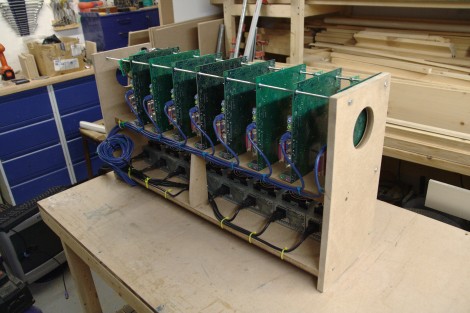
[Steven Pigeon] got his hands on ten iPaq computers that a friend acquired through an eBay auction. The older machines were in good condition but the march of technology had left them behind as casualties. He’s given them new life by assembling a cluster. The first order of business was testing the hardware to make sure it’s working. [Steven] used memtest86+ that comes along with the Ubuntu distribution of Linux to find one bad memory chip in the bunch (a revelation that took 10 hours to discover on the slow hardware). He assembled the unit above with MDF as a support structure and threaded rod to hang the boards. He ended up with a beautiful module and his next step is to choose the operating system that will pull the whole thing together.

We find this build every bit as beautiful as the file cabinet cluster. It’ll be interesting to check back with him and see what kind of performance he can get out of it.

No Nonsense Mbed Development Demo

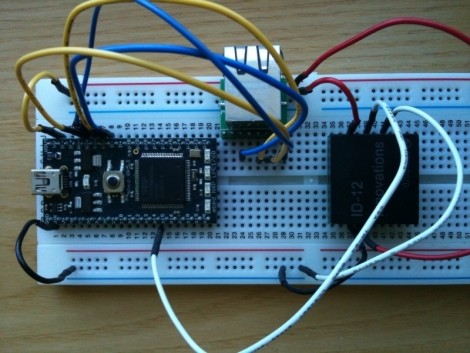
This tweeting RFID reader is a great working example for the mbed. When an RFID tag is read it is matched with the name of the owner and a Twitter message is sent out. This is very similar to the RFID cat tracker that used an Arduino.
The code is short and simple due to the use of available mbed libraries. The hardware needs just two extra modules, an RFID reader and an Ethernet socket. If you’re trying to decide if you can make the jump over to ARM development this certainly presents an easy learning curve and an opportunity to get comfortable with the code and the libraries before you make a purchase. It’s also a great set of test code to start with if you have an mbed and the two supplementary modules on hand. The quick video clip after the break will walk you through the components and the code.

Adjustable Tesla Coil Build

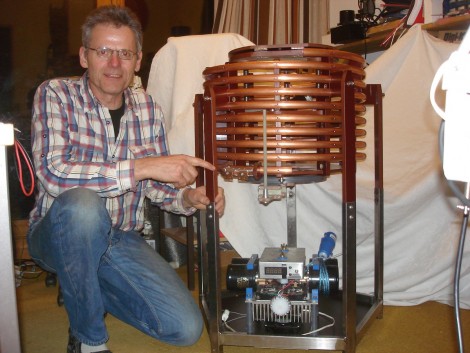
This coil has no trouble shooting sparks across four meters of empty air. [Finn Hammer] has been putting in some long hours on this labor of love, and we put in some time reading through his progress thread. He started down this path about a year ago and every step of the way he produces beautiful work. We enjoy seeing his prototyping techniques, moving from concept to hand drawing to CAD diagram before starting the physical build. Check out the demo video after the break and as you read through his thread look for the green arrows that lead to other videos and resources.

Continue reading “Adjustable Tesla Coil Build”

Most Useless Machine Loses Carbon Footprint

[youtube=http://www.youtube.com/watch?v=lxyQ3PFbK9Y]

[Clayton Boyer] took the electricity out of the useless machine, making one that runs like a clock. To this point, we’ve always seen these useless machine use electric motors. [Clayton’s] clever design uses a wind-up spring and a series of wooden gears to bring the fun, making it a great companion for the binary adder you built. The video above shows the inner workings and the design plans are for sale. We’d love to print out the parts or perhaps just laser-cut them from wood like the legs of this spider bot.

[Thanks llwynog]

Joojoo Alternative OS Installations

Joojoo hacks are starting to trickle in as non-fanboys get their hands on the iPad alternative. The custom OS forum for the device tells the tale of successful installs of Windows 7, OSX, Android, and Jolicloud.

So far the only one to have a how-to is Windows 7, but we’re sure that will change quickly. When Microsoft’s offering is installed on the device it get about four hours of use per charge which is fairly decent. We’d love to get our hands on one and try it out with Android but the $499 price tag is still a hurdle for us. We’re not saying it’s over priced, as it comes with a lot under the hood. Even at that price we think it blows the aPad out of the water.

[Thanks Andy]

Careful! That Gas Pedal Is A Nexus One

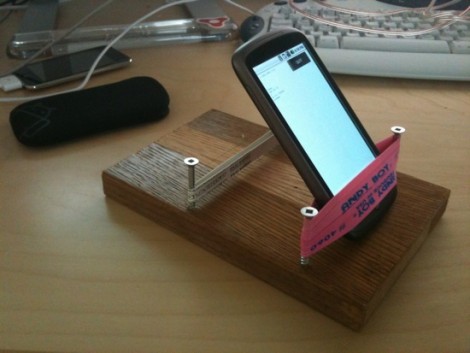
Indeed, the gizmo above is meant to be used as a gas pedal. [Grant Skinner] came up with the idea to control slot cars using an Android phone as a gas pedal. He coded the software for the handset and a computer using Adobe AIR. Once connected, the computer is sent the accelerometer data from the phone, relaying the speed control to the slot car track with the aid of a Phidgets motor controller. See it ‘go’ after the break.

We’ve seen the Phidgets board used in several projects like the augmented vending machine and the plotter white board. What we haven’t seen is hacks that make use of AIR, a framework we looked at two years ago. If you’ve got hacks that make use of AIR we want to hear about them.

Continue reading “Careful! That Gas Pedal Is A Nexus One”