Cool Yourself With A CPU Cooler And Beer Fridge

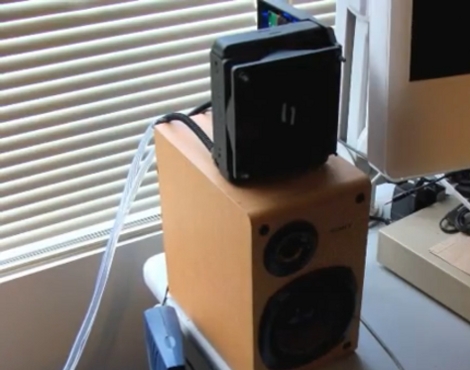
We have arrived once more at the time of year when penniless (or bored) hackers try to figure out how to keep the place cool without buying an air conditioner. [Paul Stacey] sent us his solution of pairing up a CPU cooler kit with a beer fridge. The CPU heat sink is cut out of a liquid cooling kit and discarded. In its place a loop of plastic tubing enters the freezer of the beer fridge where it exchanges salt water from a reservoir. The cold liquid circulates through the radiator of the fan kit and gives up it’s cool goodness through the fan unit seen above. This method puts a cold-air fan right in front of you with a digital temp and fan speed readout on the LCD.

Our biggest concern here is that this might heat up the beer in the fridge. Still, it’s more automatic than using a homebrew swamp cooler. Then again, we’ve always had a soft spot in our hearts for our favorite gravity fed cooling method. Anyway, check out [Paul’s] build methods after the break where he makes it look quick and easy.

Continue reading “Cool Yourself With A CPU Cooler And Beer Fridge”
Mass Storage Business Card

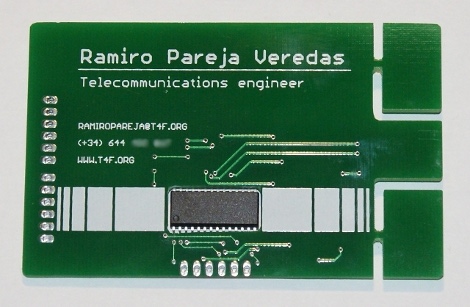
Just snap off the corners and this business card can be used as a mass storage device. Well sort of. The tab left over has four traces on the back to make it USB compatible. The PIC 24FJ64GB002 microcontroller on the card registers as a storage device and launches [Ramiro’s] resume and a cover letter loaded as an HTML file. He’s made it as useful as possible by including access to the SPI and I2C bus connections but he’s also included some firmware to act as a data logger or an oscilloscope. At about 5 euros a piece you won’t be distributing these willy-nilly but it’s not too much more than handing out breakout boards with your name all over them.

Aircraft Carrier Is Moving Target For Autonomous Quadcopter

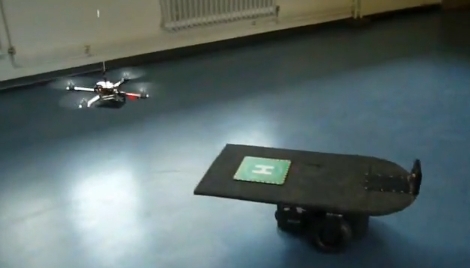
[Karl-Engelbert Wenzel] developed a UAV capable of taking off and landing on a moving platform autonomously. The platform operates aircraft-carrier-style by driving around the room in circles. The quadcopter tracks a grid of IR LEDs at the front of the landing deck by using the IR camera from a Wii remote. The best part is that the flight controls and processing are all done by the copter’s onboard ATmega644 processor, not requiring a connection to a PC. The landings are quite accurate, achieving a maximum error of less than 40 centimeters. In the video after the break you can see the first landing is slightly off the mark but the next two are dead on target.

So build yourself a mobile platform and pair it up with your newly finished quadcopter to replicate this delightful hack.

Continue reading “Aircraft Carrier Is Moving Target For Autonomous Quadcopter”

Poor MABEL

[youtube=http://www.youtube.com/v/IlWIWf4daNs]

At first, watching this video of MABEL, a bipedal robot for studying dynamic gaits, we didn’t know if we should be scared or feel sad. By the end, we know that sadness prevailed. Poor MABEL, forced into a  grueling routine, is not even allowed to rest when her leg breaks.

To be serious though, MABEL is quite impressive. Instead of using a direct drive on the legs, motors are attached to springs that act like tendons. This helps compensate for variances in the walking surface, hopefully allowing for smoother transitions between gaits as well. As you can see, MABEL handles the height differences quite well, albeit a bit slowly. It is worth noting that there are no visual sensors on MABEL and everything is done through feedback from her gait.

Bay Area Maker Faire 2010 In Pictures

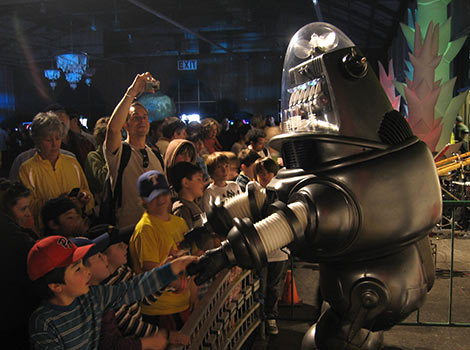
Just when you think it couldn’t possibly get any bigger and crazier, they manage to outdo themselves again. The Bay Area Maker Faire wrapped up Sunday evening, but we have so many story leads that we’ll probably be busy until next year’s event. In the meantime, here’s just a tiny, random sampling of the countless delights that greeted visitors this past weekend.

Continue reading “Bay Area Maker Faire 2010 In Pictures”

Maple R3 Now Shipping

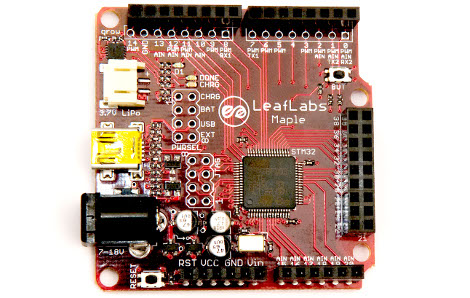
Leaf Labs is now shipping the Maple R3 boards. [Phil Burgess] gave the platform a look just before launch last fall and the high-powered prototyping board is now even better. New features come in both hardware and software varieties. The bootloader can now be upgraded without additional programming hardware, there’s hardware SPI and I2C interfaces, and a newly-polished IDE for Linux and Windows. At $50 it’s a good way to get access to the power of the ARM Cortex M3 processor at the center of the board. We’ve seen several projects that use the mbed, which is in the same class as the Maple, but we’re waiting to see what you’ve accomplished with this little devil.

DB9 Form Factor USB-RS232 Replacement

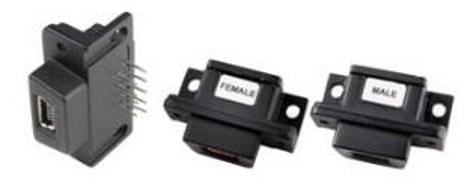
If you’re attached to that favorite DB-9 interfaced device you should look into this part. FTDI is selling a USB-RS232 adapter as a replacement for DB-9 connectors. They come with USB male or female connections depending on the application and have the same serial footprint and pinout to which you’re accustomed. Using converter cables is just fine but this simplicity requires a few minutes of desoldering, rather than redesigning, etching, and populating a board in order to give that older design built-in USB connectivity.

[Thanks Juan]