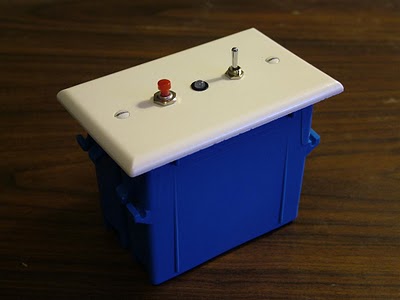
MSP430 Based Single LED Clock

[Kenneth Finnegan’s] latest clock makes use of the TI Launchpad for programming and debugging MSP430 microprocessors. We took a look at the Launchpad when it was released and we’re glad to see some hacks resulting from availability of that tool. The clock reads out the time using a bi-color LED. Press the button and a series of flashes will tell you the time. A three-position toggle switch is used along with the push button for setting the time. The protocol he developed is outlined in his demo video after the break.

We like [Kenneth’s] use of a plastic electrical box as a project box. They’re cheap and you can find them everywhere in many different sizes. He mentions the difficulty in drilling through the faceplate. We’ve had our share of shattered plastic trying to drill holes in the darn things. If you’ve got some tips on faceplate-modification we’d love to hear them.

This clock is sure the polar opposite from the TTL clock that [Kenneth] showed us back in March, trading jumper wires for lines of code. We’re going to give this one a try, hopefully fixing the button debounce along the way.

Continue reading “MSP430 Based Single LED Clock” →

Snapping Pics At The Right Moment With A Pressure Plate

[BiOzZ] built a pressure sensitive camera accessory to snap pictures at just the right moment. Before turning out all the lights the camera is set up with a twenty-second timer and a three-second exposure. The pressure plate doesn’t take the photo, but fires the flash to catch an image in the middle of the action.

The hack uses a piece of acrylic as the base of the pressure plate. A switch is constructed by placing aluminum tape on the base, and attaching a thin metal strip that is bent to add just a bit of spring. When an object is place on the plate the thin metal contacts the aluminum tape completing the circuit, a change in the weight breaks it. A simple circuit connects to this, using a relay to actuate the flash from a disposable camera. This is perfect for documenting the moment when you exercise that fruit-induced rage that has been consuming you lately.

Road Tour On A Bike With An Attitude

This is Precious. Precious is a bike that the folks over at BreakfastNY have anthropomorphised for a good cause. By adding sensors for a variety of data sources to the bike, and transmitting them back to a server via a cellular module, Precious can spit out cheeky comments about the ride on its Twitter feed. Right now Precious is on his way across the country powered by his rider, Janeen, to raise money and awareness for cancer research. You can track the progress, enjoying some attractive web design and reading the oft-beligerant comments from the bike, at yesiamprecious.com.

Although there’s no specifics about the hardware, we saw the typical project box during the teaser video. Inside you’re sure to find the usual suspects. Considering that speed, cadence, grade, temperature, humidity, and GPS data are all available on high-end bike computers we hope they found a way to just read in that data. But your guess is as good as ours; start speculating in the comments.

Android Development 101 – Part 6:Getting Ready For Market!

In this tutorial we are going to cover packaging one of our applications into an .apk file and getting it ready for the Android Market.  After we have completed this tutorial you should be able to use the tools provided in the AndroidSDK to sign your application, put the application on your phone and install it or send it to the Android Market.  These will be great assets to have if you decide to develop applications that you may want to charge for.  This tutorial will also be a change from the normal ones because it will include little, if any, code.

Super Simple Inch Worm Mechanism

[youtube=http://www.youtube.com/watch?v=dvplpWJ9CcI]

Sticklers for the definition of “robot” should simply avert your gaze for the opening title of the video. [Randofo] has posted this beautifully simple inch worm mechanism using only a ruler, some connectors, a switch, a servo, a comb, some batteries, and a couple Tupperware containers. It inches, as it was designed to do, quite well. We’re especially fond of the use of a comb as an easily modifiable switch activator.

Out Now: EL Coat, Coming Soon: EL Hat

[Render] says his coat is simply “enhanced with EL wire”, but we know the truth. He’s secretly an alien that can’t block out all of his glowing green skin with a the black coat. No? Fine,

You can put away the sewing machine, [Render] simply used a needle and fishing line to attach ~50-70 foot of electroluminescent wire to the outside of a coat he picked up at a local clothing shop. Solder and program in an inverter and controller board thanks to SparkFun, and you’re ready to go.

Just double check all your connections, high voltage directly on your person is not fun. Trust us.

RGB Lamp Bulb Replacement

[youtube=http://www.youtube.com/watch?v=TwZBMJS1teg]

Wanting to make some unique and interesting gifts for his nieces as well as improve his PCB skills and expand beyond Arduino, [Jay] has made these color changing Ikea lamps. He’s using an ATTiny2313 for the brains, a handful of RGB LEDs plus 3 warm white LEDs to keep the wife happy. you can download the schematic and PCB files if you want to reproduce this one yourself. You can see his PCB making skills have improved since the nursery room temperature monitor. We think his nieces will be pleased with their gifts.

[via HackedGadgets]