Guitar Hero As An Instrument Or Midi Controller

[youtube=http://www.youtube.com/watch?v=azfgasnWtW0]

[Robert] wrote a program using Max/MSP that lets him make music with his guitar hero controller. There’s another video after the break where he walks through the various features but here’s the gist of it. This works on Mac and Windows and allows a sort of ‘live play’ or midi mapping mode. In the midi mode each key can be configured to do your bidding. His example uses the pick bar to scroll through different samples and the green button the play them or the red button to stop.

The live mode us much more involved. In the software you choose the type of scale and the key you’d like to play in. This makes up for the controller’s lack of enough frets to make it a chromatic instrument and these settings can be adjust from the controller. There is an up-pick offset that makes the upward movement of the pick bar a different note than the downward movement. The motion control can also be used as an input. He demonstrates pitch bending and cutoff using that method.

This looks like a lot of fun. He needs to team up with [Joran] to add drums to the mix, forming a much more creative rock band than you can buy in the store.

Continue reading “Guitar Hero As An Instrument Or Midi Controller”
Battery Holder Reuses Blister Pack

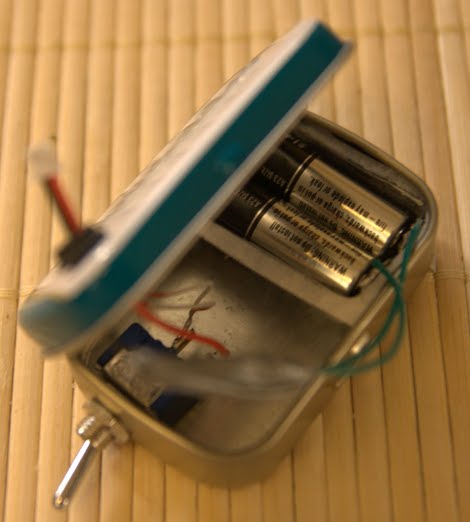
In need of a portable power supply, [Alastair] threw some batteries into an Altoids tin. The problem was he didn’t have a holder for these size A23 cells. Inspiration struck and he realized the blister pack they came in fits them snuggly and just needs some conductors to complete the circuit. He pulled some battery contacts from a broken CD player. Using foam-based double-stick tape he added some spring to the contacts and came up with a perfectly sized holder that works wonderfully.

We’ve tried making battery packs by wrapping the entire thing in clods of duct tape. This looks like it works a lot better and there’s still room to fit the batteries and a switch inside of this minty enclosure.

Propeller Takes Step-a-Sketch To A New Level

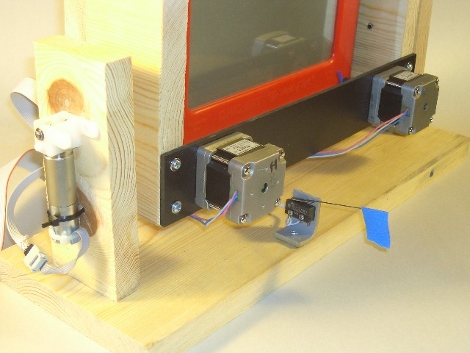
[Mpark’s] propeller controlled Etch-a-Sketch is well built and very accurate. He was inspired by the Step-a-Sketch project and he’s carried that design through to a stunning conclusion. The driver board was built around a Parallax Propeller P8X32A microcontroller. But this isn’t just a serial controller board for connecting the hardware to a PC running CNC software. He’s included TV out and a keyboard port so that programming can be done on the chip itself.

In the video after the break you can see how precise the plotting is on the Etch-a-Sketch. It is well mounted but also benefits from some software compensation for the toy’s imprecise controls. [Mpark] has also included an erase function that tilts the frame upside-down a few times. This is used not only to erase a drawing but to hide the line created when moving the stylus into its starting position.

Continue reading “Propeller Takes Step-a-Sketch To A New Level”

Winners Of The N900 PUSH Showcase Tickets.

Like all great things, they must come to an end. As such, at 10am PST, this morning – our N900 Push competition came to a close. We had some really awesome answers, some really round about, and of course the obligatory – really bad ones. For those that are just on the EDGE of your seat waiting for the final concluding answer to stop the arguing and fighting – to settle this whole dispute. The answer, and the winners are…After the break.

Continue reading “Winners Of The N900 PUSH Showcase Tickets.”

The Mechanical Diode

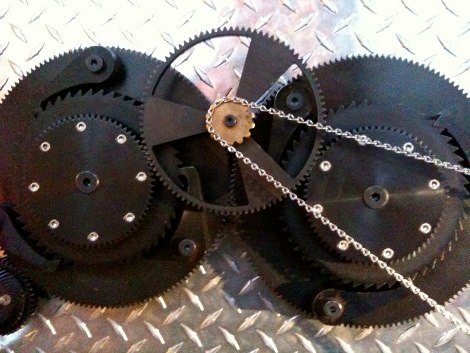
A diode allows current to travel in only one direction. With that in mind, [Alex] built a mechanical diode that will only allow gear rotation in one direction to be transmitted through the system. But wait, by connecting two of these devices together he’s built something of a mechanical rectifier. An electrical rectifier converts alternating current to direct current and this mechanical version outputs clockwise rotation no matter what direction of rotation is coming into the device.

There’s video which we’ve embedded after the break as well as many pictures on his site but not much explanation. Here’s what we’ve deduced. The two large gears are inputs. Mounted on top of them is a smaller ratcheting gear that will only turn in one direction. This ratcheting gear selects whether the smallest gear on the left or right will rotate, which then feeds the output gear at the top of this image. Continue reading “The Mechanical Diode”

Leapfrog Didj: Followup

Yesterday we mentioned the Woot! sale of the Didj, and we had some comments and emails from readers who had purchased one. We couldn’t resist either, and ordered a couple to take apart and modify. We will probably be following the work laid out by [Claude Schwarz], who seems to be one of the leading hackers on the scene. [Claude] has done some work in porting the GP2x libraries to the Didj, which gives a tremendous head start to anyone looking to have a working game system any time soon. There will also be a build log for everyone to follow along at home, and contribute what you want and have, as well as a follow up How-To when a working system is attained. Happy Hacking, everyone.

Print Your Own Pizza

[youtube=http://www.youtube.com/watch?v=XJ7gD0nH-xA]

If you think there’s never enough computerized numerical control in your life perhaps the pizza plotter should be your next project. This is a large 2-axis machine that shoots pressurized sauce onto a pizza crust. It’s a food-grade RepStrap and appears to use a garden sprayer as a reservoir. They learned their lesson when a loose hose clamp sprayed sauce around the room. We’re thinking this is a bit of reinventing the wheel as pizza-making factories but it’s fun nonetheless.