The Hack a Day store is still going strong. We’re really enjoying the fact that when you buy a Hack a Day item, it was made by one of us. We hope we can keep this up. It makes our merchandise mean so much more, we think.
We’ve been getting tons of requests for other colors of stickers as well as other products. Other colors of stickers is easy enough, we now have black, white, both gloss and matte, light grey, and just starting today, glow in the dark. We’ll be updating the store as we run out, or buy new colors. We only have a little bit of the glow in the dark right now, so if you don’t want to have to wait for more to come in, you better place your order quick.
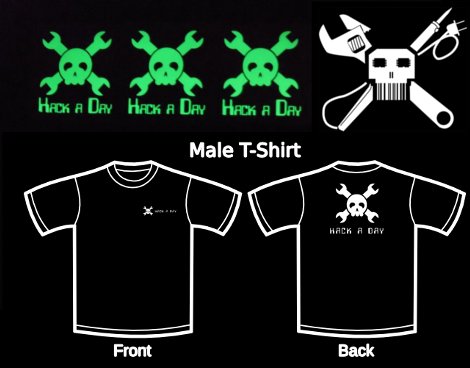
We have also received a steady flow of requests for T-shirts. Unfortunately, we just don’t have all of the equipment yet. So, we’ll begin taking pre-orders for t-shirts today. As soon as we have roughly 30 pre-orders, we should be able to start making the shirts. To begin with, we’ll be doing white logo on black shirts. There’s also a Custom shirt option that gets your name placed on the front of the shirt as well, though that does come at some additional cost. Maybe after he gets all the kinks worked out, [Jakob] will grace us with shirts to sell as well.
There is also a product that has been the source of a lot of discussion between the staff. A new logo, designed by [Caleb]. You can see it above. Some feel that we should adopt it as our new logo, since the old one is kind of a generic biker symbol. The new one reflects a little more what we do. [Phillip Torrone], the founder of Hack a Day and designer of the old one likes it and says ” love it … i say go for it – evolve or die :)”. What do you guys think? Even if it never becomes the site logo, it will be for sale in the store.
[update: Judging by the feedback, we’ll be sticking with our original logo. Custom designs will be available in the store though. Email me directly(caleb@hackaday.com) to discuss getting your design on there. ]