Modular 18650 Packs, No Spot Welding Required

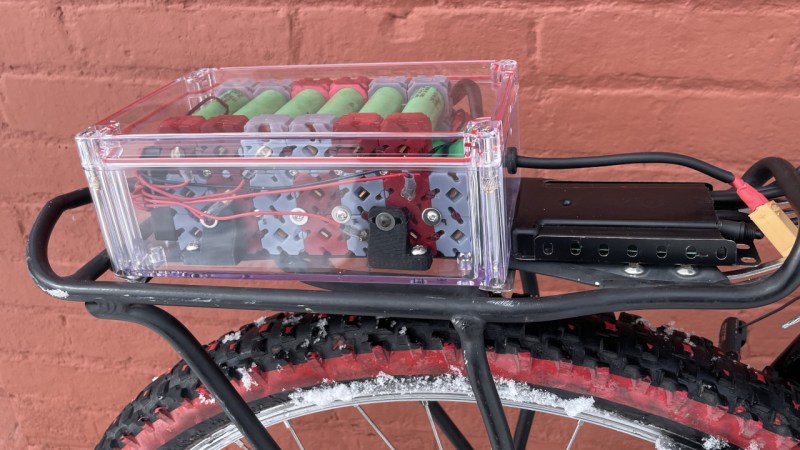
Building a battery pack from 18650 cells traditionally requires patience, a spot welder, and a supply of nickel strip. But what if there was another way? [Ben] is here with Cell-Lock, a modular battery assembly system.

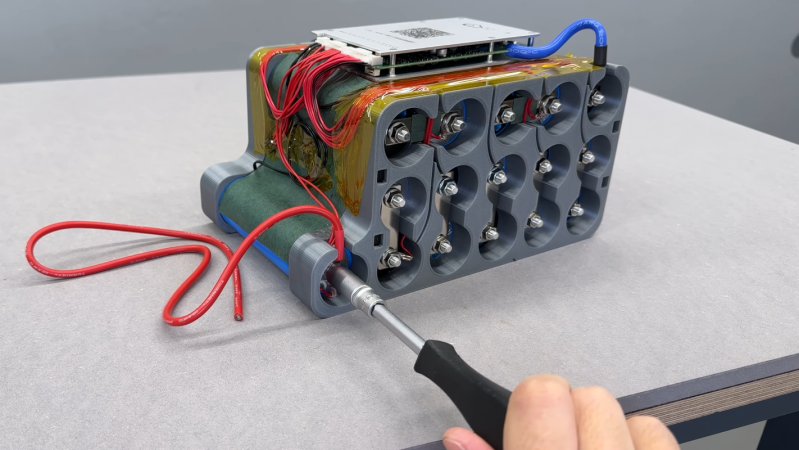
At the system’s heart are a set of interlocking end caps and connection pieces that function as locking cams as well as the electrical connections where needed. They were inspired by the cam systems used for furniture assembly, and are activated by rotation with a screwdriver. The result is a mechanically stable battery system in which different configurations can easily be assembled.
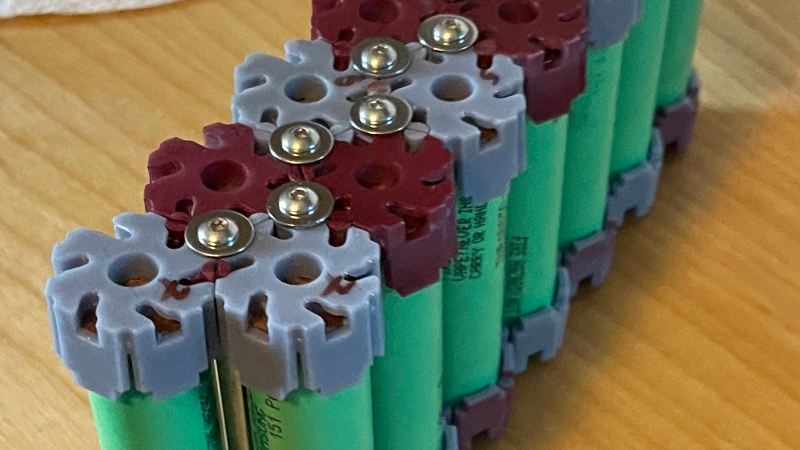
We like that it doesn’t involve any heat near those cells; in part because we’ve seen our share of dodgy connections overheating. But we do have a few concerns. These include how reliable a connection those cams would make, as well as how much current they could safely take without overheating. If both of those could be addressed, we can see that this is an idea with a future.

You can see plenty of examples on the linked project, including an e-bike pack which seems to return no problems. Meanwhile this is by no means the first modular battery pack system we’ve seen.

There’s Always Room For 3D Printed Batteries

There are many applications where you have limits on how much you can cram into a particular space. There are also many applications where you need as much battery as you can get. At the intersection of those applications, you may soon be able to 3D print custom batteries to fit into oddly shaped spaces that might otherwise go to waste.

Commercial batteries are typically cylindrical or rectangular. In theory, you could build tooling to make batteries of any size or shape you want, but it’s an expensive process in small quantities. [Lawrence Ulrich] on Spectrum talks about a new process, developed by [Gabe Elias], that can print anodes, cathodes, separators, and casings for custom battery shapes with no costly tooling.

As an example, consider an unmanned aerial vehicle crammed with avionics. You could put off-the-shelf batteries in the wings, but you’ll end up wasting a lot of space. A custom battery could fill the wing’s interior completely. The post also mentions batteries shaped like the earpieces of a pair of smart glasses.

A prototype showed that in the space of 48 cylindrical cells, the new process could deliver a printed battery that uses 35% more of the available volume and a 50% boost in energy density.

Could you do this yourself? Maybe, but it won’t be trivial. The current process requires a liquid electrolyte and the ability to produce thin layers of exotic materials. What oddly-shaped battery would you like to see? Us? We’d like to have a battery for a laptop that was spread uniformly so there wasn’t a heavy side that has the battery.

Investigating The Science Claims Behind The Donut Solid State Battery

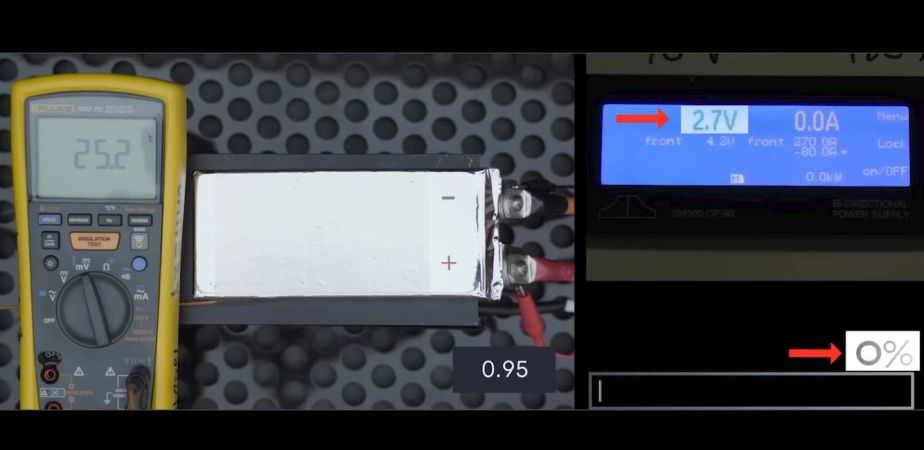
Earlier this year Donut Lab caused quite the furore when they unveiled what they claimed was the world’s first production-ready solid state battery, featuring some pretty stellar specifications. Since then many experts and enthusiasts in the battery space have raised concerns that this claimed battery may not be real, or even possible at all. After seeing the battery demonstrated at CES’26 and having his own concerns, [Ziroth] decided to do some investigating on what part of the stated claims actually hold up when subjected to known science.

On paper, the Donut Lab battery sounds amazing: full charge in less than 10 minutes, 400 Wh/kg energy density, 100,000 charge cycles, extremely safe and low cost. Basically it ticks every single box on a battery wish list, yet the problem is that this is all based on Donut’s own claims. Even aside from the concerns also raised in the video about the company itself, pinning down what internal chemistry and configuration would enable this feature set proves to be basically impossible.

In this summary of research done on Donut’s claimed battery as well as current battery research, a number of options were considered, including carbon nanotube-based super capacitors. Yet although this features 418 Wh/kg capacity, this pertains only to the basic material, not the entire battery which would hit something closer to 50 Wh/kg.

Continue reading “Investigating The Science Claims Behind The Donut Solid State Battery”

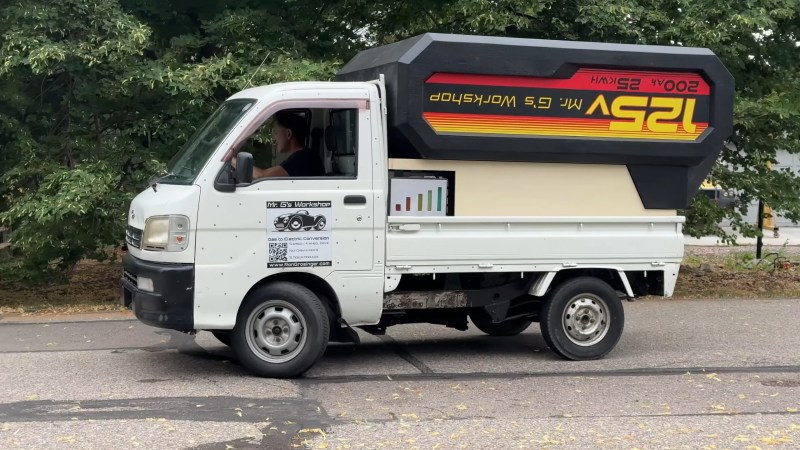
A small white work truck sitting on a faded road with trees in the background. In its bed is what looks like an enormous drill battery in an upside down position. The "battery" is black with red and yellow stripes. It has the words "125V, 500 Ah, 52 kWh" and "Mr. G's Workshop" emblazoned on the side.

Kei Truck Looks Like A Giant Power Tool

Kei trucks are very versatile vehicles, but their stock powerplant can leave a bit to be desired. If you need more power, why not try an electric conversion?

[Ron “Mr. G” Grosinger] is a high school auto shop and welding teacher who worked with his students to replace the 40 hp gas motor in this Daihatsu Hijet with the 127 hp of a Hyper 9 electric motor. The motor sits in the original engine bay under the cab and is mated to the stock transmission with a custom adapter plate made from plate steel for less than $150. We really appreciate how they left all the electronics exposed to see what makes the conversion tick.

The faux battery was made by a foam sculptor friend out of urethane foam shaped with a carving knife and then painted. It slides on a set of unistrut trolleys and reveals the 5 salvaged Tesla battery modules that power the vehicle. The fold down sides of the truck bed allow easy access to anything not already exposed if any tweaking is necessary.

We’ve seen a kei truck become a camper as well or an ebike powered with actual power tool batteries. If you’re thinking of your own electric conversion, which battery is best?

Continue reading “Kei Truck Looks Like A Giant Power Tool”

Lumafield battery quality report cover page

Lumafield Peers Into The 18650 Battery

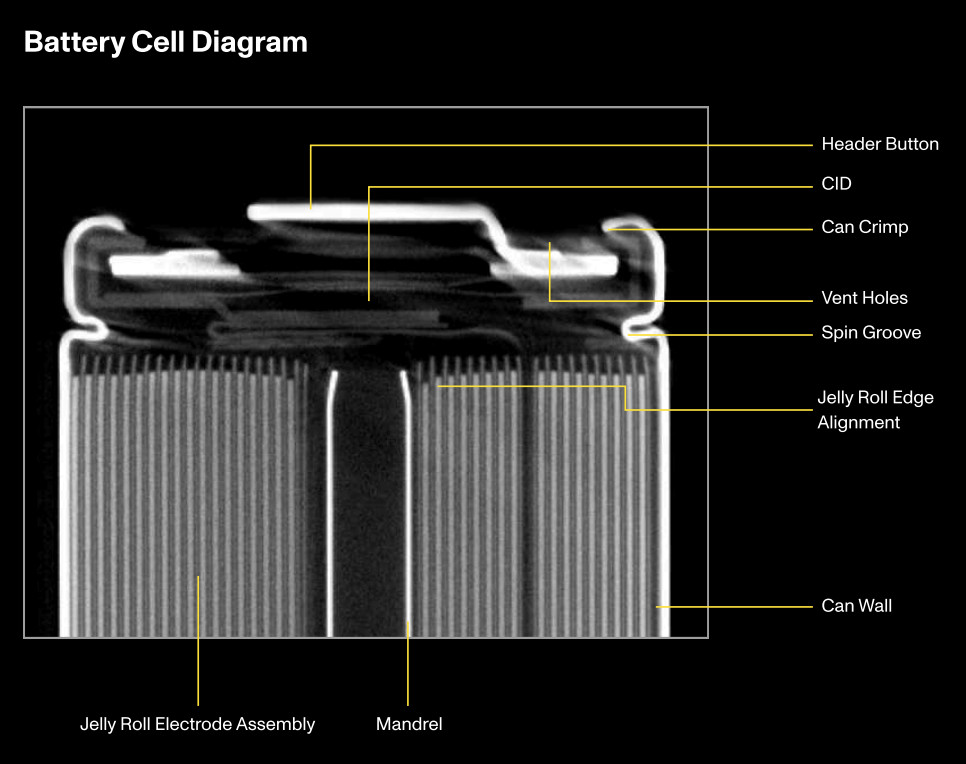
[Alex Hao] and [Andreas Bastian] of Lumafield recently visited with [Adam Savage] to document their findings after performing X-ray computed tomography scans on over 1,000 18650 lithium-ion batteries.

The short version — don’t buy cheap cells! The cheaper brands were found to have higher levels of manufacturing defects which can lead them to being unsafe. All the nitty-gritty details are available in the report, which can be downloaded for free from Lumafield, as well as the Tested video they did with [Adam] below.

Actually we’ve been talking here at Hackaday over at our virtual water-cooler (okay, okay, our Discord server) about how to store lithium-ion batteries and we learned about this cool bit of kit: the BAT-SAFE. Maybe check that out if you’re stickler for safety like us! (Thanks Maya Posch!)

We have of course heard from [Adam Savage] before, check out [Adam Savage] Giving A Speech About The Maker Movement and [Adam Savage]’s First Order Of Retrievability Tool Boxes.

Continue reading “Lumafield Peers Into The 18650 Battery”

Lead Acid Battery Upgraded To Lithium Iron Phosphate

Lithium batteries have taken over as the primary battery chemistry from applications ranging from consumer electronics to electric vehicles and all kinds of other things in between. But the standard lithium ion battery has a few downsides, namely issues operating at temperature extremes. Lead acid solves some of these problems but has much lower energy density, and if you want to split the difference with your own battery you’ll need to build your own lithium iron phosphate (LiFePO4) pack.

[Well Done Tips] is building this specific type of battery because the lead acid battery in his electric ATV is on the decline. He’s using cylindrical cells that resemble an 18650 battery but are much larger. Beyond the size, though, many of the design principles from building 18650 battery packs are similar, with the exception that these have screw terminals so that bus bars can be easily attached and don’t require spot welding.

With the pack assembled using 3D printed parts, a battery management system is installed with the balance wires cleverly routed through the prints and attached to the bus bars. The only problem [Well Done Tips] had was not realizing that LiFePO4 batteries’ voltages settle a bit after being fully charged, which meant that he didn’t properly calculate the final voltage of his pack and had to add a cell, bringing his original 15S1P battery up to 16S1P and the correct 54V at full charge.

LiFePO4 has a few other upsides compared to lithium ion as well, including that it delivers almost full power until it’s at about 20% charge. It’s not quite as energy dense but compared to the lead-acid battery he was using is a huge improvement, and is one of the reasons we’ve seen them taking over various other EV conversions as well.

Continue reading “Lead Acid Battery Upgraded To Lithium Iron Phosphate”

Battle Born LFP Battery Melts With New Problem

Following up on user-reported cases of Battle Born LiFePO4 batteries displaying very hot positive terminals, [Will Prowse] decided to buy a brand new one of these LFP batteries for some controlled cycle testing.

Starting with 30 cycles with a charging current of 49 A and a discharge current of 99 A, this put it well within the 100 A continuous rating for the battery. There is also a surge current rating of 200 A for thirty seconds, but that was not tested here.

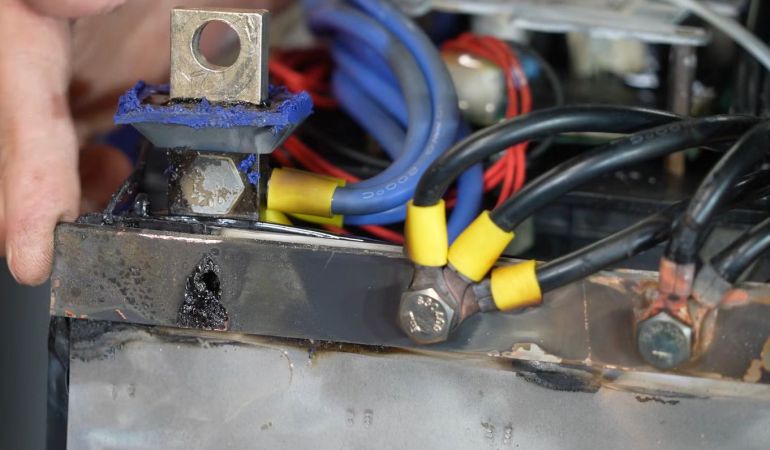
What’s interesting about the results here is that instead of the positive terminal getting visibly discolored as with the previous cases that we reported on, [Will] saw severe thermal effects on the side of the negative terminal to the point where the plastic enclosure was deforming due to severe internal heating.

During testing, the first two charge-discharge cycles showed full capacity, but after that the measured capacity became extremely erratic until the battery kept disconnecting randomly. After letting the battery cool down and trying again with 80 A discharge current the negative terminal side of the enclosure began to melt, which was a good hint to stop testing. After this the battery also couldn’t be charged any more by [Will]’s equipment, probably due to the sketchy contact inside the battery.

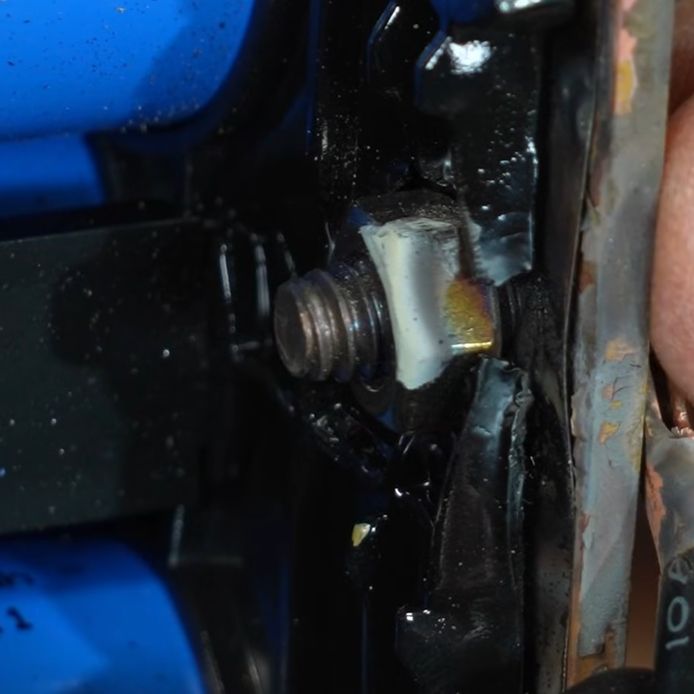
It’s clear that the plastic spacer inside the terminal bus bar was once again the primary cause, starting a cascade which resulted in not only the enclosure beginning to char and melt, but with heat damage visible throughout the battery. Considering that the battery was used as specified, without pushing its limits, it seems clear that nobody should be using these batteries for anything until Battle Born fixes what appears to be the sketchiest terminal and bus bar design ever seen in a high-current battery.

Continue reading “Battle Born LFP Battery Melts With New Problem”