Electric Vehicles, The Gasoline Problem, And Synthetic Fuels

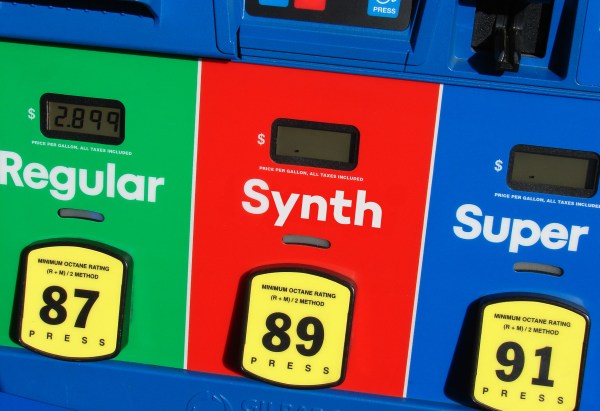
When you’re standing at the gas station filling up your car, watching those digits on the pump flip by can be a sobering experience. Fuel prices, especially the price of gasoline, have always been keenly watched, so it’s hard to imagine a time when gasoline was a low-value waste product. But kerosene, sold mainly for lighting, was once king of the petroleum industry, at least before the automobile came along, to the extent that the gasoline produced while refining kerosene was simply dumped into streams to get rid of it.

The modern mind perhaps shudders at the thought of an environmental crime of that magnitude, and we can’t imagine how anyone would think that was a good solution to the problem. And yet we now face much the same problem, as the increasing electrification of the world’s fleet of motor vehicles pushes down gasoline demand. To understand why this is a problem, we’ll start off by taking a look at how crude oil is formed, and how decreasing demand for gasoline may actually cause problems that we should think about before we get too far down the road.

Continue reading “Electric Vehicles, The Gasoline Problem, And Synthetic Fuels”
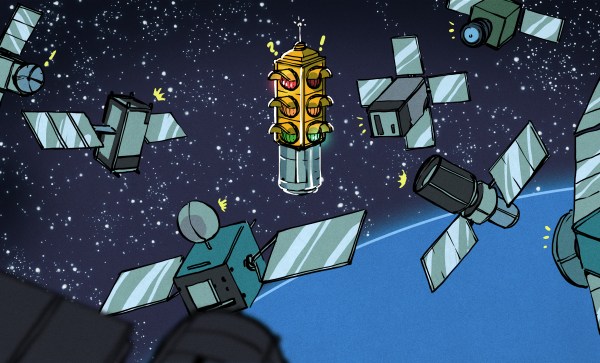
Space Age Road Rage: Right Of Way Above The Karman Line

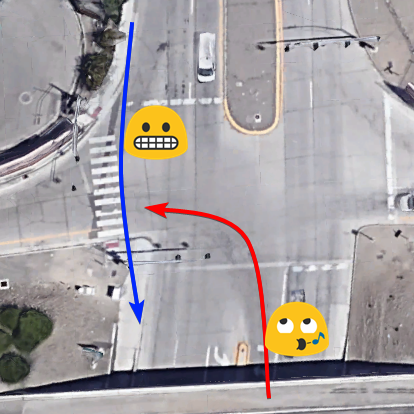
On a dark night in 2006 I was bicycle commuting to my office, oblivious to the countless man made objects orbiting in the sky above me at thousands of miles per hour. My attention was instead focused on a northbound car speeding through a freeway underpass at dozens of miles per hour, oblivious to my southbound headlamp. The car swerved into the left turn lane to get to the freeway on-ramp. The problem? I was only a few feet from crossing the entrance to that very on-ramp! As the car rushed through their left turn I was presented with a split second decision: slow, and possibly stop in the middle of the on-ramp, or just go for it and hope for the best.

A graphic depicting a dawdling bicycle rider about to be in the way of a speeding car driver
In Blue: Terrified cyclist. In Red: A speeding car careening around a corner without slowing down.

By law I had the right of way. But this was no time to start discussing right of way with the driver of the vehicle that threatened to turn me into a dark spot on the road. I followed my gut instinct, and my legs burned in compliance as I sped across that on-ramp entrance with all my might. The oncoming car missed my rear wheel by mere feet! What could have ended in disaster and possibly even death had resulted in a near miss.

Terrestrial vehicles generally have laws and regulations that specify and enforce proper behavior. I had every right to expect the oncoming car be observant of their surroundings or to at least slow to a normal speed before making that turn. In contrast, traffic control in Earth orbit conjures up thoughts of bargain-crazed shoppers packed into a big box store on Black Friday.

So is spacecraft traffic in orbit really a free-for-all? If there were stringent rules, how can they be enforced? Before we explore the answers to those questions, let’s examine the problem we’re here to discuss: stuff in space running into other stuff in space.

Continue reading “Space Age Road Rage: Right Of Way Above The Karman Line”

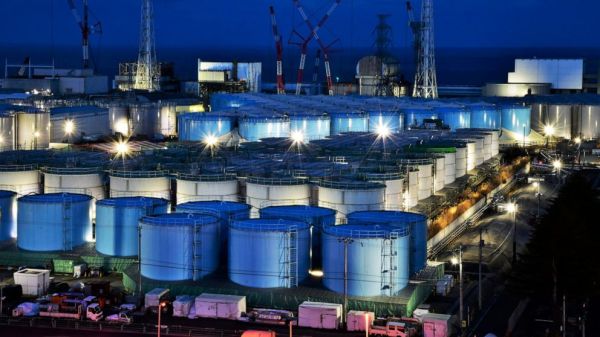
Fukushima Daiichi at night

A Tritium Story: How Afraid Should You Be Of Hydrogen’s Big Brother?

Despite being present in everything that contains water, tritium is not an isotope that many people were that familiar with outside of select (geeky) channels, such as DEF CON with a tritium-containing badge, the always excellent NurdRage’s assembly of a tritium-based atomic battery, or the creation of a tritium-phosphor-based glow-in-the-dark tesseract cube.

Tritium is a hydrogen isotope that shares a lot of characteristics with its two siblings: 1H (protium) and 2H (deuterium), with the main distinction being that tritium (3H) is not a stable isotope, with a half-life of ~12.32 years that sees it decay into 3He. Most naturally occurring tritium on Earth originates from interactions between fast neutrons (>4.0 MeV) from cosmic radiation and atmospheric nitrogen.

Recently tritium has become a politically hot topic on account of the announced release of treated water at the Japanese Fukushima Daiichi nuclear plant. This has raised for many the question of just how much tritium is ‘too much’ and what we’re likely to notice from this treated — but still tritium-containing water — being released into the ocean.

Continue reading “A Tritium Story: How Afraid Should You Be Of Hydrogen’s Big Brother?”

Things Are Looking Brighter! But Not The Stars

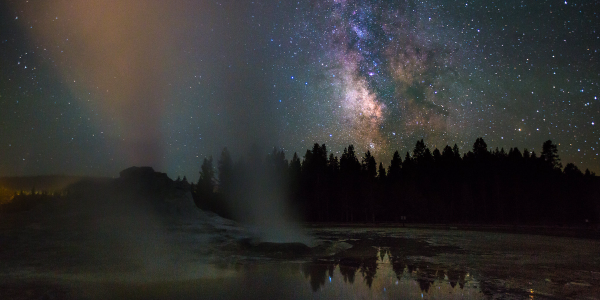
Growing up in Montana I remember looking out at night and seeing the Milky Way, reminding me of my insignificance in the universe. Now that I live in a city, such introspection is no longer easy, and like 1/2 of humanity that also lives in urban areas, I must rely on satellites to provide the imagery. Yet satellites are part of the problem. Light pollution has been getting worse for decades, and with the recent steady stream of satellite launches and billionaire joyrides we have a relatively new addition to the sources of interference. So how bad is it, and how much worse will it get?

Looking up at the night sky, you can usually tell the difference between various man-made objects. Planes go fairly slowly across the sky, and you can sometimes see them blinking green and red. Meteors are fast and difficult to see. Geostationary satellites don’t appear to move at all because they are orbiting at the same rate as earth’s rotation, while other orbit types will zip by.

SpaceX has committed to reducing satellite brightness, and some observations have confirmed that new models are a full magnitude darker, right at the threshold of naked-eye observation. Unfortunately, it’s only a step in the right direction, and not enough to satisfy astronomers, who aren’t looking up at the night sky with their naked eyes, naturally.

The satellites aren’t giving off the light themselves. They are merely reflecting the light from the sun back to the earth, exactly the same way the moon is. Thus something that is directly in the shadow of the Earth will not reflect any light, but near the horizon the reflection from the satellites can be significant. It’s not practical to only focus our observatories in the narrow area that is the Earth’s shadow during the night, so we must look closer to the horizon and capture the reflections of the satellites. Continue reading “Things Are Looking Brighter! But Not The Stars”

Counting Down To The Final Atlas Rocket

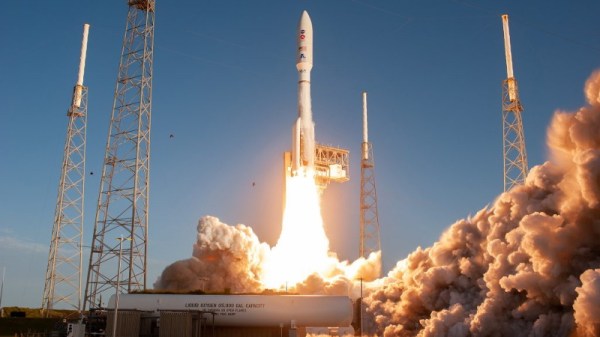
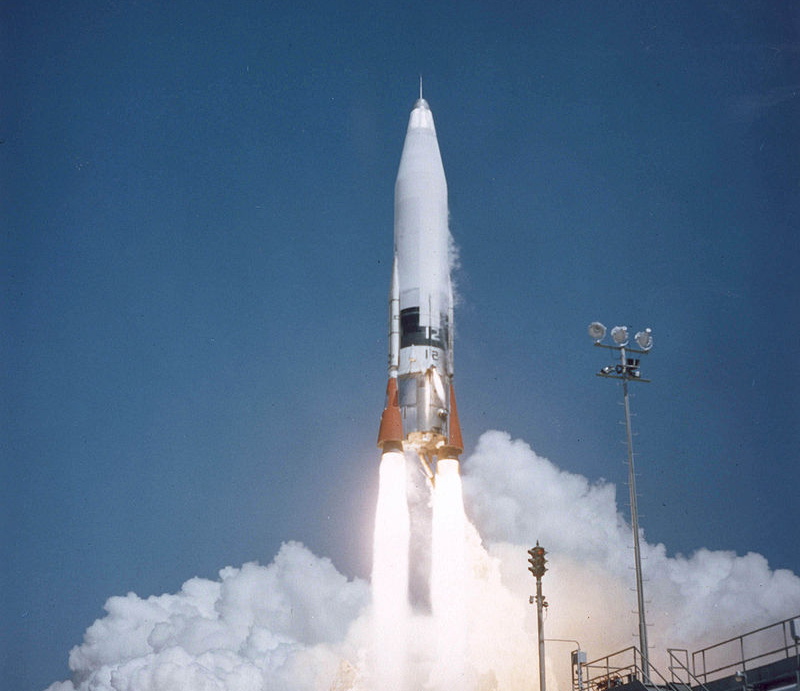
The Atlas family of rockets have been a mainstay of America’s space program since the dawn of the Space Age, when unused SM-65 Atlas intercontinental ballistic missiles (ICBMs) were refurbished and assigned more peaceful pursuits. Rather than lobbing thermonuclear warheads towards the Soviets, these former weapons of war carried the first American astronauts into orbit, helped build the satellite constellations that our modern way of life depends on, and expanded our knowledge of the solar system and beyond.

SM-65A Atlas ICBM in 1958

Naturally, the Atlas V that’s flying today looks nothing like the squat stainless steel rocket that carried John Glenn to orbit in 1962. Aerospace technology has evolved by leaps and bounds over the last 60 years, but by carrying over the lessons learned from each generation, the modern Atlas has become one of the most reliable orbital boosters ever flown. Since its introduction in 2002, the Atlas V has maintained an impeccable 100% success rate over 85 missions.

But as they say, all good things must come to an end. After more than 600 launches, United Launch Alliance (ULA) has announced that the final mission to fly on an Atlas has been booked. Between now and the end of the decade, ULA will fly 28 more missions on this legendary booster. By the time the last one leaves the pad the company plans to have fully transitioned to their new Vulcan booster, with the first flights of this next-generation vehicle currently scheduled for 2022.

Continue reading “Counting Down To The Final Atlas Rocket”

NASA Sets Eyes On Deep Space With Admin Shuffle

Since the Apollo 17 crew returned from the Moon in 1972, human spaceflight has been limited to low Earth orbit (LEO). Whether they were aboard Skylab, Mir, the Space Shuttle, a Soyuz capsule, or the International Space Station, no crew has traveled more than 600 kilometers (372 miles) or so from the Earth’s surface in nearly 50 years. Representatives of the world’s space organizations would say they have been using Earth orbit as a testing ground for the technology that will be needed for more distant missions, but those critical of our seemingly stagnated progress into the solar system would say we’ve simply been stuck.

Many have argued that the International Space Station has consumed an inordinate amount of NASA’s time and budget, making it all but impossible for the agency to formulate concrete plans for crewed missions beyond Earth orbit. The Orion and SLS programs are years behind schedule, and the flagship deep space excursions that would have utilized them, such as the much-touted Asteroid Redirect Mission, never materialized. The cracks are even starting to form in the Artemis program, which appears increasingly unlikely to meet its original goal of returning astronauts to the Moon’s surface by 2024.

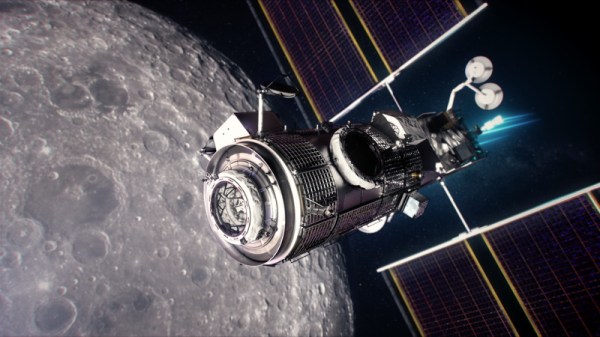
But with the recent announcement that NASA will be splitting the current Human Exploration and Operations Mission Directorate into two distinct groups, the agency may finally have the administrative capacity it needs to juggle their existing LEO interests and deep space aspirations. With construction of the ISS essentially complete, and the commercial spaceflight market finally coming together, the reorganization will allow NASA to start shifting the focus of their efforts to more distant frontiers such as the Moon and Mars.

Continue reading “NASA Sets Eyes On Deep Space With Admin Shuffle”

The Coming Copper Shortage: Aluminium Or Carbon Nanotubes To The Rescue?

The use of aluminium in wiring is unlikely to bring a smile to the face of anyone who has had to deal with it in a 1960s, or early 1970s-era house. The causes behind the fires and other accidents were myriad, including failure to deal with the higher thermal expansion of aluminium, the electrically insulating nature of aluminium oxide, and the general brittleness of aluminium when twisted.

Yet while copper is superior to aluminium in terms of electrical conductivity and ease of installation, copper prices have skyrocketed since the 1970s, and are on the verge of taking off to the moon. A big part of the reason is the increased use of copper in everything from electronics and electrical motors to generators, driven by large-scale deployment of wind turbines and electrical vehicles.

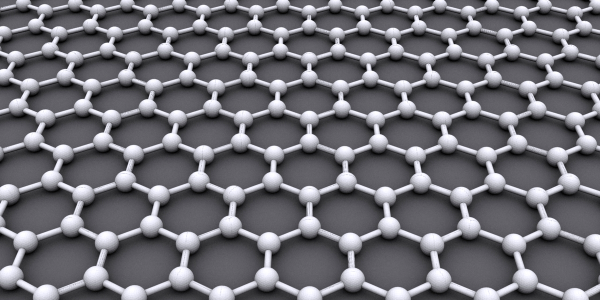
As the world moves to massively expand the use of electrical cars and installation of wind turbines, copper demand is predicted to outstrip current copper supply. With aluminium likely to make a big return as a result, it’s worth taking a look at modern-day aluminium-based wiring, including copper-clad aluminium and the use of carbon-based replacements. Continue reading “The Coming Copper Shortage: Aluminium Or Carbon Nanotubes To The Rescue?”