The desire to innovate and change the world can drive one to take dangerous risks. Sometimes, inventors pay the ultimate price. Inventors can be early testers of a device under development, and sometimes pushing the limits of what’s possible has deadly consequences. In this era of warning labels on coffee cups, it’s perhaps worth taking a look back at some inventors of the past who lost their lives in the pursuit of building something new.
Hackaday Columns4822 Articles
This excellent content from the Hackaday writing crew highlights recurring topics and popular series like Linux-Fu, 3D-Printering, Hackaday Links, This Week in Security, Inputs of Interest, Profiles in Science, Retrotechtacular, Ask Hackaday, Teardowns, Reviews, and many more.
Friday Hack Chat: Audio Systems
Join us this Friday for a Hack Chat on Audio Systems. It’s going down June 2 at noon PDT (handy time zone converter thing).
Every Friday, we gather round the campfire with the best in the business to tease out whatever secrets are stored in their mind. This is the Hack Chat, and this week, we’re going to be talking about audio systems with [Dafydd Roche]. Bring your low-distortion volume knobs and porcelain speaker cable risers, this is going to be a good one.
[Dafydd] got his start in electronics in an application for a music degree. He mentioned he’d built a few guitar pedals, which landed him a call from the electronics department at York University. They told him he was a terrible musician, but that he might excel at electronics.
Many years later he’s still going strong with audio applications with Expat Audio, manufacturers of fine preamps. [Dafydd] is also the Audio Strategic Marketing Manager at Dialog, and spends his days arguing with engineers and doing his best to solve customer problems. [Dafydd] has been on The Amp Hour, and has published articles on audio systems.
For this Hack Chat, we’re going to be running the gamut of audio, electronics, and small business. The questions on audio mythbusting are sure to entertain, and we’ll also be discussing audio signal chains and small business production. Bring your questions and put them on the sheet to guide the discussion.
Here’s How To Take Part:
Our Hack Chats are live community events on the Hackaday.io Hack Chat group messaging.
Log into Hackaday.io, visit that page, and look for the ‘Join this Project’ Button. Once you’re part of the project, the button will change to ‘Team Messaging’, which takes you directly to the Hack Chat.
You don’t have to wait until Friday; join whenever you want and you can see what the community is talking about
Retrotechtacular: The Transistor (1953 Film)
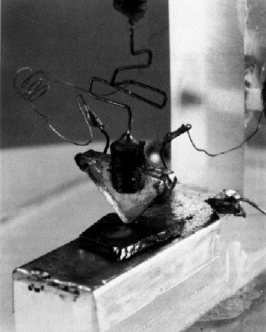
If we cast our minds back to the early years of the transistor, the year that is always quoted is 1947, during which a Bell Labs team developed the first practical germanium point-contact transistor. They would go on to be granted the Nobel Prize for their work in 1956, but the universal adoption of their invention was not an instantaneous process. Instead there would be a gradual change from vacuum to solid state that would span the 1950s and the 1960s, and even in the 1970s you might still have found mainstream devices on sale containing vacuum tubes.

To speed up this process, Bell Labs made every effort to publicize their invention. Thus we come to our subject today, their 1953 publicity film The Transistor, in which the electronics industry of the era is described and how each part of it might revolutionize by the transistor is laid out.
We start with a look at a selection of electronic components, among which are a few transistors. The point contact device is already described as superceded by the junction transistor, but as well as those two we are shown a phototransistor and a junction tetrode, a now-obsolete design that had two base connections.
Unexpectedly we don’t dive straight into the world of transistors, but take a look back at the earlier years of the century to the development of vacuum electronics. We’re taken through the early development and operation of vacuum tubes, then their use in long-distance radio communications, through the advent of electronics in mass entertainment, and finally into the world of radar and microwave links. Only then do we return to the transistor, with a posed shot of [John Bardeen], [William Shockley], and [Walter Brattain] hard at work in a lab. The merits of the transistor as opposed to the tube are then set out, though we can’t help wondering whether they have confused a milliwatt and a microwatt when they describe the transistor as requiring only a millionth of a watt to operate.
Continue reading “Retrotechtacular: The Transistor (1953 Film)”
Hackaday Links: May 28, 2017
Boeing and DARPA are building a spaceplane. Right now it’s only a press release and a few concept images, but it looks like this is an air-launched system kind of like a Tristar/Pegasus, only much higher and completely unmanned. It’s a ton and a half to low earth orbit, with a goal of 10 flights in 10 days.
Up in Albany? There’s a new hacker con happening in a few weeks. Anycon is a hacking, infosec, and cyber security conference happening June 16 & 17th in Albany, NY. The organizers of this con ([Chris], and his company Leet Cybersecurity) are loosely modeling this con after Derbycon. [Dave Kennedy] of TrustedSec will be attending as the keynote speaker.
GOOD NEWS! [Casey Neistat] is under investigation by the FAA. [Casey Neistat] is the YouTuber that flies drones right in the middle of the Hudson River corridor, and is a menace to general aviation around NYC.
This is neat. The Supplyframe Design Lab is the Hackaday Mothership right in the middle of Pasadena where we host our designers in residence, host a few meetups, and slowly fill every cubic inch of space with either dust or tools. The Design Lab just won a design award. You can check out the ‘design’ part of the Design Lab here, but keep in mind it will never be that clean ever again.
Here’s an interesting Twitter to follow. Alitronik is a curator of the weird and wonderful cheap crap that can be found on AliExpress. Need an Altera Cyclone dev board? Here you go. A desk-mountable OLED inspection microscope? Done. A seven dollar Tesla coil? Dude, you can totally fit this inside a hat.
[Drygol] had a nice old Commodore C16 with a broken TED chip. A shame, really. He did what anyone would do: put a C64 motherboard in the case for a fancy stealth upgrade.
Is the great crowdfunded 3D printer boom over? Some would say that ship sailed after dozens of 3D printer crowdfunding projects failed to deliver, or delivered very low-quality machines. These people were wrong. This Polaroid-branded 3D printing pen might not get funding. A year ago, this project would have been funded on day one. There would have been writeups in The Verge on how Polaroid is turning the corner after decades of wasted opportunities. Now, the Crowdfunded 3D printer boom is finally over.
The Hackaday crew was at the Bay Area Maker Faire last weekend and holy crap did we have a blast. Everyone came to the meetup on Saturday except for the fire marshall. The secret OSHPark bringahack on Sunday was even more impressive. We also saw a Donkey Car capable of driving around a track autonomously, but the team behind it didn’t have their work up on the Internet at the time.
Embed With Elliot: LIN Is For Hackers
A car is a rolling pile of hundreds of microcontrollers these days — just ask any greybeard mechanic and he’ll start his “carburetor” rant. All of these systems and sub-systems need to talk to each other in an electrically hostile environment, and it’s not an exaggeration to say that miscommunication, or even delayed communication, can have serious consequences. In-car networking is serious business. Mass production of cars makes many of the relevant transceiver ICs cheap for the non-automotive hardware hacker. So why don’t we see more hacker projects that leverage this tremendous resource base?
The backbone of a car’s network is the Controller Area Network (CAN). Hackaday’s own [Eric Evenchick] is a car-hacker extraordinaire, and wrote up most everything you’d want to know about the CAN bus in a multipart series that you’ll definitely want to bookmark for reading later. The engine, brakes, doors, and all instrumentation data goes over (differential) CAN. It’s fast and high reliability. It’s also complicated and a bit expensive to implement.
In the late 1990, many manufacturers had their own proprietary bus protocols running alongside CAN for the non-critical parts of the automotive network: how a door-mounted console speaks to the door-lock driver and window motors, for instance. It isn’t worth cluttering up the main CAN bus with non-critical and local communications like that, so sub-networks were spun off the main CAN. These didn’t need the speed or reliability guarantees of the main network, and for cost reasons they had to be simple to implement. The smallest microcontroller should suffice to roll a window up and down, right?
In the early 2000s, the Local Interconnect Network (LIN) specification standardized one approach to these sub-networks, focusing on low cost of implementation, medium speed, reconfigurability, and predictable behavior for communication between one master microcontroller and a small number of slaves in a cluster. Cheap, simple, implementable on small microcontrollers, and just right for medium-scale projects? A hacker’s dream! Why are you not using LIN in your multiple-micro projects? Let’s dig in and you can see if any of this is useful for you. Continue reading “Embed With Elliot: LIN Is For Hackers”
Music Reading For Machines
“Dammit Jim, I’m a hacker, not a musician!”, to paraphrase McCoy Scotty from the original Star Trek series. Well, some of us are also musicians, some, like me, are also hack-musicians, and some wouldn’t know a whole note from a treble clef. But every now and then the music you want is in the form of sheet music and you need to convert that to something your hack can play. If you’re lucky, you can find software that will read the sheet music for you and spit out a MIDI or WAV file. Or, as with my hand-cranked music player, you may have to read just enough of the music yourself to convert musical notes to frequencies for something like a 555 timer chip. We’ll dive into both cases here.
Friday Hack Chat: Antiquated Technologies With Fran Blanche
Join us this Friday for a Hack Chat on antiquated technologies.
Every Friday, we round up someone from the hardware scene and sit them down in front of a keyboard to discuss what they’re working on. This week, we’re talking with [Fran Blanche] to discuss ancient technologies, weird electronics, and everything that goes into building a hardware company from the ground up.

Who’s [Fran Blanche], you might ask? She’s a self-taught electronic engineer, artist, musician, photographer, mechanical engineer, and YouTube vlogger. She’s the founder of Frantone Electronics, one of the very first manufacturers of boutique guitar effects. Her Peachfuzz is one of the very, very few original distortion/fuzz circuits out there. She’s given talks at Brown University on the boutique effects industry, worked with the Franklin Institute on the Maillardet Automaton, wandered around the largest musical instrument, taken apart flight hardware from the Saturn V just to see how it works, and she’s been inside the warehouse for the Smithsonian’s Air and Space museum.
With a resume of work this cool, what’s [Fran] working on now? She’s trying to recreate the DSKY from the Apollo Guidance Computer. The DSKY is the user interface for the Apollo Guidance Computer, a wonderful block of aluminum studded with beautiful buttons and electroluminescent displays. For the last few years, her attempts to reproduce a modern DSKY — including the custom segmented EL display — has been on the back burner, but now [Fran] is attempting to raise the money for a reproduction on GoFundMe. I encourage you all to at least look at that GoFundMe campaign.
Here’s How To Take Part:

Our Hack Chats are live community events on the Hackaday.io Hack Chat group messaging.
Log into Hackaday.io, visit that page, and look for the ‘Join this Project’ Button. Once you’re part of the project, the button will change to ‘Team Messaging’, which takes you directly to the Hack Chat.
You don’t have to wait until Friday; join whenever you want and you can see what the community is talking about.