This excellent content from the Hackaday writing crew highlights recurring topics and popular series like Linux-Fu, 3D-Printering, Hackaday Links, This Week in Security, Inputs of Interest, Profiles in Science, Retrotechtacular, Ask Hackaday, Teardowns, Reviews, and many more.
The VCF East is the largest gathering of retrocomputing aficionados on the east coast. It’s three days of talks, exhibits, a flea market, and a pow-wow of the greatest minds buried under obsolete technology. No VCF is complete without a few talks, and this year is shaping up to be great. Keynotes will include [Bjarne Stroustrup], designer / implementor / inventor of C++. Computer historian [Bill Degnan] will give a review of 40 years of ‘appliance computers’, and [Tom Perera], Ph.D. will be giving a talk on the Enigma machine.
The exhibits at VCF are always the star of the show, and this year is no different. Highlights include mechanical computers, the finest from Silicon Graphics, and a version of Unix published by Microsoft. The individual exhibits are always great; last year the world’s first digital camera made an appearance. If you’re in the area, this isn’t an event to miss. VCF is going down at InfoAge, a science center at the former Camp Evans — a military installation that is best described as, ‘DARPA before World War II’.
Hackaday is proud to once again sponsor VCF East. This has been going on for a couple of years now and our Art Director, [Joe Kim] has created some incredible art as part of the sponsorship. Click on the thumbnail of this year’s art to embiggen. The VCF West art from last year is a stunning take on the Macintosh and last year’s VCF East art reflected the retro hackathon we sponsored.
The nuclear age changed steel, and for decades we had to pay the price for it. The first tests of the atomic bomb were a milestone in many ways, and have left a mark in history and in the surface of the Earth. The level of background radiation in the air increased, and this had an effect on the production of steel, so that steel produced since 1945 has had elevated levels of radioactivity. This can be a problem for sensitive instruments, so there was a demand for steel called low background steel, which was made before the trinity tests.
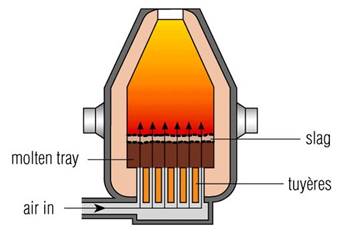
The Bessemer process pumps air through the iron to remove impurities. shropshirehistory.com
The production of steel is done with the Bessemer process, which takes the molten pig iron and blasts air through it. By pumping air through the steel, the oxygen reacts with impurities and oxidizes, and the impurities are drawn out either as gas or slag, which is then skimmed off. The problem is that the atmospheric air has radioactive impurities of its own, which are deposited into the steel, yielding a slightly radioactive material. Since the late 1960s steel production uses a slightly modified technique called the BOS, or Basic Oxygen Steelmaking, in which pure oxygen is pumped through the iron. This is better, but radioactive material can still slip through. In particular, we’re interested in cobalt, which dissolves very easily in steel, so it isn’t as affected by the Bessemer or BOS methods. Sometimes cobalt is intentionally added to steel, though not the radioactive isotope, and only for very specialized purposes.
Recycling is another reason that modern steel stays radioactive. We’ve been great about recycling steel, but the downside is that some of those impurities stick around.
Why Do We Need Low Background Steel?
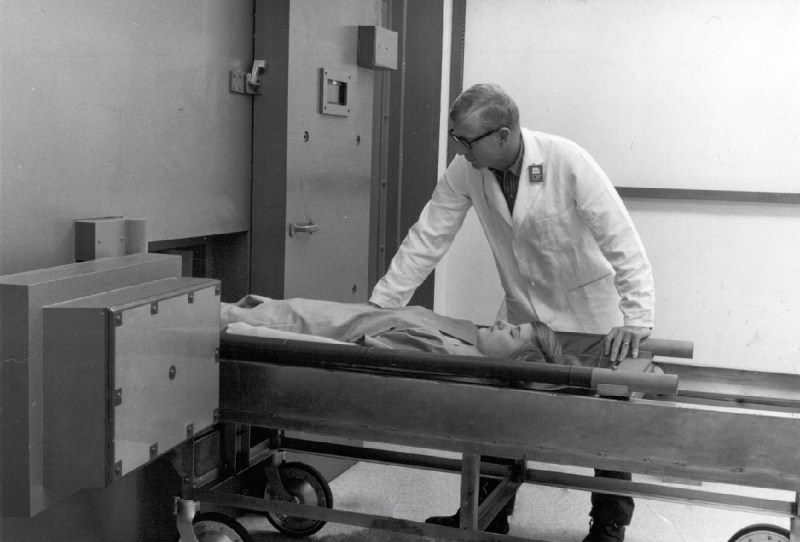
Imagine you have a sensor that needs to be extremely sensitive to low levels of radiation. This could be Geiger counters, medical devices, or vehicles destined for space exploration. If they have a container that is slightly radioactive it creates an unacceptable noise floor. That’s where Low Background Steel comes in.
A person is placed into a low background steel container with sensitive equipment to measure the radioactivity of the body, which may be near the background level. Photo from orau.org
So where do you get steel, which is a man-made material, that was made before 1945? Primarily from the ocean, in sunken ships from WWII. They weren’t exposed to the atomic age air when they were made, and haven’t been recycled and mixed with newer radioactive steel. We literally cut the ships apart underwater, scrape off the barnacles, and reuse the steel.
Fortunately, this is a problem that’s going away on its own, so the headline is really only appropriate as a great reference to a popular movie. After 1975, testing moved underground, reducing, but not eliminating, the amount of radiation pumped into the air. Since various treaties ending the testing of nuclear weapons, and thanks to the short half-life of some of the radioactive isotopes, the background radiation in the air has been decreasing. Cobalt-60 has a half-life of 5.26 years, which means that steel is getting less and less radioactive on its own (Cobalt-60 from 1945 would now be at .008% of original levels). The newer BOS technique exposes the steel to fewer impurities from the air, too. Eventually the need for special low background steel will be just a memory.
Oddly enough, steel isn’t the only thing that we’ve dragged from the bottom of the ocean. Ancient Roman lead has also had a part in modern sensing.
PoC||GTFO 14 is now out. It’s a 40 MB PDF that’s also a Nintendo Entertainment System ROM, and a Zip archive. Pastor Laphroaig Screams High Five To The Heavens As The Whole World Goes Under. Download this, but don’t link – host it yourself. Bitrot will be the end of us all.
[Photonicinduction] is back. The guy best known for not starting an electrical fire in his attic has been working through some stuff recently. He got married, went to India, and he’s going to try to blow a five thousand amp fuse. Good on him.
There’s a certain segment of the Internet that believes the Raspberry Pi Zero doesn’t exist. The logic goes something like this: because I can’t buy a Ferrari right now, Ferraris don’t exist. Now there’s a new and improved website that checks if the Pi Zero and Pi Zero W are in stock: thepilocator.com. It checks a dozen or so online stores for the Pi Zero and Pi Zero W. Guess what? They’re mostly in stock.
[bxcounter] built a PC case and holy crapthis thing is incredible. This case is made out of Paulownia wood, and is made up out of fifty pieces held together with magnets. This thing is hand-carved and looks fantastic. Inside is a Mini-ITX motherboard, an i3, a Gigabyte ITX-sized 1060, and an SSD. It’s no powerhouse, but then again it’s not overkill, either. This is a fantastic addition to any battlestation.
As most hackerspaces do, the Omaha Maker Group had a storage problem. Previously, members used plastic totes someone picked up as surplus, but these totes were in short supply. Banker’s Boxes are a better idea, but how to store them? A box case. This ‘bookcase for boxes’ holds 21 standard Banker’s Boxes and only uses two full sheets of MDF in its construction.
It is widely accepted that Gutenberg’s printing press revolutionized thought in Europe and transformed the Western world. Prior to the printing press, books were rare and expensive and not generally accessible. Printing made all types of written material inexpensive and plentiful. You may not think about it, but printing–or, at least, printing-like processes–revolutionized electronics just as much.
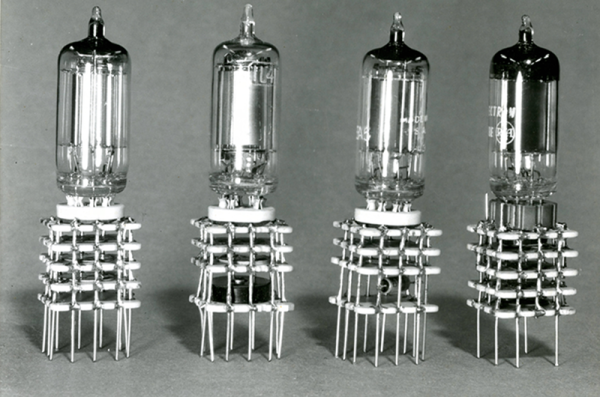
In particular, the way electronics are built and the components we use have changed a lot since the early 1900s when the vacuum tube made amplification possible. Of course, the components themselves are different. Outside of some specialty and enthusiast items, we don’t use many tubes anymore. But even more dramatic has been how we build and package devices. Just like books, the key to lowering cost and raising availability is mass production. But mass producing electronic devices wasn’t always as easy as it is today.
Hackaday has been expanding into all kinds of new areas. We find ourselves stretched a bit thin and it’s time to ask for help. Want to lend a hand while making some extra dough to plow back into your projects? These are work-from-home (or wherever you like) positions and we’re looking for awesome, motivated people to help guide Hackaday forward!
Contributors are hired as private contractors and paid for each post. You should have the technical expertise to understand the projects you write about, and a passion for the wide range of topics we feature. If you’re interested, please email our jobs line, and include:
Details about your background (education, employment, etc.) that make you a valuable addition to the team
Links to your blog/project posts/etc. which have been published on the Internet
One example post written in the voice of Hackaday. Include a banner image, at least 150 words, the link to the project, and any in-links to related and relevant Hackaday features
What are you waiting for? Ladies and Gentlemen, start your applications!
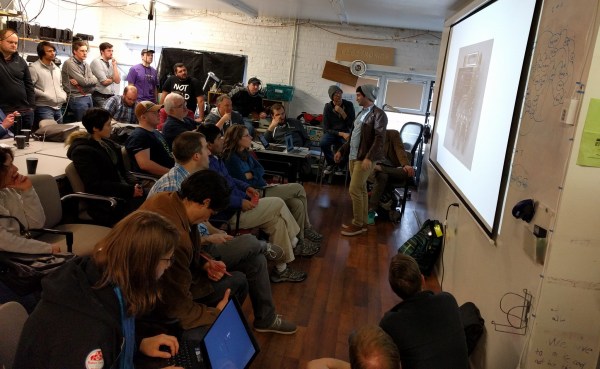
On Saturday the Hackaday community turned out in force to try something new. The first Hackaday Unconference was held in three places at the same time, and I was in Chicago and was amazed at the turnout and variety of presentations. The image above sums up the concept quite well, everyone shows up ready to give an eight minute talk, but as a whole, no one knows what to expect. Well, we should have known to expect awesome and that’s what we got.
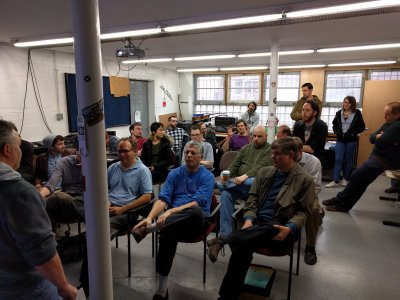
As usual, people are excellent… to one another and in adapting to the fluid nature of the day. Pumping Station: One, a renowned Hackerspace in the Avondale neighborhood near downtown Chicago, opened their doors for us. Not knowing how many people to expect we set up two presentation rooms with a third on deck just in case it was needed.
We just barely squeezed everyone in one room for the first track but ended up splitting into two for part of the day. Here you can see that second room filling up. Even so we still had a handful of presentations that didn’t get a chance to shine — we simply must do this again so they can have the chance and because I had such a great time!
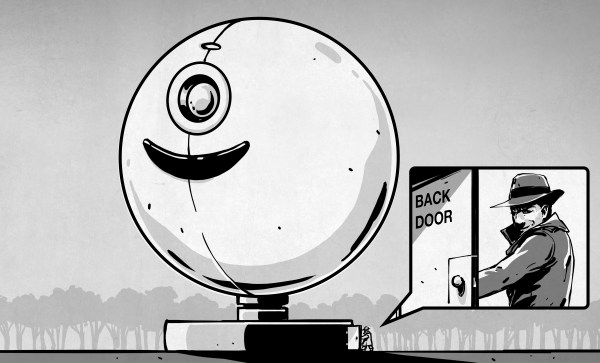
We all know that what we mean by hacker around here and what the world at large thinks of as a hacker are often two different things. But as our systems get more and more connected to each other and the public Internet, you can’t afford to ignore the other hackers — the black-hats and the criminals. Even if you think your data isn’t valuable, sometimes your computing resources are, as evidenced by the recent attack launched from unprotected cameras connected to the Internet.
As [Elliot Williams] reported earlier, Trustwave (a cybersecurity company) recently announced they had found a backdoor in some Chinese voice over IP gateways. Apparently, they left themselves an undocumented root password on the device and — to make things worse — they use a proprietary challenge/response system for passwords that is insufficiently secure. Our point isn’t really about this particular device, but if you are interested in the details of the algorithm, there is a tool on GitHub, created by [JacobMisirian] using the Trustwave data. Our interest is in the practice of leaving intentional backdoors in products. A backdoor like this — once discovered — could be used by anyone else, not just the company that put it there.


 The VCF East is the largest gathering of retrocomputing aficionados on the east coast. It’s three days of talks, exhibits, a flea market, and a pow-wow of the greatest minds buried under obsolete technology. No VCF is complete without a few talks, and this year is shaping up to be great. Keynotes will include [Bjarne Stroustrup], designer / implementor / inventor of C++. Computer historian [Bill Degnan] will give a review of 40 years of ‘appliance computers’, and [Tom Perera], Ph.D. will be giving a talk on the Enigma machine.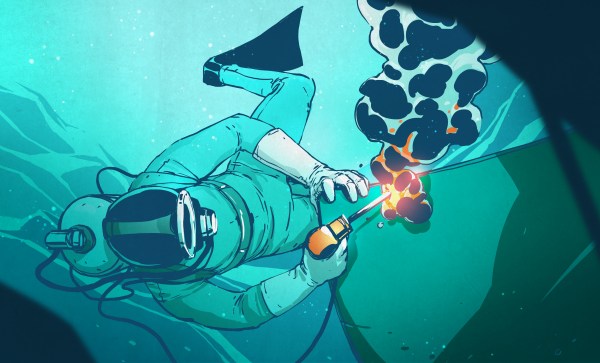
 Fortunately, this is a problem that’s going away on its own, so the headline is really only appropriate as a great reference to a

 As usual, people are excellent… to one another and in adapting to the fluid nature of the day.