Embed With Elliot: Shifting Gears With AVR Microcontrollers

Most modern computers are able to dynamically adjust their operating frequency in order to save power when they’re not heavily used and provide instantaneous-seeming response when load increases. You might be surprised to hear that the lowly 8-bit AVR microcontrollers can also switch CPU-speed gears on the fly. In this edition of Embed with Elliot, we’ll dig into the AVR’s underappreciated CPU clock prescaler.

Continue reading “Embed With Elliot: Shifting Gears With AVR Microcontrollers”

New Part Day: Indoor Location Systems

GPS is an enabling technology that does far more than the designers ever dreamed. If you want a quadcopter to fly to a waypoint, GPS does that. If you want directions on your phone, GPS does that. No one in the 70s or 80s could have dreamed this would be possible.

GPS, however, doesn’t work too well indoors. This is a problem, because we really don’t know what is possible if we can track an object to within 10cm indoors. Now there’s a module that does just that. It’s the decaWave DWM1000.

This module uses an 802.15 radio to track objects to within just a few centimeters of precision. It does this by sending time stamps to and from a set of base stations, or ‘anchors’. The module is also a small, and relatively high bandwidth (110kbps) radio for sensors and Internet of Things things makes it a very interesting part.

Some of the potential for this module is obvious: inventory management, and finding the remote and/or car keys. Like a lot of new technology, the most interesting applications are the ones no one has thought of yet. There are undoubtedly a lot of applications of this tech; just about every ball used in sports is bigger than 10cm, and if ESPN ever wanted even more cool visuals, just put one inside.

If you’d like to try out this module, decaWave has an eval kit available through distributors for about $600. Somehow, there’s also a Kickstarter for a board that uses the same module, Arduino compatible, of course.

Thanks [Roy] for the tip.

Ask Hackaday (And Adafruit): The New CEO Of MakerBot

Just a few years ago, MakerBot was the darling of the Open Hardware community. Somehow, in the middle of a garage in Brooklyn, a trio of engineers and entrepreneurs became a modern-day Prometheus, capturing a burgeoning technology into a compact, easy to use, and intoxicating product. A media darling was created, a disruptive technology was popularized, and an episode of the Colbert Report was taped.

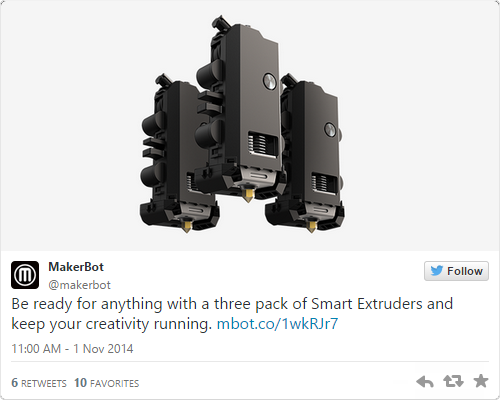
The phrase ‘meteoric rise’ doesn’t make sense, and since then the reputation of MakerBot has fallen through the floor, crashed through the basement, and is now lodged in one of the higher circles of hell. It’s not surprising; MakerBot took creations from their 3D object hosting site, Thingiverse, and patented them. The once-Open Source line of 3D printers was locked up behind a closed license. The new MakerBot extruder – the Smart Extruder – is so failure prone MakerBot offers a three pack, just so you’ll always have a replacement on hand. False comparisons to Apple abound; Apple contributes to Open Source projects. The only other way for a company to lose the support of the community built around it so quickly would be a name change to Puppy Kickers, LLC.

In the last few months, figurehead CEO of MakerBot [Bre Pettis] was released from contractual obligations, and MakerBot’s parent company, Stratasys, has filled the executive ranks with more traditional business types. It appears PR and Marketing managers have noticed the bile slung at their doorstep, and now MakerBot is reaching out to the community. Their new CEO, [Jonathan Jaglom] specifically requested a hot seat be built at Adafruit for an open discussion and listening meeting. Yes, this means Makerbot is trying to get back on track, winning the hearts and minds of potential customers, and addressing issues Internet forums repeat ad nauseam.

If you’ve ever wanted to ask a CEO how they plan to stop screwing things up, this is your chance. Adafruit is looking for some direction for their interview/listening meeting, and they’re asking the community for the most pressing issues facing the 3D printing community, the Open Source community, and MakerBot the company.

Already on the docket are questions about MakerBot and Open Source, MakerBot’s desire to put DRM in filament, the horrors of the Smart Extruder and the 5th generation MakerBots, problems with Thingiverse, and the general shitty way MakerBot treats its resellers.

This isn’t all Adafruit wants to ask; the gloves are off, nothing is off the table, and they’re looking for questions from the community. What would you like to ask the MakerBot CEO?

Personally, the best interview questions are when the interviewee’s own words are turned around on them. By [Jonathan Jaglom]’s own admission, the barrier to entry for 3D design work has been substantially lowered in the last three years, ostensibly because of incredible advances in Open Source projects. Following this, do MakerBot and Stratasys owe a debt to Open Source projects, and should Stratasys contribute to the rising tide of Open Source development?

That’s just one question. There will, of course, be many more. Leave them down in the comments. “You are not [Tim Cook],” while a valid statement in many respects, is not a question.

Retrotechtacular: Making Porcelain Insulators

Here is a silent film produced by General Electric that depicts the making of many kinds of porcelain insulators for power lines. Skilled craftsmen molded, shaped, and carved these vital components of the electrical grid by hand before glazing and firing them.

Porcelain insulators of this time period were made from china clay, ball clay, flint, and feldspar. In the dry process, ingredients are pulverized and screened to a fine powder and then pressed into molds, often with Play-Doh Fun Factory-type effects. Once molded, they are trimmed by hand to remove fins and flashing. The pieces are then spray-glazed while spinning on a vertical lathe.

Other types of insulators are produced through the wet process. The clay is mixed in a pug mill, which is a forgiving machine that takes scrap material of all shapes, sizes, and moisture levels and squeezes out wet, workable material in a big log. Chunks of log are formed on a pottery wheel or pressed into a mold. Once they are nearly dry, the pieces get their final shape at the hands of a master. They are then glazed and fired in a giant, high-temperature kiln.

Continue reading “Retrotechtacular: Making Porcelain Insulators”

Hackaday Links Column Banner

Hackaday Links: June 14, 2015

You know we’re running this gigantic contest to build hardware and send someone to space, right? We’re doing community voting right now. If you’re on Hackaday.io, head over there and pick the best project. We’re giving away t-shirts and $1000 gift cards to people who vote. The drawing for this round is next Friday.

MicroPython is a pretty interesting development in the area of interpreted languages running on microcontrollers. It’s Python, the BASIC of the modern era, and now it’s being funded by the ESA. Great news, there’s going to be a port to SPARC, and it looks like MicroPython is going to be in a few satellites.

[EloquentlyMawkishBunny]’s calculator stopped working on the morning of his AP Physics test. It was the ribbon cable for the display. What did he do? He grabbed some magnet wire and made it work. If I’m reading this right, he did this the day of his AP test. Wow.

[Will] has made a name for himself by building roller coasters in his backyard. He’s also worked on the ProtoPalette, and now he’s building a hackerspace in Concord, California.

[Josh] needed to drill some very large holes with his mill. He decided a hole saw was the easiest way to do this, but his hole saw has a hex shank. He ended up chopping the shank of a hole saw extension, basically turning it into a hex to round adapter.

Did you know the Arduino IDE on Raspbian is stuck at version 1.0.5? The newest version is 1.6.4, and there’s useful stuff like autosave in the IDE now. Amazing. [CRImier] got the latest Arduino IDE working on the Raspberry Pi 2. Yes, there’s an issue up but if for some reason you’re programming Arduinos on the Pi, you should probably do this yourself.

Oooohhhh, case modding. The Intel NUC is a pretty interesting platform for case modding; it’s small, and I shouldn’t have to remind anyone of all the cool case mods that were created when the Mini-ITX format gained popularity in the early ‘aughts. [Femke] got herself an Intel NUC, made a case, and the results are amazing. How’d she get that metal bowl? Metal spinning. Very cool.

Crowdfunding Follies: Proof That Ohm’s Law Is Arcane Knowledge

This is a cell phone case that can recharge a cellphone using energy captured from its own radio. It’s been featured on dozens of tech blogs, wowed judges at TechCrunch Disrupt, and it’s a Kickstarter Staff Pick. It’s also proof that nearly everyone in the media who claims any knowledge of technology has no idea behind the foundational properties of technology.

What it is

The Nikola Phone Case from Nikola Labs is a very special phone case for the iPhone 6 and Samsung Galaxy S6. The claims behind this cell phone case state it will recharge your battery by capturing radio energy put out by the cell phone itself. This means capturing RF from the WiFi and cellular transmitters. This captured energy is then converted into something that can recharge the phone, is sent to the USB or Lightning port, and – theoretically – the cycle of electrons turning into photons begins again.

Why it’s crap

Astonishingly, this is not a perpetual motion machine, a device that is completely impractical, or an outright fraud. It’s deceptively correct when it comes to the physics of this device, and as always implementation is everything.

Inside each Nikola Phone Case is a small antenna, boost converter, and circuitry to capture the RF energy coming from the phone. This phone case will actually harvest RF energy, but it will never be able to extend the life of the phone’s battery. Nikola Labs claims their phone case will recover 30% of a battery’s life by harvesting RF energy and using that energy to recharge the phone. However, the energy for this RF energy harvesting scheme comes from the phone itself. The captured energy that would – ideally – end up at a cell phone tower or WiFi router will disappear into this cell phone case. This results in both a dramatic decrease in reception and most likely an increase in power draw due to the phone increasing its transmit power.

To Nikola Labs’ credit, the FAQ on their Kickstarter does address concerns that a phone’s transmitter and antenna may be affected:

The device may change the impedance and overall pattern slightly. We are performing detail characterization of these changes, if any.

Nikola Labs has not performed due diligence on their design. There is a method that will report the RSSI of the cellular radio in an Android phone. Any competent engineer would, upon first seeing this device, figure out if signal strength is affected. This can be done in a few dozen lines of Java. It can be done in under an hour by someone who has never programmed an Android device. Nikola Labs does not provide a comparison of the signal strength of a phone both with and without their case. This is evidence of incompetence, if not malice.

Simply by definition, any device that captures RF energy will ‘shadow’ the transmission. Just like putting a solar panel in front of a flashlight, energy will be captured, but the overall light output of the flashlight and solar panel system will decrease. Nikola Labs has an answer to that:

The device harvests the RF energy around the phone, which is usually absorbed by the hand holding the phone.

It is true that the human body will absorb RF coming out of a phone. WiFi works on the same frequencies as a microwave oven, and defrosting a piece of chicken in a microwave isn’t that much different from grabbing an antenna on a router. Lower powers and different geometries aside, you are right now absorbing microwaves from a WiFi router.

The best way of understanding why simply holding a phone isn’t a very big deal is coming at it from the direction of designing a smart phone. One of the biggest drivers behind the design of a cell phone is how long it will last on a single charge. You can design a phone with a powerful CPU and a huge screen, but the battery won’t last long. Likewise, the engineers that design cell phones will put the antennas in an out of the way place, where they won’t be absorbed by the human body. The Nikola Labs case destroys the engineering decisions inside each cell phone. Think about it; if power was wasted inside a cell phone, wouldn’t engineers at Apple and Samsung work to reduce that waste?

Why everything else is crap, too

There is simply no excuse why hundreds of people would give tens of thousands of dollars to a company that makes outrageous claims with zero evidence. One could attribute this to the public’s severe lack of understanding when dealing with electricity or radio. This, in my opinion, is far too kind.

Nikola Labs’ Kickstarter would not exist without the help of Kickstarter itself and members of the tech media. We first heard of Nikola Labs at TechCrunch Disrupt, where four judges could not find anything wrong with this technology. The presentation at Disrupt went on to be covered by Engadget and a flurry of other tech blogs. Now, dozens of other tech blogs have reported on this Kickstarter, and Kickstarter itself has named it a Staff Pick.

Yes, there are stupid people out there. There are people who will throw money at anything. There are also people who will Barnum up the place sell snake oil to rubes. The fact that Kickstarter would endorse something without a technical assessment defies belief. The only conceivable reason this could be a Staff Pick on Kickstarter is because Kickstarter believes it will be funded, thus earning them a percentage of gross.

This is the end of capitalism, folks. No longer do you need to innovate and make a better mouse trap. All you need to do is convince enough people that you’ve made a better mouse trap.


Hacklet 51 – Crowdfunding Projects

Ah crowdfunding. You might say we have a love/hate relationship with it here at Hackaday. We’ve seen some great projects funded through sites like Kickstarter, IndieGoGo, and the like. We’ve also seen projects where the creators were promising more than they could deliver. While the missed deliveries and outright scams do get a lot of press, we believe that crowdfunding in general is a viable platform for getting a project funded.

Closer to home, Hackaday.io hosts thousands of projects. It’s no surprise that some of these have had crowdfunding campaigns. This week’s Hacklet focuses on those projects which have taken the leap into the crowdfunding arena.

matrixWe start with [Louis Beaudoin] and SmartMatrix. [Louis] has created an awesome Teensy 3.1 based system for displaying images, animated graphics, and random patterns on a 32×32 RGB LED panel. The LED panel is the same type used in commercial LED billboards. SmartMatrix is open source, and includes extra pins for hacking. Our own [Mike Szczys] hacked the SmartMatrix to create a 1-pixel PacMan clone. [Louis’] Kickstarter is almost over, and needs a huge boost for fully-assembled SmartMatrix to make its goal. Even if the campaign isn’t successful, we think its a great project and you can always get a solder-it-yourself kit from The Hackaday Store!

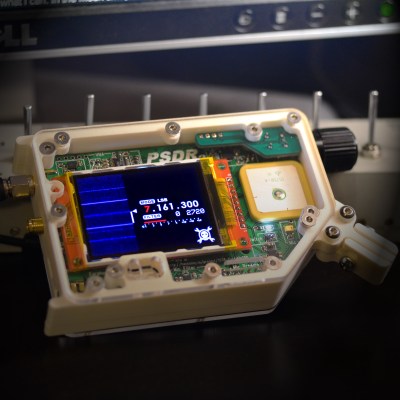
psdrNext up is [Michael R Colton] with PortableSDR. PortableSDR was one of the five finalists in The 2014 Hackaday Prize. This pocket-sized software defined radio transceiver started as a ham radio project: a radio system which would be easy for hams to take with them on backpacking trips. It’s grown into so much more now, with software defined radio reception and transmission, vector network analysis, antenna analysis, GPS, and a host of other features. [Michael] raised a whopping $66,197 in his Kickstarter campaign, and he’s already delivered the hand assembled prototypes to their respective backers! Even the lower level rewards are awesome – [Michael’s] PSDR key chains are actually PCBs which can be turned into maple compatible ARM devboards with just about $10 of additional parts.
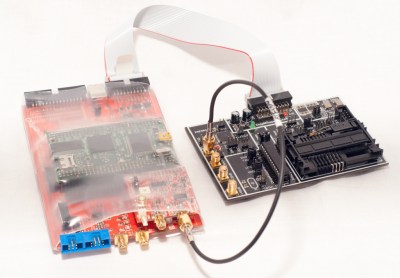
chip whisperNext we have The ChipWhisperer, [Colin Flynn’s] embedded security testing system, which won second place in the 2014 Hackaday Prize. We’ve covered both [Colin] and the ChipWhisperer  several times on the Blog. You can always buy the full ChipWhisperer from [Colin’s] company, NewAE Technology Inc. At $1500 USD, the ChipWhisperer is incredibly affordable for a hardware security tool. That price is still a bit high for the average hacker though. [Colin] created a Kickstarter campaign for a light version of the ChipWhisperer. This version is a great platform for learning hardware security, as well as an instrument for testing embedded systems. The campaign was a huge success, raising $72,079.

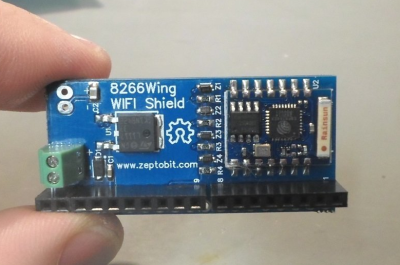
wingboardNot every crowdfunding project has to be a massive megabuck effort though. [ZeptoBit] just wanted to solve a problem, he needed a WiFi shield for Arduino using an ESP8266 module. ESP8266 WiFi modules have been all the rage for months now, but they can be a bit of a pain to wire up to an Arduino Uno. The dual row .100 headers are not bread board friendly. The ESP8266’s 3.3 V power and interface requirements mean that a regulator and level shifters are needed to get the two boards working together. [ZeptoBit] put all that and more on his wingboard. It worked so well that he launched a Kickstarter campaign for a small run of boards – his initial goal was kr3,500, or $425 USD. He ended up raising kr13,705, or $1665 USD. Not bad at all for a hobby project!

If this isn’t enough crowdfunding goodness for you, check out our Crowdfunding list! That’s it for this week’s Hacklet, As always, see you next week. Same hack time, same hack channel, bringing you the best of Hackaday.io!