Zork Zcode Interpreters Appear Out Of Nowhere

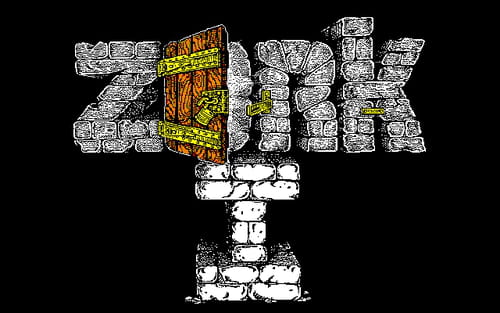
Some of our readers may know about Zork (and 1, 2, 3), the 1977 text adventure originally written for the PDP-10. The game has been public domain for a while now, but recently, the interpreters for several classic 1980s machines have also appeared on the internet.

What’s the difference? Zork is not a PDP-10 executable, it’s actually a virtual machine executable, which is in turn run by an interpreter written for the PDP-10. For example, Java compiles to Java bytecode, which runs on the Java virtual machine (but not directly on any CPU). In the same way, Zork was compiled to “Z-machine” program files, called ZIP (which was of course used in 1990 by the much more well known PKZIP). To date, the compiler, “Zilch” has not been released, but the language specification and ZIP specifications have, which has led some people to write custom ZIP compilers, though with a different input language.

For more on the VM, check out Maya’s Zork retrospective. (And dig the featured art. Subtle!)

Of course, that’s not the only type of interpreter. Some programming languages are interpreted directly from source, like this BASIC hidden in the ESP32’s ROM.
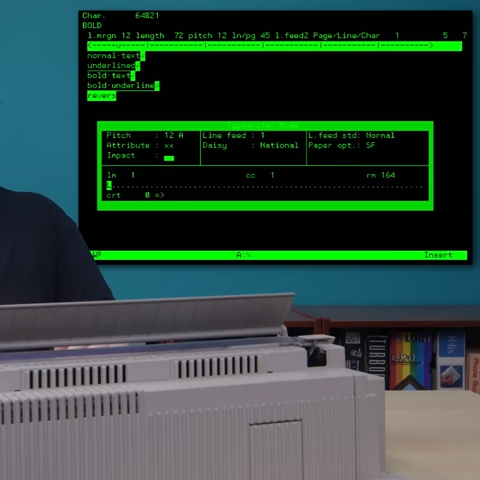
Wandering Through Old Word Processors Yields A Beast

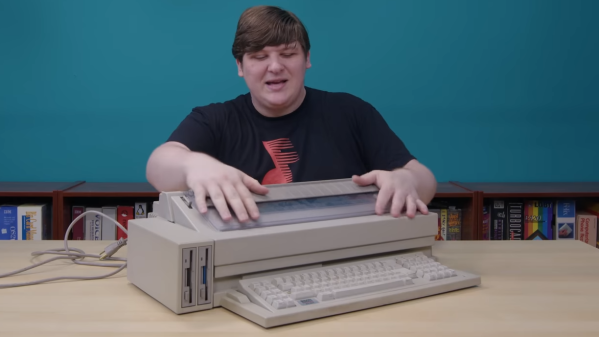
The world once ran on hardcopy, and when the digital age started to bring new tools and ways of doing things, documents were ripe for change. Today, word processors and digital documents are so ubiquitous that they are hardly worth a thought, but that didn’t happen all at once. [Cathode Ray Dude] has a soft spot for old word processors and the journey they took over decades, and he walks through the Olivetti ETV 2700.

In the days of character displays and no multitasking, WYSIWYG as a concept was still a long ways off.

The ETV 2700 is a monstrous machine; a fusion of old-school word processor, x86-based hardware, and electric 17 inch-wide typewriter.

With it one could boot up a word processor that is nothing like the WYSIWYG of today, write and edit a document, and upon command, the typewriter portion could electronically type out a page. A bit like a printer, but it really is an electric typewriter with a computer interface. Characters were hammered out one at a time with daisy wheel and ink ribbon on a manually-loaded page using all the usual typewriter controls.

While internally the machine has an x86 processor, expects a monitor and even boots MS-DOS, the keyboard had its own layout (and even proprietary keys and functions), did not support graphical output, and in other ways was unusual even by the standards of the oddball decades during which designers and products experimented with figuring out what worked best in terms of functionality and usability.

Nowadays, we see AI-enabled typewriter projects and porting vintage OSes to vintage word processor hardware, but such projects are in some part possible in part thanks to the durability of these devices. The entire video is embedded below, but you can jump directly to what the Olivetti ETV 2700 looked like on the inside if that’s what interests you most.

Continue reading “Wandering Through Old Word Processors Yields A Beast”

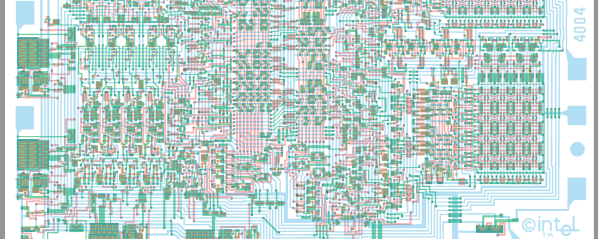
The masks with which the Intel 4004 was fabricated

Supersize Your Intel 4004 By Over 10 Times

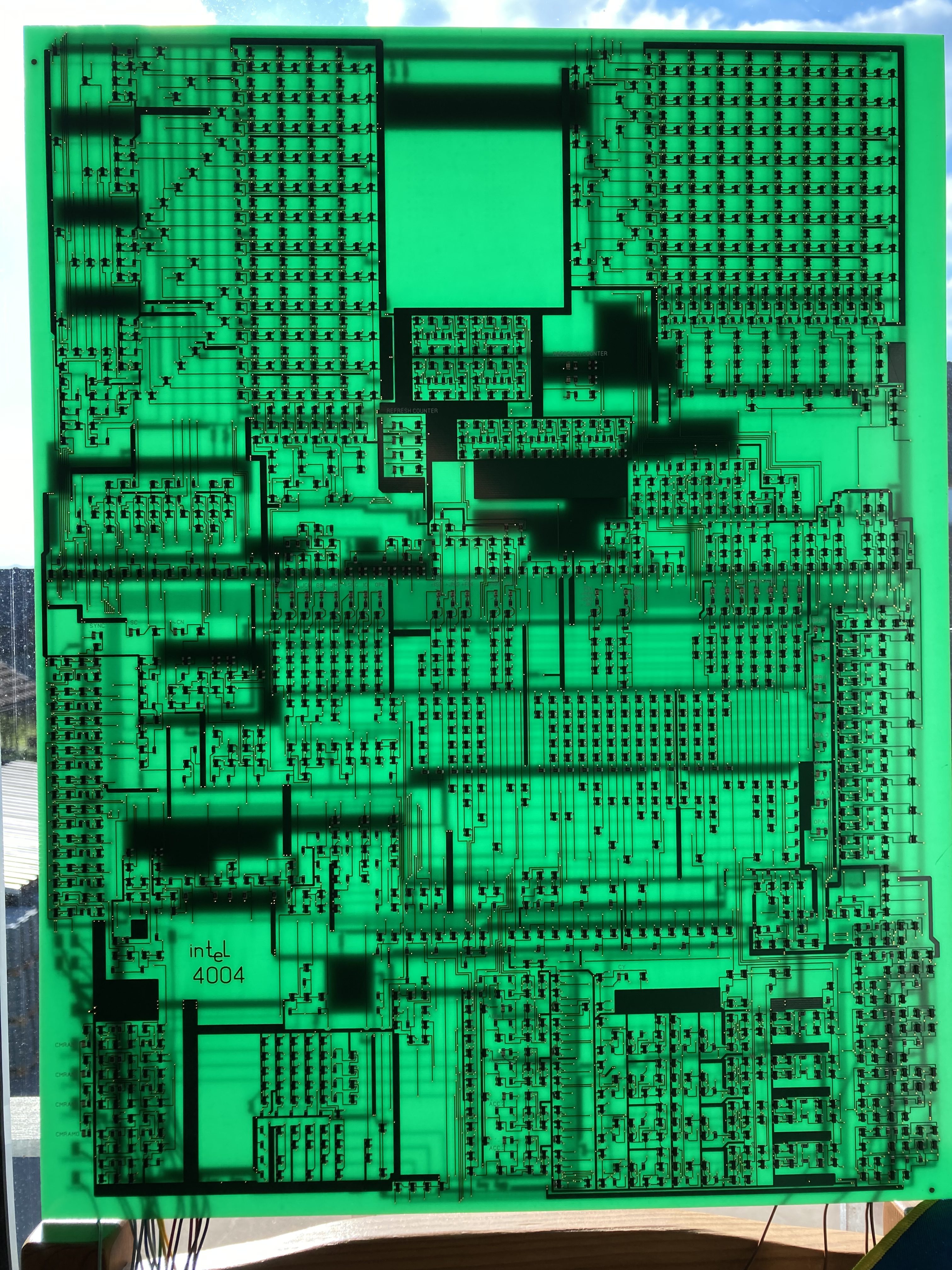
A PCB covered in discrete transistors with light shining through it
This is quite a bit bigger than the original 12mm² die.

The Intel 4004 was among the first microprocessors and one of the first to use the MOS silicon-gate technology. In the decades long race to build bigger CPUs, it’s been mostly forgotten. Forgotten that is, until [Klaus Scheffler] supersized it over ten-fold!

The project took about 2 years to complete and re-creates it faithfully – all 2,300 transistors included – enough to run software written for the Intel 4004. But the idea for this project isn’t unique and dates all the way back to 2000, so what gives? Turning a bunch of masks for silicon fabrication into a schematic is actually harder than it seems! [Tim McNerney] originally came up with the idea to make a giant 4004 for its “35th anniversary”. [Tim] managed to convince Intel to give him schematics and other drawings and would in return make an exhibit for Intel’s museum. With the schematic straight from [Federico Faggin], software analysis tools from [Lajos Kintli] and [Klaus Scheffler] to actually build the thing, they did what [Federico] did in one year without CAD, but in two with modern tools.

The full story by [Tim] is a lot longer and it’s definitely worth a read.

Apple Archeology: The Future Once Had Server Side Computing In It

To read the IT press in the early 1990s, those far-off days just before the Web was the go-to source of information, was to be fed a rosy vision of a future in which desktop and server computing would be a unified and powerful experience. IBM and Apple would unite behind a new OS called Taligent that would run Apple, OS/2, and 16-bit Windows code, and coupled with UNIX-based servers, this would revolutionise computing.

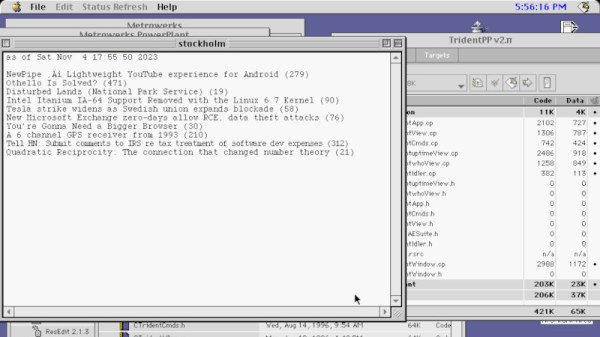
We know that this never quite happened as prophesied, but along the way, it did deliver a few forgotten but interesting technologies. [Old VCR] has a look at one of these, a feature of the IBM AIX, which shipped with mid-90s Apple servers as a result of this partnership, in which Mac client applications could have server-side components, allowing them to offload computing power to the more powerful machine.

The full article is very long but full of interesting nuggets of forgotten 1990s computing history, but it’s a reminder that DOS/Windows and Novell Netware weren’t the only games in town. The Taligent/AIX combo never happened, but its legacy found its way into the subsequent products of both companies. By the middle of the decade, even Microsoft had famously been caught out by the rapid rise of the Web. He finishes off by creating a simple sample application using the server-side computing feature, a native Mac OS application that calls a server component to grab the latest Hacker News stories. Unexpectedly, this wasn’t the only 1990s venture from Apple involving another company’s operating system. Sometimes, you just want to run Doom.

The Quaint History Of The Commodore ChessMate

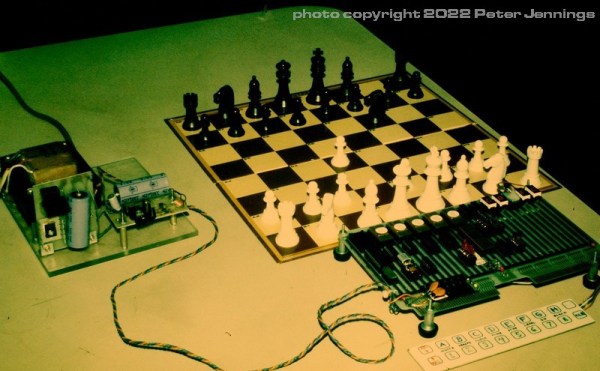
The Commodore International of the 1970s was a company which dabbled in a bit of everything when it came to consumer electronics, with the Commodore ChessMate being a prime example of the circuitous way that some of its products came to be. Released in 1978, its existence was essentially the result of MOS Technology releasing the KIM-1 single board computer in 1976. In May of that year, [Peter Jennings] traveled all the way from Toronto, Canada to Cleveland, USA to attend the Midwest Regional Computer Conference and acquire a KIM-1 system and box of manuals for a mere $245. On this KIM-1 he’d proceed to develop his own chess game, called MicroChess, implemented fully in 6502 ASM to fit within the 1 kB of RAM.

As one of the first major applications to run on the KIM-1, it quickly became an international hit, which caught the attention of Commodore – which had acquired MOS Technology by then – who ended up contacting [Peter] about a potential chess computer project. This turned out to based on the custom MOS 6504 CPU, while sharing many characteristics with the KIM-1 SBC. Being a MicroChess-only system, the user experience was optimized for more casual users, with the user manual providing clear instructions on how to start a new game and how to enter the position of a newly moved piece, along with no less than eight difficulty settings.

If you’re feeling like making your own ChessMate, or want to dig into the technical details, this excellent article by [Hans Otten] has got you covered.

Top image: Commodore ChessMate Prototype in 1978. (Credit: Peter Jennings)

(Thanks to [Stephen Walters] for the tip)

General Instruments Video Game Chip Rides Again

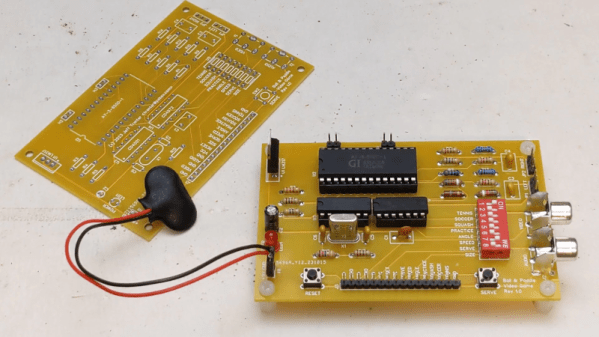
Early video games like Pong were not computer-controlled. They used discrete logic to generate the TV signals. As you might expect, the market exploded when you could get all the logic on a chip. Many of those games used the General Instrument AY-3-8500-1 chip, and [Jeff Tranter] shows us the chip and the many different yet similar games it could play. You can check out the retro gameplay in the video below.

These were marvels of their day, although, by today’s standards, they are snoozers. All the games were variations on a theme. A ball moved and hit paddles, walls, or goals. A few available light gun games were rarely seen in the wild because they took extra components.

Continue reading “General Instruments Video Game Chip Rides Again”

The IBM MDA Should Have Been The CDA

If you are reading this on an IBM PC-compatible computer, it is a certainty that its graphics card will support the lowest common denominator of PC displays, the Monochrome Display Adapter, or MDA. This was a video card which delivered a text-only display in black-and-white that was an option fitted to the very first PC models. But was it really a monochrome display adapter? [TubeTimeUS] is here to show us that when connected to the appropriate colour monitor, it can produce text in colour. It seems that this was a feature only on the very earliest revisions of the card.

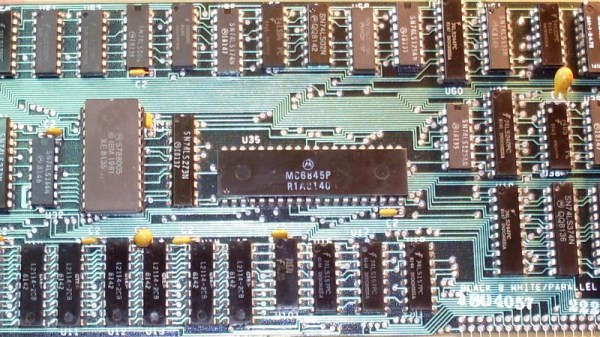
Reading up on the MDA card, we find that at its heart it had a Motorola MC6845 CRT controller, a chip that appeared in a huge variety of machines from that era. The beauty of this chip was that it provided the correct timing signals and memory locations for video to be created, but didn’t include any video circuitry thus the designer was free to craft a video device to their specification, allowing for it to appear in both colour and monochrome devices. While the MDA card only supported a text mode it seems its designers managed to put in some form of colour attribute support even if it was never marketed as such. We’re not students of IBM graphics card modes here at Hackaday, but it would be fascinating to know whether this undocumented mode works in the same way from the software side as the colour text modes on CGA and better colour cards.

Continue reading “The IBM MDA Should Have Been The CDA”