Hacking Buttons Back Into The Car Stereo

To our younger readers, a car without an all-touchscreen “infotainment” system may look clunky and dated, but really, you kids don’t know what they’re missing. Buttons, knobs, and switches all offer a level of satisfying tactility and feedback that touchscreens totally lack. [Garage Tinkering] on YouTube agrees; he also doesn’t like the way his aftermarket Kenwood head unit looks in his 2004-vintage Nissan. That’s why he decided to take matters into his own hands, and hack the buttons back on.

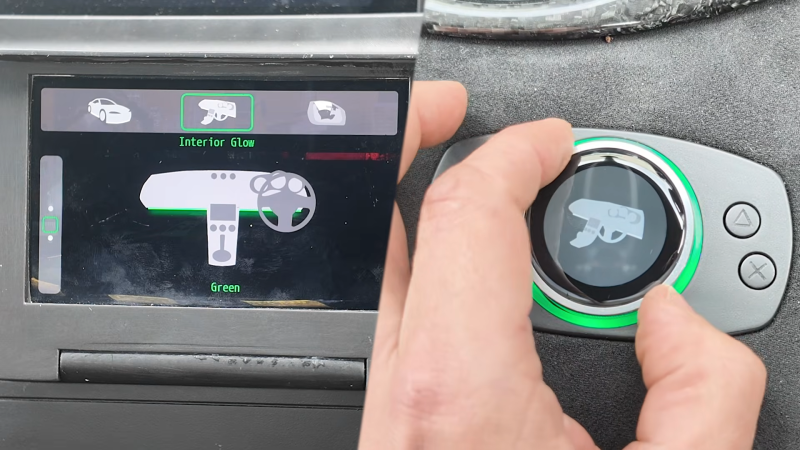
Rather than source a vintage stereo head unit, or try and DIY one from scratch, [Garage Tinkering] has actually hidden the modern touchscreen unit behind a button panel. That button panel is actually salvaged from the stock stereo, so the looks fit the car. The stereo’s LCD gets replaced with a modern color unit, but otherwise it looks pretty stock at the end.

Adding buttons to the Kenwood is all possible thanks to steering-wheel controls. In order to make use of those, the touchscreen head unit came with a little black box that translated the button press into some kind of one-wire protocol that turned out to be an inverted and carrier-less version of the NEC protocol used in IR TV remotes. (That bit of detective work comes from [michaelb], who figured all this out for his Ford years ago, but [Garage Tinkering] is also sharing his code on GitHub.) Continue reading “Hacking Buttons Back Into The Car Stereo”

Original E39 Head Unit Modernized

Although most modern cars have moved to using proprietary components nearly everywhere, especially when it comes to infotainment systems, for a brief moment which peaked in the 90s and 00s most cars shipped with radios that fit in a standard size opening called a DIN slot. If you wanted a new Pioneer or Kenwood stereo it was usually a simple matter to slide the factory radio out and put your choice of aftermarket head unit in its place. [Stefan] has an E39 BMW from this era and wanted to upgrade the factory radio but use the original hardware instead of replacing it.

This isn’t just a simple stereo upgrade either. [Stefan] has gone all-out for this build which he started in 2020. Beginning with a Kotlin/Jetpack Compose Linux application to handle control input from the vehicle’s various knobs and buttons he moved on to a map application and an on-screen keyboard. From there he implemented VGA to send video to the OEM screen, and now has a fully functional system based on a Raspberry Pi. It does everything the original unit can do including playing music and showing the feed from the backup camera, plus adds plenty of new, modern features like Bluetooth.

For a certain classic car enthusiast, this build hits a sweet spot of modernizing a true classic like the E39 without removing or permanently modifying any OEM components. The amount of work that went into it is pretty staggering as well, with [Stephan] putting in over 100 hours of work just to get the video signal timing correct. We also like it because it reminds us of the flash-in-the-pan “carputer” trend from the late 00s where people in the pre-smartphone age were shoving all kinds of computing horsepower in their trunks.

A Tale Of Two Car Design Philosophies

As a classic car enthusiast, my passion revolves around cars with a Made in West Germany stamp somewhere on them, partially because that phrase generally implied a reputation for mechanical honesty and engineering sanity. Air-cooled Volkswagens are my favorites, and in fact I wrote about these, and my own ’72 Super Beetle, almost a decade ago. The platform is incredibly versatile and hackable, not to mention inexpensive and repairable thanks to its design as a practical, affordable car originally meant for German families in the post-war era and which eventually spread worldwide. My other soft-spot is a car that might seem almost diametrically opposed to early VWs in its design philosophy: the Mercedes 300D. While it was a luxury vehicle, expensive and overbuilt in comparison to classic Volkswagens, the engineers’ design choices ultimately earned it a reputation as one of the most reliable cars ever made.

As much as I appreciate these classics, though, there’s almost nothing that could compel me to purchase a modern vehicle from either of these brands. The core reason is that both have essentially abandoned the design philosophies that made them famous in the first place. And while it’s no longer possible to buy anything stamped Made in West Germany for obvious reasons, even a modern car with a VIN starting with a W doesn’t carry that same weight anymore. It more likely marks a vehicle destined for a lease term rather than one meant to be repaired and driven for decades, like my Beetle or my 300D.

Continue reading “A Tale Of Two Car Design Philosophies”

Airbags, And How Mercedes-Benz Hacked Your Hearing

Airbags are an incredibly important piece of automotive safety gear. They’re also terrifying—given that they’re effectively small pyrotechnic devices that are aimed directly at your face and chest. Myths have pervaded that they “kill more people than they save,” in part due a hilarious episode of The Simpsons. Despite this, they’re credited with saving tens of thousands of lives over the years by cushioning fleshy human bodies from heavy impacts and harsh decelerations.

While an airbag is generally there to help you, it can also hurt you in regular operation. The immense sound pressure generated when an airbag fires is not exactly friendly to your ears. However, engineers at Mercedes-Benz have found a neat workaround to protect your hearing from the explosive report of these safety devices. It’s a nifty hack that takes advantage of an existing feature of the human body. Let’s explore how air bags work, why they’re so darn loud, and how that can be mitigated in the event of a crash.

Continue reading “Airbags, And How Mercedes-Benz Hacked Your Hearing”

The Hottest Spark Plugs Were Actually Radioactive

In the middle of the 20th century, the atom was all the rage. Radiation was the shiny new solution to everything while being similarly poorly understood by the general public and a great deal of those working with it.

Against this backdrop, Firestone Tire and Rubber Company decided to sprinkle some radioactive magic into spark plugs. There was some science behind the silliness, but it turns out there are a number of good reasons we’re not using nuke plugs under the hood of cars to this day.

Continue reading “The Hottest Spark Plugs Were Actually Radioactive”

Homebrew Tire Pressure Monitoring System

When [upir] saw that you could buy tire valve stem caps that read pressure electronically, he decided to roll his own Tire Pressure Monitoring System (TPMS) like the one found on modern cars. An ESP32 and an OLED display read the pressure values. He didn’t have a car tire on his workbench though, so he had to improvise there.

Of course, a real TPMS sensor goes inside the tire, but screwing them on the valve stem is much easier to deal with. The sensors use Bluetooth Low Energy and take tiny batteries. In theory, you’re supposed to connect to them to your phone, although two different apps failed to find the sensors. Even a BLE scanner app wouldn’t pick them up. Turns out — and this makes sense — the sensors don’t send data if there’s no pressure on them, so as not to run down the batteries. Putting pressure on them made them pop up on the scanner.

Continue reading “Homebrew Tire Pressure Monitoring System”

Engine Data Displayed Live On Dash

In the auto world, there are lots of overarching standards that all automakers comply with. There are also lots of proprietary technologies that each automaker creates and uses for its own benefit. [Shehriyar Qureshi] has recently been diving into Suzuki’s Serial Data Line standard, and has created a digital dash using the data gained.

The project started with Python-based scanner code designed to decode Suzuki’s SDL protocol. Armed with the ability to read the protocol, [Shehriyar] wanted to be able to do so without having to haul a laptop around in the car. Thus, the project was ported to Rust, or “oxidized” if you will.

More after the break…

Continue reading “Engine Data Displayed Live On Dash”