Digital License Plates Are Here, But Do We Need Them?

It’s a story as old as time: you need to swap between your custom license plates, but you can’t find a screwdriver and you’re already running late for a big meeting at the Business Factory. You called AAA to see if they could come out and do it for you, but as luck would have it something must be wrong with your phone because the line was disconnected as soon as you explained the situation. As if life in the First World couldn’t get any more difficult.

Luckily, a company called Reviver Auto has come up with a thoroughly modern solution to this age old problem. Assuming you live in Arizona, California, and Michigan and are willing to pay $800 USD (plus a small monthly service fee), you can join the Rplate revolution! Less a license plate and more of a “cool-looking, multi-functional digital display and connected vehicle platform”, the Rplate will ensure you never again find yourself stuck on the side of the road with an unfashionable license plate.

What’s that? You’ve had the same license plate for years, possibly decades, and have never given it much thought? Well, in that case the Rplate might be sort of a tough sell. Did we mention that someday you might be able to display the current weather on it while your car is parked? Of course, if you can see the license plate you’re already outside, so…

This all might sound like an out of season April Fool’s joke, but as far as I can tell from reading the Reviver Auto site and watching their promotional videos, this is essentially the value proposition of their line of Rplate digital license plates. There are some admittedly interesting potential extensions of the technology if they can convince other companies and systems to plug into their ecosystem, but given the cost of the Rplate and the few states in which it’s currently legal to use, that seems far from a given at this point.

But of course we’re fans of weird and wonderful technology here at Hackaday, so we should give this device a fair shake. On the surface it might seem to be a solution looking for a problem, but that’s often said of technology ahead of its time. So what exactly is the Rplate, how does it work, and where does it go from here?

Continue reading “Digital License Plates Are Here, But Do We Need Them?”
Transistor Tester Becomes Car Display

These days, the electronics hobbyist is lucky to have access to a wide range of ready-made modules that enable sensors, screens, and microcontrollers to all be linked up with ease. However, this manner of working generally ends up with a project that becomes more of a PCB salad than a finished product. Oftentimes, it’s possible to find something off the shelf that’s close to your requirements, and repurpose it to work. That’s exactly what [Aaron] did.

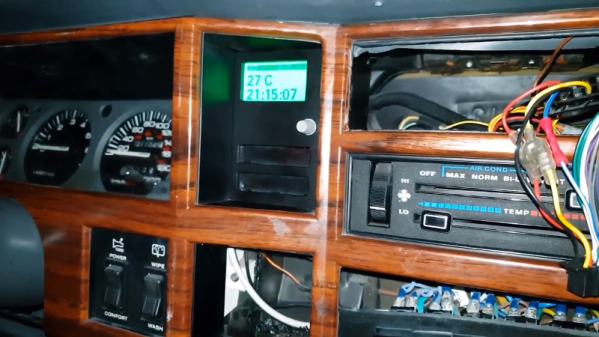
[Aaron] wanted to install a display in his classic Jeep to display the time and some basic parameters. A screen and a microcontroller were called for, and a cheap open-source transistor tester had exactly that already. Consisting of an ATmega-328P linked up to an 128 x 64 graphic LCD module, it had most of what [Aaron] needed from the get go.

To repurpose the device, [Aaron] started by swapping the 8 MHz crystal for a 16 MHz one to make it more easily programmable through the Arduino IDE. Then, a custom firmware was written, which communicates with a DS3232 real time clock, temperature and pressure sensors, and also monitors battery voltage. It’s all neatly installed in the vehicle behind a 3D printed faceplate, and the graphic LCD is clear and easy to read – if you speak German.

[Aaron] has helpfully outlined the various online resources that helped with the hack, including the transistor tester schematic. Our very own [Adam Fabio] reviewed these units in 2015.

If you’ve cleverly reused some existing hardware yourself, be sure to let us know on the tip line. Video after the break.

Continue reading “Transistor Tester Becomes Car Display”

Goodbye Chevy Volt, The Perfect Car For A Future That Never Was

A month ago General Motors announced plans to wind down production of several under-performers. At the forefront of news coverage on this are the consequences facing factories making those cars, and the people who work there. The human factor associated with the closing of these plants is real. But there is also another milestone marked by the cancellation of the Volt. Here at Hackaday, we choose to memorialize the soon-to-be-departed Chevrolet Volt. An obituary buried in corporate euphemisms is a whimper of an end for what was once their technological flagship car of the future.

Continue reading “Goodbye Chevy Volt, The Perfect Car For A Future That Never Was”

Why Converting Classic Cars To Electric Drive Is A Thing

A vintage British sportscar is a wonderful thing. Inimitable style and luxury, beautiful curves, and a soundtrack that could make even Vinnie Jones shed a tear. However, even under the most diligent maintenance schedule, they are known, above all, for their unreliability. As the value of such cars is tied heavily to their condition as unmodified examples, owners are typically reluctant to make modifications to remedy these issues.

However, things are starting to change. Cities across the world are enacting measures to ban fossil fuel vehicles from their streets, and sales of such vehicles are similarly going to be banned entirely. The automotive industry is preparing for a major pivot towards electric drivetrains, and no carmaker will be left untouched. In this landscape, it’s not just Tesla and Nissan who are selling electric cars anymore. Luxury brands are beginning to deliver electric vehicles, too.

Continue reading “Why Converting Classic Cars To Electric Drive Is A Thing”

Karakuri Kaizen: Hacks For The Factory Floor

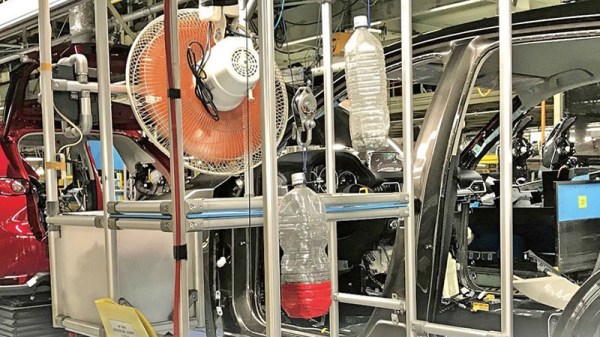
Anyone who has an interest and/or career in manufacturing would have heard of Kaizen, generally a concept to continuously improve your process everywhere. Under that huge umbrella is Karakuri Kaizen, encouraging workers on the factory floor to adopt a hacker mentality and improve their own work stations. It is right up our alley, manufacturer or not, making this overview by Automotive News an entertaining read.

Karakuri could be translated as “mechanism”, but implies something novel in the vein of English words gadgets, gizmos, or dare we say it: hacks. Karakuri has a history dating back to centuries-old wind-up automatons all the way to modern Rube Goldberg contraptions. When applied to modern manufacturing (as part of factory training) it encourages everyone to devise simple improvements. Each might only shave seconds off assembly time, but savings add up in due time.

Modern global manufacturing is very competitive and survival requires producing more efficiently than your competitors. While spotlights of attention may be focused on technology, automation, and construction of “alien dreadnoughts”, that focus risks neglecting gains found at a smaller and simpler scale. Kaizen means always searching for improvements, and the answer is not always more technology.

Several points in these articles asserted purely mechanical karakuri are far less expensive than automated solutions, by comparing price tags which are obviously for industrial automation equipment. We’d be curious to see if our favorite low cost tools — AVR, PIC, ESP32, and friends — would make future inroads in this area. We’ve certainly seen hacks for production at a much smaller scale.

Embedded below the break is a short video from Toyota showing off a few karakuri on their factory floor.

Continue reading “Karakuri Kaizen: Hacks For The Factory Floor”

A DIY Interface for Subaru Select Monitor 1

Hacking A 20 Year Old Subaru

While cars are slowing becoming completely computer-controlled, road vehicles have been relying on computers since the 1970’s. The first automotive use of computers was in engine control units (ECUs) which came along as fuel injection systems started to replace carburetors.

[P1kachu]’s 1997 Subaru Impreza STi, like most cars of this vintage, uses an ECU and provides a diagnostic connector for external communications. [P1kachu]’s Subaru hacking project includes building a diagnostic interface device, dumping the ECU’s firmware, and reverse engineering the binary to understand and disable the speed limiter. If this looks familiar, it’s because we just covered the infotainment hacks in this car on Saturday. But he added information about the communications protocols is definitely worth another look.

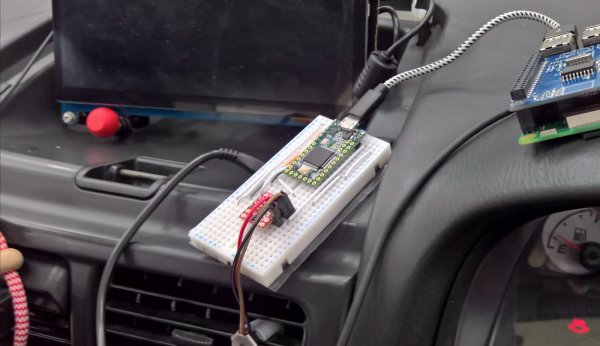
This era of Subaru uses a non-standard diagnostics protocol called SSM1, which is essentially a 5 volt TTL serial line running at 1953 bits per second. The custom interface consists of a Teensy and a 3.3V to 5V level shifter. Once connected, commands can be sent directly to the ECU. Fortunately, the protocol has been quite well documented in the past. By issuing the “Read data from ECU address” command repeatedly, the full firmware can be dumped.

[P1kachu] goes on to locate the various engine tuning maps and discover the inner workings of the speed limiter. With cars getting more computerized, it’s nice to see folks are still able to tune their rides, even if it means using Teensys instead of wrenches.

Fail Of The Week: How Not To Electric Vehicle

If you ever doubt the potential for catastrophe that mucking about with electric vehicles can present, check out the video below. It shows what can happen to a couple of Tesla battery modules when due regard to safety precautions isn’t paid.

The video comes to us by way of [Rich], a gearhead with a thing for Teslas. He clearly knows his way around the EV world, having rebuilt a flood-soaked Tesla, and aspires to open an EV repair shop. The disaster stems from a novelty vehicle he and friend [Lee] bought as a side project. The car was apparently once a Disney prop car, used in parades with the “Mr. Toad’s Wild Ride” theme. It was powered by six 6-volt golf cart batteries, which let it maintain a stately, safe pace on a crowded parade route. [Rich] et al would have none of that, and decided to plop a pair of 444-cell Tesla modules into it. The reduced weight and increased voltage made it a real neck-snapper, but the team unwisely left any semblance of battery management out of the build.

You can guess what happened next, or spin up to the 3:00 mark in the video to watch the security camera mayhem. It’s not clear what started the fire, but the modules started cooking off batteries like roman candles. Quick action got it pushed outside to await the fire department, but the car was a total loss long before they showed up. Luckily no other cars in the garage were damaged, nor were there any injuries – not that the car didn’t try to take someone out, including putting a flaming round into [Lee]’s chest and one into the firetruck’s windshield.

[Rich] clearly knew he was literally playing with fire, and paid the price. The lesson here is to respect the power of these beefy batteries, even when you’re just fooling around.

Continue reading “Fail Of The Week: How Not To Electric Vehicle”