Giant LED Matrix

We all love blinky lights. What we love even more than blinky lights is a very detailed tutorial with great photos. [Richard Kline] has written this fantastic tutorial on how to build a large 5×7 LED matrix and control it with a PIC processor.  The bulk of the body is a foam insulation board, covered with a diffuser. Source code and schematics are available for download from the site. If you’ve ever thought about getting into PIC processors, this would be a great beginner project.

[via MakeZine]

Morse Code Clock

[youtube=http://www.youtube.com/watch?v=vQwGw0s2qAc&w=470]

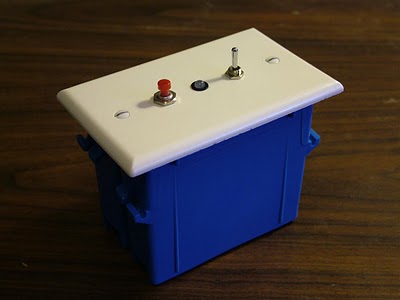
[Johnny Carlo] put another spin on clock displays with his Propeller-based Morse Code clock. He repurposed a tap light, using the tap function as a switch input and actuating the bulb inside with the help of a transistor. If you want to know the time just give it a tap and the device will transmit back to you in a series of flashes. This is great if you’re contemplating a career as a Navy Signalman or just need another way to practice Morse Code.

[Thanks Mike]

Color Clock Makes Telling Time Impossible

[Bogdan] set out to build the all-too-familiar binary clock. But, he didn’t want to be ordinary, and set the goal of making the clock as hard to read as possible. What he ended up with is a clock that is almost impossible to read correctly.
He’s using colors to tell the time. We immediately thought this might make use of resistor codes as the display but it doesn’t. Red shows the hours, green for minutes, and blue for seconds. Now stack all of them on top of each other in binary and you’ve got the time. That means you’ve got to know all of your color combinations, plus read the binary value correctly, to decipher the time. Add to that the display changing every second and we’re in trouble.
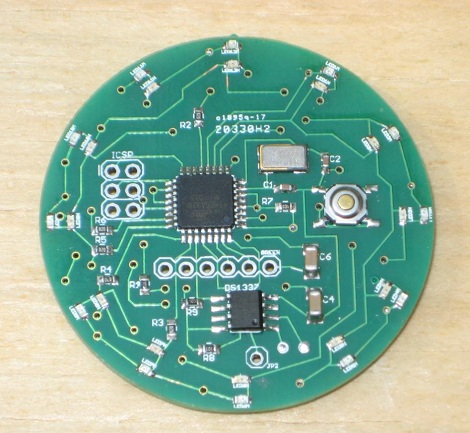
Aside from the user difficulty level, this is a really clean build. It uses an ATmega8535 in conjunction with our favorite DS3232 RTC chip. The etched board is nice and clean, making for an aesthetically pleasing clock.

Six Digit LED Clock

Got a bag of LEDs handy? Why not build a display with them? We’ve seen a lot of clocks that make use of LED modules but soldering your own is a fun pastime. [Vadim Suhovatih] did just that using 130 LEDs to build this clock. Each segment of the 7-segment digits consists of three LEDs in parallel which are switched by some 2N4401 transistors. An ATmega328 in the form of an Arduino controls the device with the aid of a DS1307 real-time clock for timekeeping and a 4017 decade counter to assist with scanning the display. Check out the demo after the break.

Continue reading “Six Digit LED Clock”

Talking Clock Sounds Just Like You

[vimeo=http://www.vimeo.com/10852914]

We’d bet a large portion of our readers don’t remember when you could call the phone company and get the time of day. Gadget Gangster is bringing back the tried and true method with this talking clock. Just press the button and the ‘operator’ will read the time of day to you. Record your own voice and place the WAV files on an SD card, from there a Propeller chip takes care of the rest.

As a side note, we’re big fans of the method used to breadboard the power supply using the TO-220 package leads as their own jumpers. We’ve always been partial to using a breadboard regulator on a PCB but this method is simple and takes almost no space at all.

Biopunk Watch: Time, Temperature, Gaming

[Matthew Garten] built this watch based on an Arduino. The face is a small color display which allows you to choose to show time in digital, binary, or analog formats. In keeping with the recent trend here on Hackaday he has a glove-based add-on that has temperature sensors in the fingers; for Firefighters or those with nerve damage to their fingers (we’re thinking Darkman). For entertainment in any situation he’s included a trackball and the ability to play breakout or draw in 16-bit color. Details are scarce but apparently he’ll be sharing more soon. For now, watch the video after the break and think of ways to shrink this down into a nice package like the Pong Watch enjoys.

Continue reading “Biopunk Watch: Time, Temperature, Gaming”