Watch The Day Inch Along With A Tape Measure Clock

If we asked you to rattle off all the tools at your own personal disposal, you’d probably leave your timepieces off the list. But we say clocks are definitely tools — cool tools that come in countless forms and give meaning to endless days.

A clock form we hadn’t considered was that of an actual tool. So we were immeasurably delighted to see [scealux]’s clock made from a measuring tape. At least, the time-telling part of the clock is made from a measuring tape. The case isn’t really from a tape measure — it’s entirely printed, Bondo’d, sanded, and painted so well that it’s quite easy to mistake it for the real thing.

Tightly packed inside this piece of functional art is an Arduino Nano and a DS3231 precision RTC module, which we think is fitting for a tool-based clock. The Nano fetches the time and drives a stepper motor that just barely fits inside. There’s just enough tape wound around the printed hub to measure out the time in increments of one hour per inch. Take 1/16″ or so and watch the demo and brief walk-through video after the break.

Not all tools are sharp, and not all clocks are meant to be precise. Here’s a clock for the times that gives you the gist.

Continue reading “Watch The Day Inch Along With A Tape Measure Clock”

Servo-Powered 7-Segments Choreograph This Chronograph

Good clocks are generally those that keep time well. But we think the mark of a great clock is one that can lure the observer into watching time pass. It doesn’t really matter how technical a timepiece is — watching sand shimmy through an hourglass has its merits, too. But just when we were sure that there was nothing new to be done in the realm of 7-segment clocks, [thediylife] said ‘hold my beer’ and produced this beauty.

A total of 28 servos are used to independently control four displays’ worth of 3D-printed segments. The servos pivot each segment back and forth 90° between two points: upward and flat-faced to display the time when called upon, and then down on its side to rest while its not needed.

Circuit-wise, the clock’s not all that complicated, though it certainly looks like a time-consuming build. The servos are controlled by an Arduino through a pair of 16-channel servo drivers, divided up by HH and MM segments. The Arduino fetches the time from a DS1302 RTC module and splits the result up into four-digit time. Code-wise, each digit gets its own array, which stores the active and inactive positions for each servo. Demo and full explanation of the build and code are waiting after the break.

When it comes to 7-segment displays, we say the more the merrier. Here’s a clock that uses pretty much all of them.

Continue reading “Servo-Powered 7-Segments Choreograph This Chronograph”

LED Clock Strips Time Down To Pulses Of Light

Nietzsche said (essentially) that time is a flat circle — we are doomed to repeat history whether we remember it or not. This is a stark and sobering thought for sure, but it’s bound to dissipate the longer you look at [andrei.erdei]’s literal realization of time as a flat circle.

A clock that uses nothing but RGB LEDs to give the time sounds confusing and potentially cluttered, but the result here is quite pleasing and serene. We figure it must be the combination of brighter LEDs to represent 12, 3, 6, and 9, and dimmer LEDs for the rest of the numbers, plus the diffusion scheme. The front plate is smoky acrylic topped with two layers of frosted black window foil.

Inside the printed plastic ring are two adhesive RGB LED strips running on an ESP8266 that ultimately connects to an NTP time server. The strips are two halves of an adhesive 60 LED/meter run that have been stuck together back to back so that the lights are staggered for seamless coverage. This sets up the coolest thing about this clock — the second hand, which is represented by a single pink LED zig-zagging back and forth around the ring. Confused? Watch the short demo after the break and you’ll figure it out in no time.

Now that times are strange, you might be more interested in a straightforward approach to finding out what day it is. The wait is over.

Continue reading “LED Clock Strips Time Down To Pulses Of Light”

Edge-Lit 7-Segments Clock The New Normal

People keep saying that time has lost all meaning now, but we’re still over here divvying up the days with hacks. Most of the hacks you see here are open source. But if you want something even more transparent to meter out the meaninglessness, we invite you to make one of these clearly awesome see-through clocks, which happens to be both.

A word of warning though — according to [GeekMomProjects], this is an incredibly fiddly build with tight tolerances everywhere that acrylic meets acrylic or an LED strip. We can see how it might be like forcing fragile puzzle pieces together. Since the whole thing is crystal clear acrylic, light is going to go everywhere.

[GeekMomProjects] cleverly blocked the escaping light by painstakingly applying non-conductive adhesive foil to the edges of all the smaller pieces. In spite of all that work, we think it would be worth it to have such a fantastic timepiece glowing away the hours somewhere in the house.

Electronically speaking, this beauty is pretty simple. The lights run off of an ItsyBitsy M4 Express, and the time is separately fetched with an ESP8266. [GeekMomProjects] had so much fun that she made one with seconds and one without. Check out their RGB dance routine after the break.

If you prefer your blinky 7-segment clocks a bit more utilitarian, here’s a clock made of shelves.

Continue reading “Edge-Lit 7-Segments Clock The New Normal”

Quarantine Clock Focuses On The Essential

In these dire times of self quarantining, social distancing, and life as know it coming to a halt, time itself can become rather blurry, and even word clocks may seem unnecessarily precise — especially if you happen to have a more peculiar circadian rhythm. And let’s face it, chances are your usual schedule has become somwehat irrelevant by now, so why bother yourself with dates or an exact time anyway? If you can relate to this, then [mwfisher3] has the perfect clock for you, displaying only the day of the week and a rough estimate of how far that day has progressed.

Using a Raspberry Pi and a spare touch screen, [mwfisher3] had an easy game to begin with, so the clock itself is just Chrome running in Kiosk mode, displaying a local web site with the hours of the day mapped to an array of their textual representation. A few lines of JavaScript are then updating the web site content with the current day and “time”, and a Python script is handling the screen’s back light based on the readings from a Philips Hue motion sensor, using the phue library.

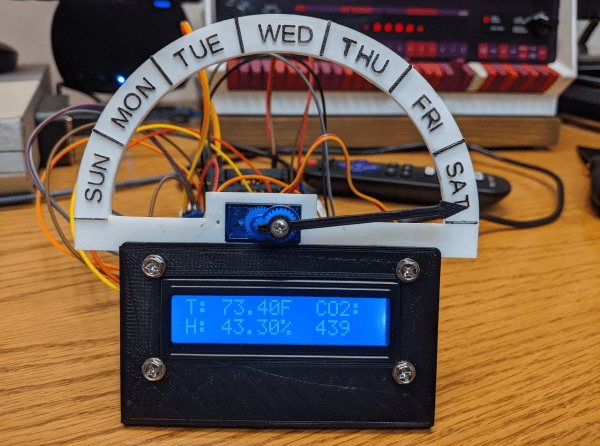
While this is definitely one of the simpler clock projects we’ve seen, this simplicity offers actually a great introduction to some easy JavaScript-based web displays on a Raspberry Pi without much fuzz and distraction. But if that’s not your thing, and you like things more mechanical, we’ve recently covered this day clock that follows the same idea, and then there’s also this light box for an artistic approach of getting a rough estimate of the time.

Planetary Gears Tell Time In This Ornamental Clock

A clock is perhaps one of the the most popular projects among makers. Most designs we see are purely electronic and do not bother with the often more complicated mechanical part. Instructables user [Looman_projects] though was not afraid of calculating gear ratios and tooth counts for his planetary gear clock.

As shown in the picture, a planetary gear, also known as epicyclic gear, consists of three parts: a central sun gear, planetary gears moving around the sun gear and an outer ring with inward-facing teeth holding it all together. The mechanism dates back to ancient Greece but is still being used in car transmissions and has become quite popular in 3D printing. In his instructable [Looman_projects] has some useful inlinks including an explanation video of how planetary gear sets work and a website helping you to calculate the tooth counts for specific gear ratios. It is also noteworthy that he tried to cut the gears from aluminum with a waterjet which unfortunately failed because the parts were too small. What makes the clock visually stand out is the beautiful ornamental see-through design of the dial plate and hands made from laser-cut wood. Despite the mechanical gearbox, it is not surprising that the driving mechanism is based on ubiquitous pieces of digital electronics including an Arduino Nano, DS3231 RTC module, and a stepper motor. To avoid a cabling mess [Looman_projects] designed a custom PCB that interconnects all the electronics and says he even got some spare PCBs left for people interested in rebuilding the clock.

Actually, this is not the first laser-cut planetary gear clock that we have seen. In case you are wondering about the advantages of planetary gearboxes, you might want to check out how a 3D printed version is lifting an anvil.

Continue reading “Planetary Gears Tell Time In This Ornamental Clock”

Seven-Segment Single-Steps Through The Time

Have you ever looked at the time, and then had to look again because it just didn’t register? This phenomenon seems more prevalent with phone timepieces, but it’s been known to happen with standard wall clocks, too. This latest offering in a stream of unusual clocks fashioned by [mircemk] solves that problem by forcing the viewer to pay attention as the time flashes by in a series of single digits, separated by a hyphen.

Inside the boxy blue base is an Arduino Nano, a DS3231 real-time clock module, and a perfboard full of transistors for switching the LED strips inside the segments. There’s an LED on the front that blinks the seconds, and honestly, we’re kind of on the fence about this part. It would be nice if it faded in and out, or was otherwise a little less distracting, but it did grow on us as we watched the demo.

We love the way this clock celebrates the seven-segment display, and only wish it were much bigger. The STLs and code are available if you want to make one, though they only cover the 7-segment part — the base is made of foam board. Check out the demo and build video after the break.

Would you rather hear the time go by in gentle chimes? Here’s chime clock that uses old hard drive actuators.

Continue reading “Seven-Segment Single-Steps Through The Time”