Most people who are serious about designing, building, or improving 3D printers see the Midwest Reprap Festival as the place where the latest and greatest is on show for all to see. But if you live on the other side of the world as I do, chances are slim that you’ll be able to attend.
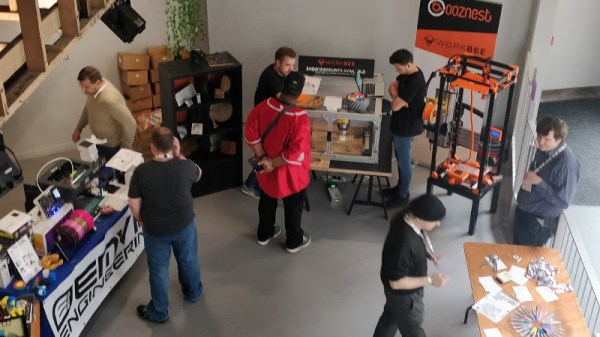
I live in the UK, and there haven’t traditionally been any events quite like MRRF, but that may be changing. The 3D Meetup UK in Birmingham is a community-organised event bringing together the 3D printing maker and hacker community for a couple of days of talks, demonstrations, and tours. I went along this year to see what was going on, and to take the temperature of the British side of this community.
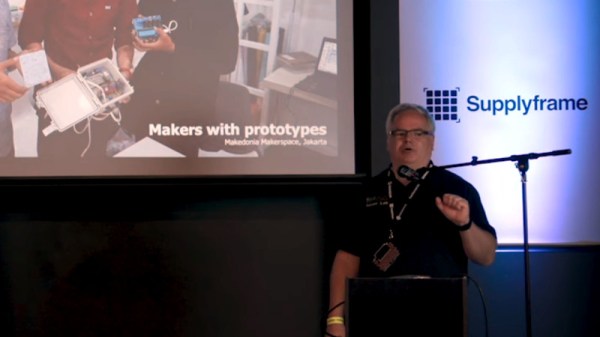
Throughout the six years of the Hackaday Prize we have seen a stream of projects tackling all manner of applications and challenges. Many of them have a goal of addressing issues faced by people in developing countries, and this was the topic upon which Rob Ryan Silva spoke at the Hackaday Superconference.
Rob’s perspective is an interesting one: he runs the maker lab at Development Alternatives Incorporated, or DAI, who are best described as a specialist contractor in the international development sector. Thus while many of the Prize entrants are hardware hackers who have become involved in development related projects, he is a development specialist who has made the opposite journey to becoming a hardware hacker.
Join me below for the video of Rob’s talk and a deep dive into it. Also of note, tickets for the 2019 Hackaday Superconference are now available, the Call for Proposals is now open, and of course, the 2019 Hackaday Prize is ready for your entry! Okay, now onto Rob’s talk.
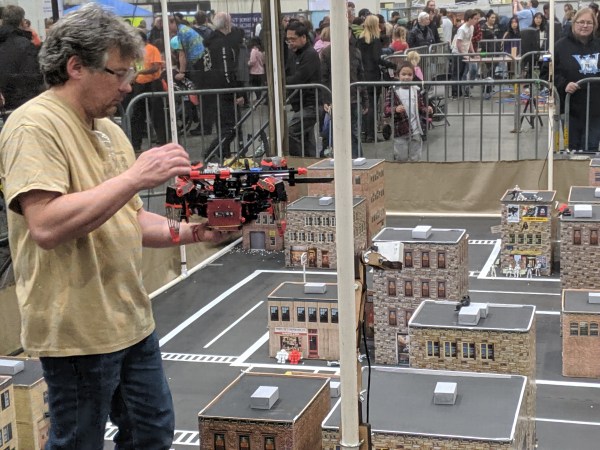
The sound a set of machined robot legs tapping on concrete make is remarkable. If for nothing more, the video after the break is worth watching just for this. It’s what caught my attention when I first wandered by the Mech Warfare area at Maker Faire, as one of the competitors had their bot out wandering around as a demo during the setup day.
Installing target plate
Making sure the ammo is set to go
This is truly a hacker’s robotics competition. There are constraints, but there’s also a lot of room for freedom. Meet a dozen or so requirements and you be as creative as you want with the rest. My favorite part is that this is not a destructive event like many the battle-based robot TV shows that tend to turn my stomach. Instead, these robots each carry an electric AirSoft gun and seek to hit any of four target panels on their competitor’s robot. Continue reading “Mech Warfare: Like Driving A Building-Sized Robot Through A Busy City”→
Blade Runner showed us a dystopian megatropolis vision of Los Angeles in the far-off future. What was a distant dream for the 1982 theater-goes (2019) is now our everyday. We know Los Angeles is not perpetually overcast, flying cars are not cruising those skies, and replicants are not hiding among the population. Or… are they?
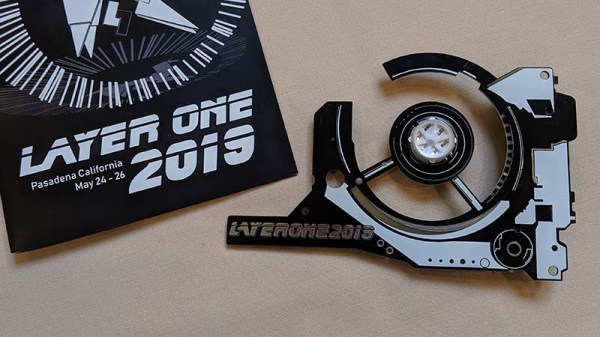
The LayerOne conference takes place in greater Los Angeles and this year it adopted a Blade Runner theme in honor of that landmark film. My favorite part of the theme was the conference badge modeled after a Voight-Kampff machine. These were used in the film to distinguish replicants from humans, and that’s exactly what this badge does too. In the movies, replicants are tested by asking questions and monitoring their eyes for a reaction — this badge has an optional eye-recognition camera to deliver this effect. Let’s take a look!
It has been fascinating to watch the rise of the #BadgeLife community in North America, and a little sad when viewed from a European perspective that their creative vibrancy has not quite fully made it across the Atlantic. It’s pleasing therefore to report on something traveling in the opposite direction. We’ve found a #BadgeLife creation that’s as American as they come, but which hides a bit of European flavor under its shell.
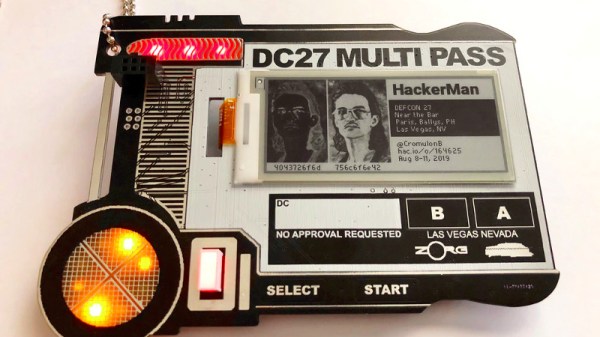
The DC27 Multi Pass is a Def Con indie badge themed as a prop from the film The Fifth Element. That is not its only trick though, because under the hood it runs the ESP32-based badge.team, the badge software platform created by the team from the Netherlands who brought us the SHA 2017 and Hacker Hotel 2019 badges. Like those two it sports an e-ink screen and a set of touch buttons, which they’ve very neatly incorporated into the Multi Pass design. The badge.team ecosystem brings with it a fully-functional and stable hackable badge platform with MicroPython apps and an app library (We won’t call it a store, it’s all free!) referred to as the hatchery. There is even a Hackaday logo nickname, should you have one of these badges and wish to identify yourself as a reader.
The launch of a new #BadgeLife badge is always cool, but with the best will in the world it is not in itself news. Where this one does, however, get interesting is that it proves that badge.team is a viable route to getting full event badge functionality into an indie badge without the heartache of creating a software platform. It also serves as a fascinating perspective on why the USA has spawned its artistic badge scene while Europe has less diversity. The whole Def Con experience is extremely expensive, while European hacker camps are relatively not so. There is no need for a European hacker to finance their trip to EMF Camp by selling badges, so for many people, the impetus to create finds its outlet in other directions. It would be nice to think that European badge scene will in time evolve as far as the US one, but meanwhile, it’s good to see the Netherlands community supplying their platform to what we think will be a very interesting Def Con indie badge.
The artistic elite exists in a stratum above we hoi polloi, a world of achingly trendy galleries, well-heeled collectors, and art critics who act as gatekeepers to what is considered the pinnacle du jour of culture. Artistic movements that evolve outside this bubble may be derided or ignored as naive and unsophisticated, even in complete denial of their raw creative edge. When they are discovered by the establishment a few of their artists are selected and anointed, while inevitably the crucible in which they were formed is forgotten. On the streets of Bristol the incredible work of far more graffiti artists can be seen than just that of Banksy.
Our community has an art form all of its own, in the guise of PCB artwork and the #BadgeLife community. One day you will see electronic badges from darlings of the art world behind glass in those trendy galleries, but for now they live in glorious abundance in the wild. Here at Hackaday we are lucky enough to have in Brian Benchoff a colleague who is pushing the boundaries of PCB art, and at the Hackaday Superconference he took us through one of his more recent pieces of work.
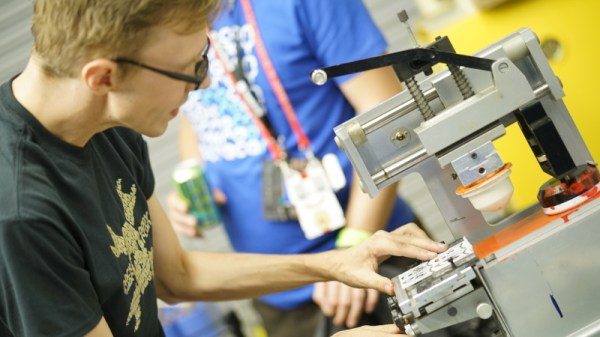
Brian’s pad printer.
The colour palette of a typical printed circuit board is limited by the combination of fibreglass, copper, soldermask, plating, and silkscreen its designer selects. Thus while the variety of soldermask colours and plating materials can make for an eye-catching work, they have remained a colour-tinted near monochrome. The Holy Grail of the PCB artist has been to step into the world of full colour, and Brian has been pursuing that goal by exploring pad printing to produce extra colours beyond the sodermask..
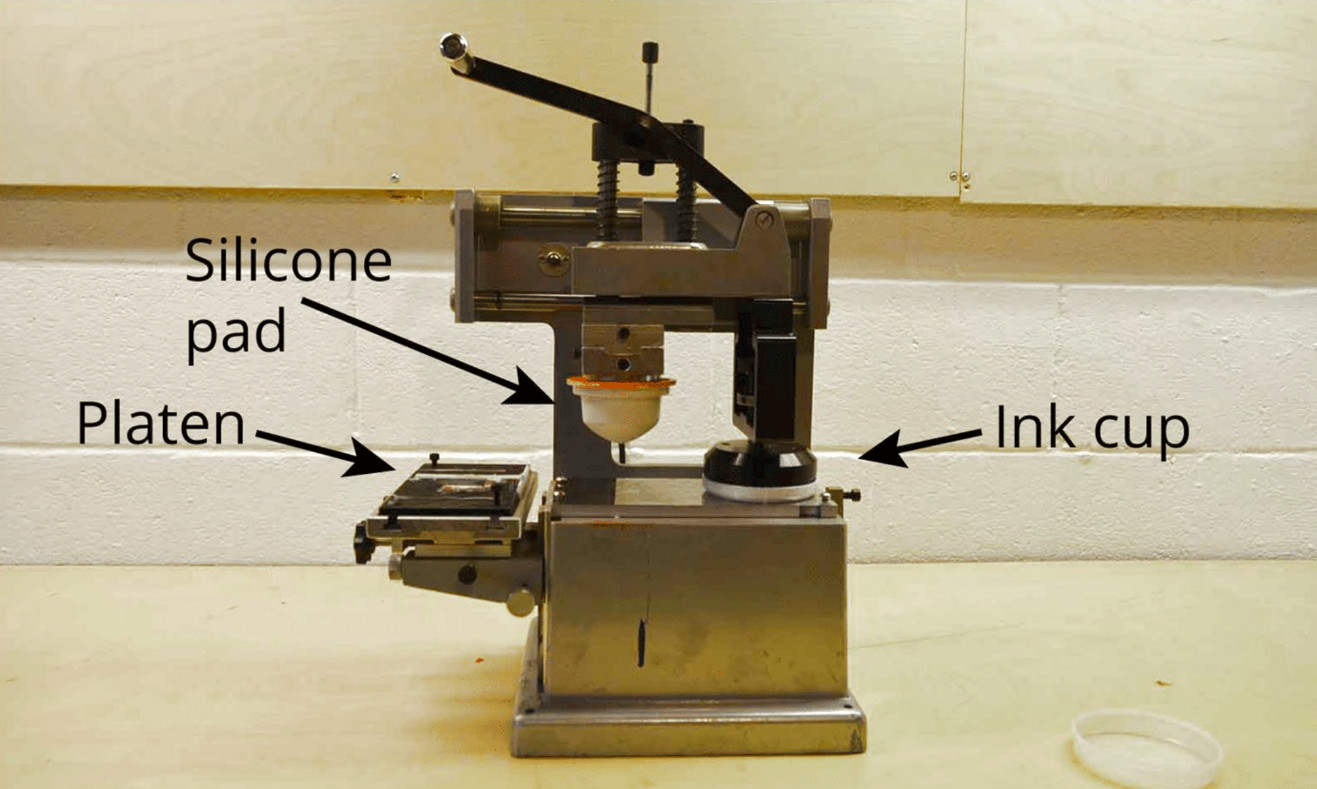
It’s a subject he’s written about here in the past, and he introduces it in the talk with a look at existing badge artwork and a mention of an expensive commercial inkjet process before considering the type of printing you see daily on the sides of promotional pens. Those company titles are deposited on pens using pad printing, an offset process in which ink is first deposited upon a photo-etched metal plate before being picked up on a silicone rubber pad for transfer to the object to be printed. It’s not the panacea for all coloured-PCB tasks, but for adding relatively small blocks of pigment to an otherwise monochromatic board it can be very successful.
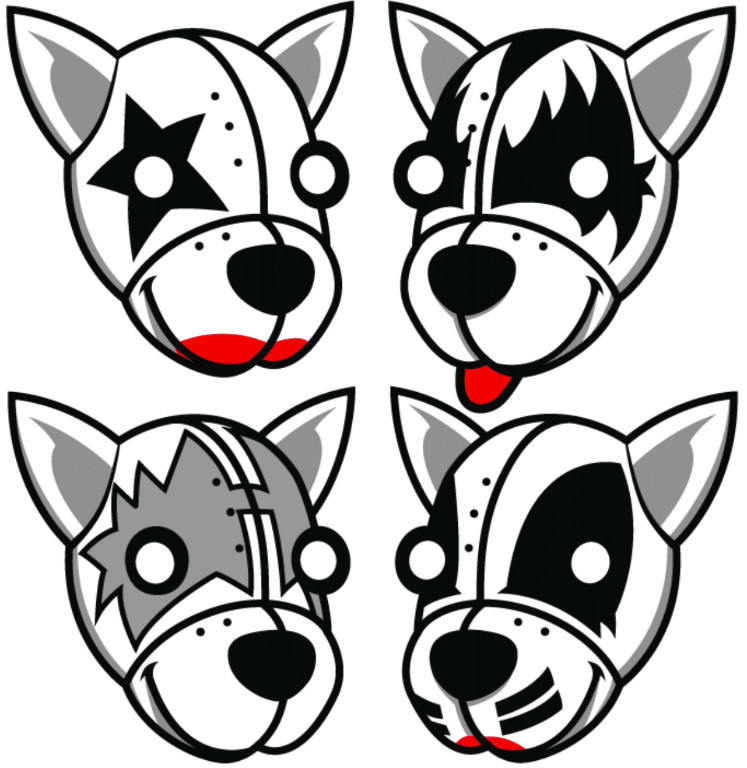
The eye-catching Kiss -themed Tindie badges.
Brian’s examples are a panelised set of Tindie badges as a homage to the rock band Kiss, and his Tide pod addon containing a serial number in an EEPROM that was part of a Blockchain-inspired game. The Kiss Tindie badges use black soldermask with extensive white silkscreen and a modest area of red pad printing for the stage makeup, while the Tide addon makes clever use of the same swoosh printed in alternate colours at 180 degrees to each other.
In both cases there is some labour involved in creating the prints, and as his detailed write-up of printing the Tide pods reminds us, the process of creating the printing plate is not exactly an easy one. But it remains the best way yet to add extra colours to a board without paying a small fortune for the inkjet process, and if you’d like to put your own designs at the bleeding edge of PCB art you might wish to read his writeups and watch the video below the break.
This is just one example of the kind of manufacturing techniques, and electronic design principles on display at the Hackaday Superconference. There’s another Supercon just around the corner, so grab your ticket and send in your own talk proposal right away!
Stop what you’re doing and get your ticket to the Hackaday Superconference. This is the ultimate hardware conference, November 15th, 16th, and 17th in Pasadena, California. It will sell out, especially the early bird tickets which are certain to be snapped up before the end of this day. (Edit: Early Bird tickets are already sold out, but you can still get the Early Bird price by submitting a talk).
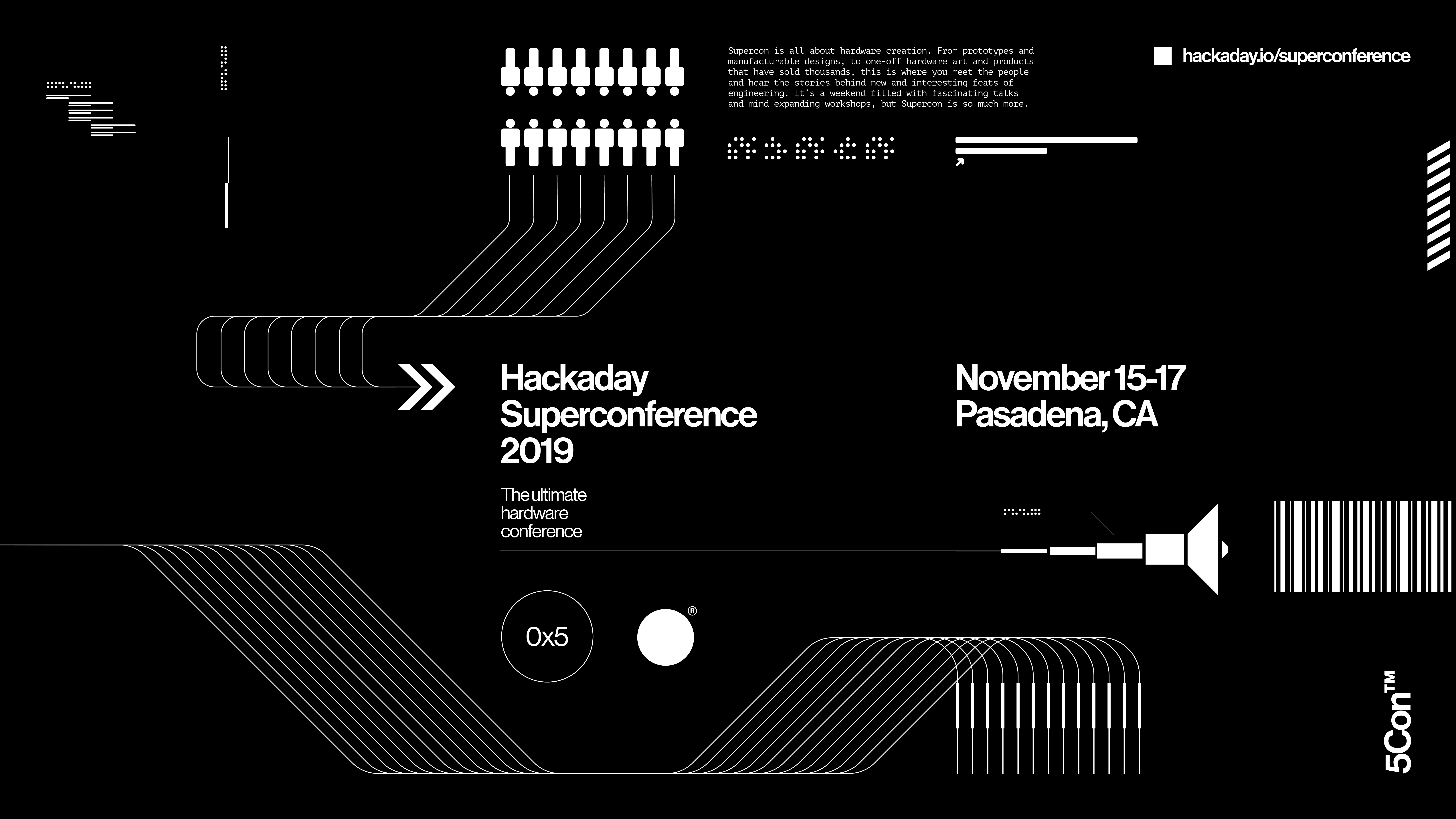
Supercon is all about hardware creation. From prototypes and manufacturable designs, to one-off hardware art and products that have sold thousands, this is where you meet the people and hear the stories behind new and interesting feats of engineering. It’s a weekend filled with fascinating talks and mind-expanding workshops, but Supercon is so much more.
This is a Hacker Village where the greenest beginner and the grayest veteran sit shoulder to shoulder to solder, to code, to dream of the future, and to share stories of the past. We want you here, and you need to make it happen. Whether it’s professional development (yes! ask your boss to make this a business outing) or your hard-earned vacation, Supercon will recharge your batteries and top off your inspiration for the year to come.
Yes, I’m talking to you. Core to the mission of the Hackaday Superconference is to encourage more people to speak publicly about everything that goes into designing and manufacturing hardware. This means we want first time speakers just as much as we want seasoned presenters. You will be celebrated at Supercon; the ethos of this community is warm, welcoming, and thankful that you took the time to help everyone learn something interesting.
Don’t stop to ask yourself if you should… yes, we want to read your talk proposal. No topic is too big or too small for consideration. This is your chance to give back as a thank-you to so many people who have helped you gather your own skills over the years. We stand on the shoulders of giants, it’s your turn to be giant.
True Believer Tickets
We like to think of our Early Bird tickets as a nod to the true believers out there. We haven’t published the speakers, the workshops, or really anything else. That info will be public as everything comes together, but by then it may be too late to get a ticket. Right now all we can tell you for certain is that there will be a big celebration to name the grand prize winner of the 2019 Hackaday Prize, there will be a ton of badge hacking on a mind-blowing hardware badge being designed by Sprite_TM (Jeroen Domburg), you will have way too much fun and get far too little sleep, and tickets will sell out. In other words, this will be awesome.
Competitive soldering
Hackaday Prize winners
Opening ceremonies were packed tight!
Workshops in full swing
Badge hacking throughout the weekend
Standing room only as Ben Krasnow gives the last talk of the conference on Sunday
Need more convincing? You can watch the recap video from 2018, or dive into the weekend overview, badge-hacking, and competitive soldering roundups. I’ve never met anyone from the first four years of Supercon who regretted buying early bird tickets. I’ve met plenty of people who regretted missing out. Don’t miss out on year five of the movement. This is your community, there is truly something for everyone, and Pasadena is a beautiful place to be in the middle of November. See you at Supercon!