For everyone who will be here in person, the entire Hackaday crew is busy as beavers preparing for your arrival. We’re assembling badges, rigging AV for the talks, stuffing goodie bags, calling caterers, and taping cables to the floor. This is by far the biggest Superconference yet.
Doors open at 9 am Friday at the Supplyframe HQ. This is your first chance to get your hands on the fantastic Supercon Badge that’s a freakin’ computer. The day is filled with badge hacking, workshops, badge talks, and a launch party. [Rich Hogben] and [Andrew Bakhit] will be doing live IDM sets on Friday night, as we celebrate into the wee hours of the morning.
Saturday, doors open at 9 am over at the Supplyframe Design Lab as we turn on the livestream and get the main event under way with over 50 speakers and workshops. Badge hacking continues throughout the weekend, and this year we’ve added the SMD Soldering Challenge to the fun. There will be meetups during Supercon; the Tindie meetup and the amateur radio meetup are both Saturday at 1 pm.
Over the weekend, the last available tickets to the Hackaday Superconference vanished. This will be the fullest, most exciting, hack-packed Supercon ever.
We’ve always had a stunning slate of speakers. It’s hard to objectively say we will top previous years, but yes this collection of talks is an insane concentration of hardware speakers that tops anything we’ve seen before. You can’t look at the schedule without feeling an electric jolt of excitement. The good news is you can still get in on those talks. Bookmark this Hackaday Superconference Live-Stream which begins at 10 am PDT on Saturday, November 3rd.
Of course, talks are only one component of Supercon. The secret sauce has always been the people at the con. If you’re not joining us, we still need you to take part. There is a conference chat on Hackaday.io and all are welcome. Pop in and visit with people at the con, and others around the globe who wish they could have made it in person.
Make sure you’re on the live stream Saturday evening to watch as the Grand Prize is presented on stage during the Hackaday Prize Ceremony. Follow along throughout the weekend on social media with the #Supercon tag. Pop into the chat and ask for updates on badge hacking, the SMD Soldering Challenge, and all of the other shenanigans that make Supercon super. We look forward to seeing hundreds of you in Pasadena starting this Friday, and thousands of you online through out the weekend!
Hackaday Superconference is just a week away (precious few tickets remain), a celebration of all things Hackaday, which naturally includes creative projects making the most of their hardware. Every attendee gets a platform for hacking in the form of the conference badge.
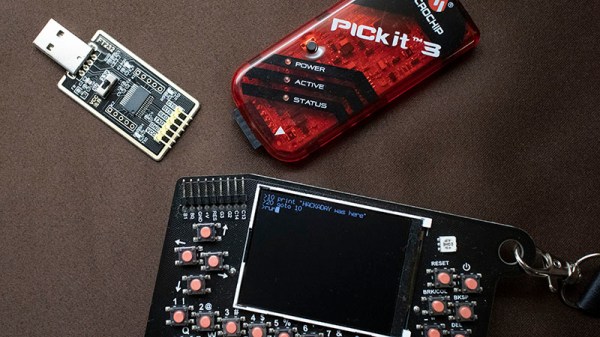
To make the most of your badge hacking fun, plan ahead so you will have the extra components and the tools you need. At the most basic, bring along a serial to USB cable and a PIC programmer. These are common and if you don’t own them, ask around and you will likely be able to borrow them. Now is also the time to put in a parts order for any components you want to use but don’t have on hand!
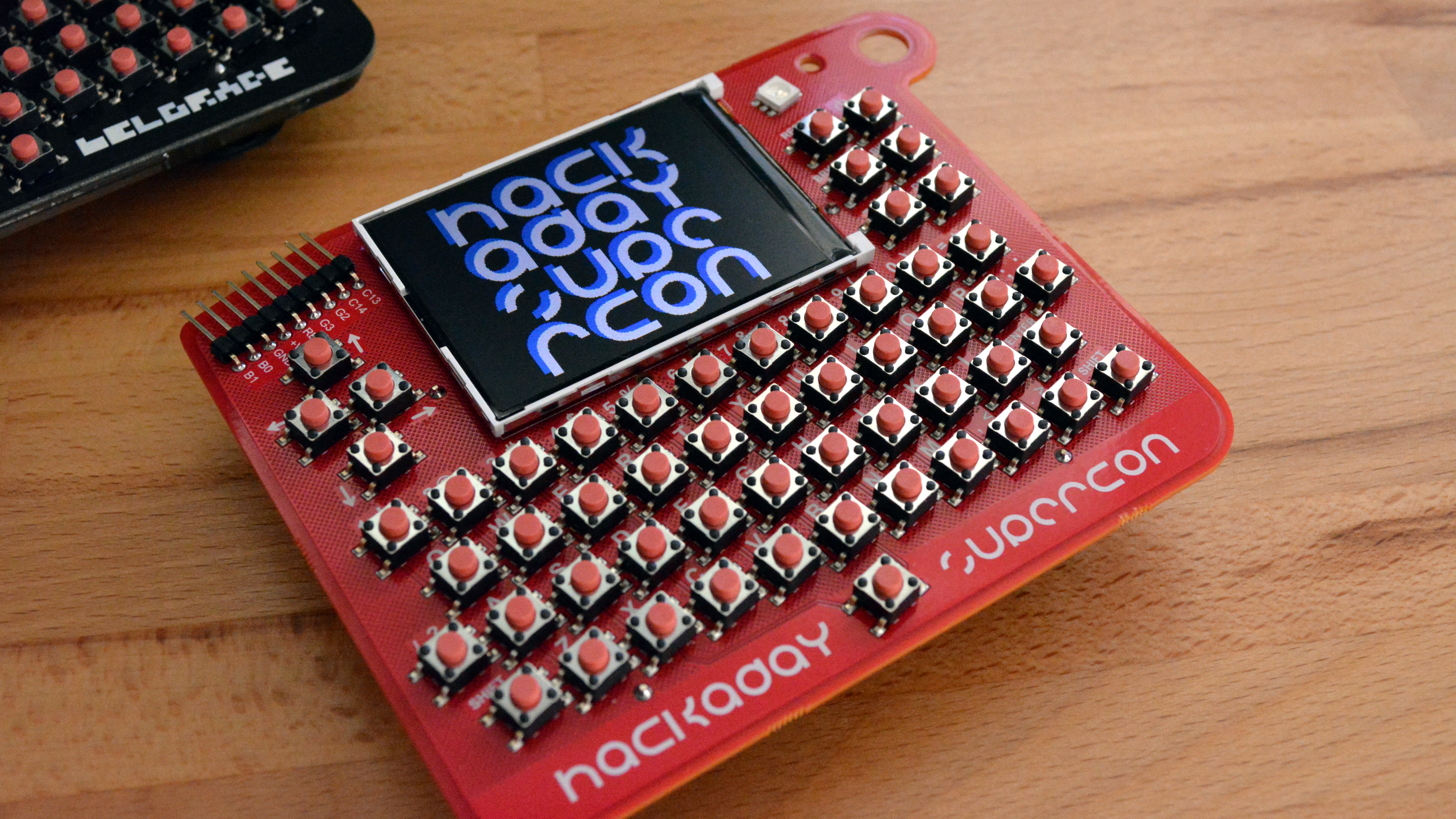
The badge is hackable without any extras, but it’s designed for adding hardware and hacking the firmware. We’re excited to see what you can do with it. We gave an overview of this retro themed pocket computer a few days ago, today we’re inviting you to exploit its potential for your hardware hacks.
Let’s play a guessing game. Shown here is a sneak peek at the rear view of a hardware demo being built specifically for the Hackaday Superconference in Pasadena this November 2-4. It’s sure to be a crowd pleaser when finished, but if you’re anything like us, studying what’s behind the finished face of a project like this is even more satisfying than seeing the final product.
If you think you know what it is, you can score yourself a free hardware badge from the conference! Leave a comment below with your best guess about what this is — we’ll pick whoever is closest to win the badge.
The red round board at the bottom is the PIR motion sensor, the part of another project which is not related neither to HAL nor to the badge. There is a clearly visible 915 MHz module, which is disconnected and has no function in this project.
It is connected to the lower left Raspberry just because it has to be supplied with about 3V and it uses Raspberry’s LDO. It also generates Reset signal for all four Raspis, as it turned out that the 5V supply (bottom right) delivers the slow-rise voltage when turned on, so Raspis won’t boot at all without the external Reset.
When someone walks in front of HAL, motion sensor randomly triggers one of 30 HAL’s sentences from the movie. That’s why the lower left Raspberry is connected to the amplifier and has an extra wire from the motion sensor board to GPIO 24.
And the demo video:
The Prize for Guessing Correctly:
Voja Antonics builds beautiful hardware. The Hackaday Superconference badge is a piece of art, as is the Hal 9000 console. Voja will be at Supercon along with hundreds of other awesome hackers. Come join us for a weekend you’ll never forget!
Wiring is one of those things that we’ve all had to do on a project, but probably didn’t give a lot of thought to. It’s often the last thing that happens during the build, and almost certainly doesn’t get approached with any kind of foresight. You look at the components you need to connect, dig through the parts bins until you find something that looks like it should fit, and tack it in with a blob of solder and perhaps some hot glue if you’re feeling really fancy. We’re all guilty of it from time to time, but Bradley Gawthrop is here to tell you there’s a better way.
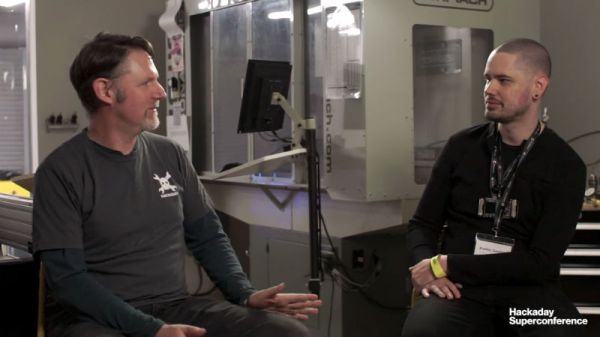
If you’re hoping his talk from the 2017 Hackaday Superconference contains “One crazy trick” for turning your normal rat’s nest of wiring into a harness worthy of the Space Shuttle, sorry to disappoint. Bradley acknowledges it takes some extra planning and a couple specialized tools, but the end results speak for themselves. While his talk is a must-watch for anyone looking to master the arcane arts of electron corralling, his post-talk chat with Elliot Williams after the break is a great primer for the how and why of everyone’s least favorite part of building their own hardware.
Bradley will be at Supercon again this year. It’s one anecdote for the concentration of awesome people you find at the event. We’re now just two seeks away so go get your ticket and then join us after the break for the interview.
It is mind-boggling when you think about the computing power that fits in the palm of your hand these days. It wasn’t long ago when air-conditioned rooms with raised floors hosted computers far less powerful that filled the whole area. Miniaturization is certainly the order of the day. Things are getting smaller every day, too. We were so impressed with the minuscule entries from the first “Square Inch Project” — a contest challenging designers to use 1 inch2 of PCB or less — that we decided bring it back with the Return of the Square Inch Project. The rules really were simple: build something with a PCB that was a square inch.
Grand Prize
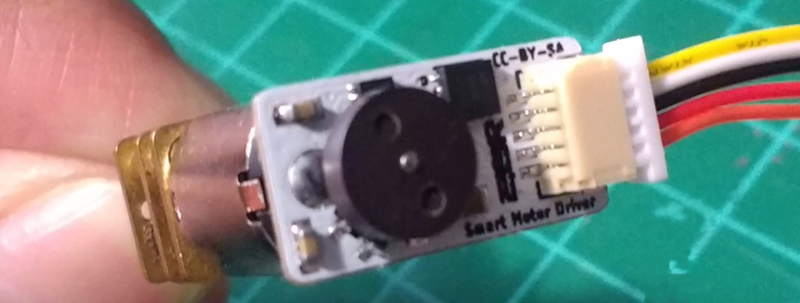
It was hard to pick, but there can only be one grand prize winner. This time around that honor goes to [Danny FR] for a very small smart motor driver for robotics. The little board takes an I2C link to a microcontroller and does PID control with RPM feedback. No need for an H-bridge or any sophisticated control electronics — that’s all onboard.
The board is a great fit for a motor and makes it easy to build moving projects. That was the grand prize, but there were some other great entries that won in specific categories, too.
Best Project
[Drix] likes to know where things are. The Hive Tracker uses laser “lighthouses” that sweep across the room. A special microcontroller with a dedicated hardware block reads the laser light and triangulates its position relative to the lighthouses with a great deal of precision. A picture’s worth a thousand words, so:
The high-speed reading of the lasers uses “Programmable Peripheral Interconnect” — a feature of a Nordic BLE microcontroller that lets the chip read timestamps in hardware without interrupting the processor. The little boards hook up to a hub board which is also pretty small.
We’re hackers, so we think a few bare PCBs connected to another PCB can be artistic. But most people have something different in mind.
Best Artistic Project
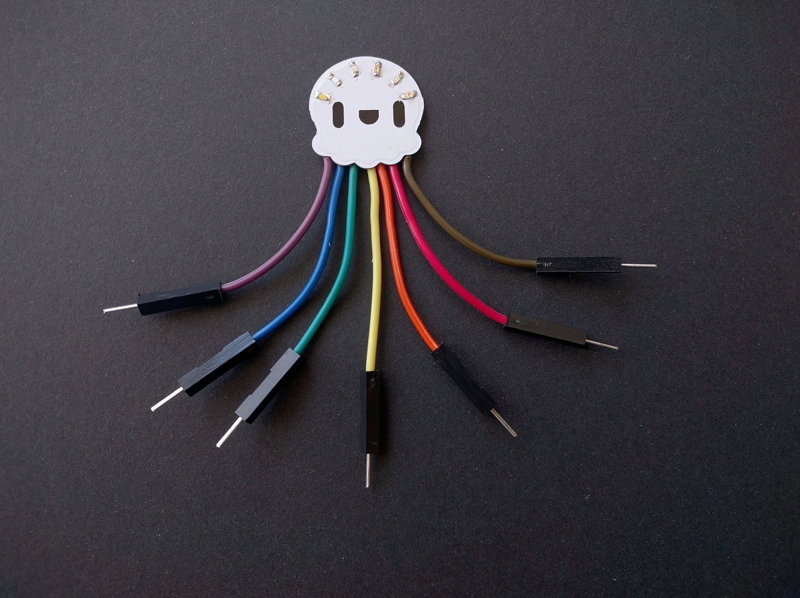
If you hang out at Hackaday.io much, you’ll recognize [ꝺeshipu] and his entry was one of those things that you immediately know you could use, but also brings a little smile to your face when you use it. How often do you need to plug some LEDs into a breadboard? Why not do it with a Rainbow Jellyfish?
The circuit operation should be obvious. We really liked the color-coded wiring. You could probably use at least two of these so they could keep each other company. You could probably even use this as part of a badge.
Best Social Media Award
Speaking of badges, [nwmaker] built a badge that looks like another animal — an owl called PurpleSnowy. Again, the circuit is simple enough, but what caught our eye on this project was how well the social media promotion of it was. Maybe cute owls are just easier to go viral, but we liked it.
Best Documentation
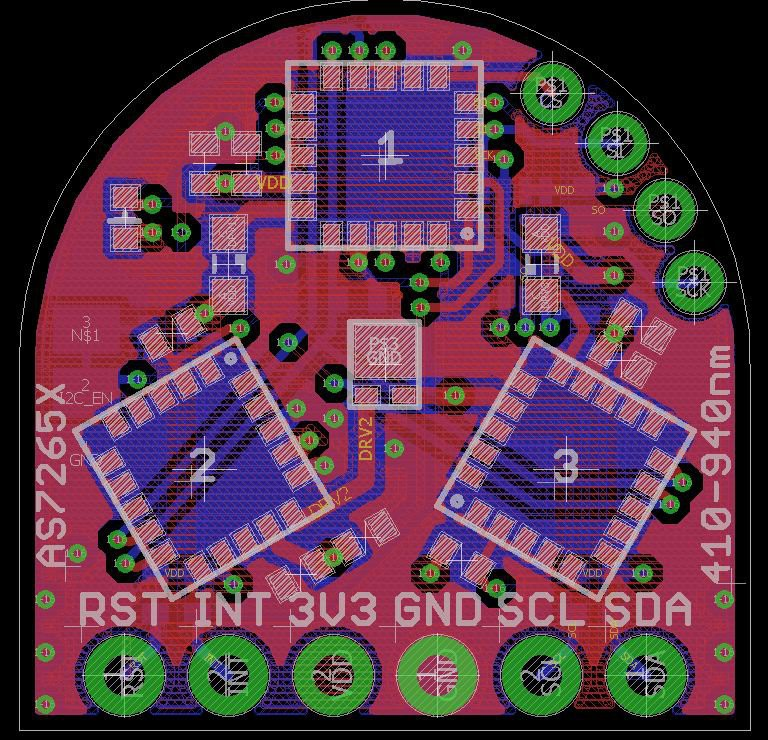
[Kris Winer] (remember that name), built a very high-tech spectrometer project. Not only was it small in size, but at $25 it was also small in price. The project used the AMS AS7265X 3-chip set to provide an 18 channel, 20 nm FWHM spectrometer. The documentation was very well done and we were impressed with the fitment of the chips on the board.
Many Runners-Up
We had so many great entries that it was hard to pick so we named several runners-up.
[Greg Davill’s] Bosun frame grabber that uses an FPGA to capture images from a FLIR Boson camera.
[Kris Winer’s] high-tech $25 spectrometer project (from above) was also runner-up, and [Kris] was also recognized for sensors that can smell and hear.
If you want something less science-related, the Rotovis-Mod1 by [zakqwy] makes it easier to build persistence of vision displays. Of course, as hackers, we love an oscilloscope and [Mark Omo’s] 20 msps scope that fits in one inch caught our imagination for making some really cool instrument panels.
You really should look at all the entries — they were amazing. [Kris] really went all out, taking two runner up slots and the best documentation prize.
Recap:
Speaking of prizes, The grand prize was $500, and the other prizes received $100 Tindie gift certificates. Thanks to OSH Park, the runner ups also got $100 OSH Park gift cards — that’s a lot of one inch PCBs.
Will this be our last inch square contest? The magic 8 ball says probably not, so don’t stop thinking small and look for your chance to enter your design in the next contest.
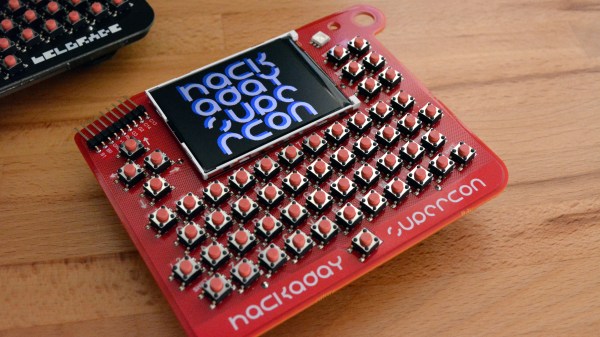
It hangs around your neck, comes with the cost of admission, and would blow away a desktop computer from the 1980’s. This is the Hackaday Superconference badge and you can get your hands on one for the price of admission to the ultimate hardware conference.
Everyone through the door gets one of these badges featuring a 320 x 240 color display, a full qwerty keyboard, and limitless hacking potential! The stock firmware runs a BASIC interpreter, the CP/M operating system, and includes games and Easter Eggs. It’s a giant playground, and we want to see what you can do with this custom hardware during the three days of Supercon. Get your ticket now, then join me after the break for a demo video and plenty more info.


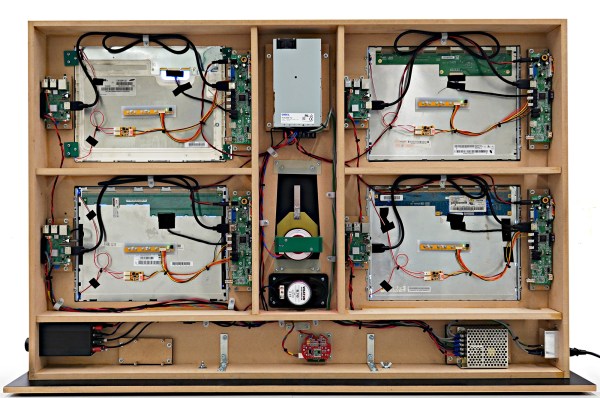














The red round board at the bottom is the PIR motion sensor, the part of another project which is not related neither to HAL nor to the badge. There is a clearly visible 915 MHz module, which is disconnected and has no function in this project.
It is connected to the lower left Raspberry just because it has to be supplied with about 3V and it uses Raspberry’s LDO. It also generates Reset signal for all four Raspis, as it turned out that the 5V supply (bottom right) delivers the slow-rise voltage when turned on, so Raspis won’t boot at all without the external Reset.
When someone walks in front of HAL, motion sensor randomly triggers one of 30 HAL’s sentences from the movie. That’s why the lower left Raspberry is connected to the amplifier and has an extra wire from the motion sensor board to GPIO 24.