See Actual Microwaves — No More Faking It

Last week we saw a lot of interest in faux visualization of wireless signals. It used a tablet as an interface device to show you what the wireless signals around you looked like and was kind of impressive if you squinted your eyes and didn’t think too much about it. But for me it was disappointing because I know it is actually possible to see what radio waves look like. In this post I will show you how to actually do it by modifying a coffee can radar which you can build at home.

The late great Prof. David Staelin from MIT once told me once that, ‘if you make a new instrument and point it at nature you will learn something new.’ Of all the things I’ve pointed Coffee Can Radars at, one of the most interesting thus far is the direct measurement and visualization of 2.4 GHz radiation which is in use in our WiFi, cordless phones (if you still have one) and many other consumer goods. There is no need to fool yourself with fake visualizations when you can do it for real.

Continue reading “See Actual Microwaves — No More Faking It”

How CMOS Works: Some Final Words About CMOS

Finishing up on the topic of CMOS bus logic I am going to show a couple of families with unique properties that may come in handy one day.

High Voltage Tolerant Family: AHC/AHCT

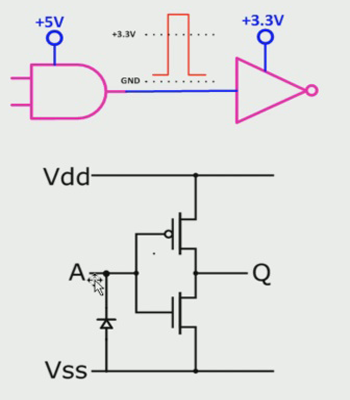
AHCT w/o high side diode
Note the missing diode to VDD

First up is a CMOS logic family  AHC/AHCT that has one of the protection diodes on the input removed.  This allows a 5V input voltage to be applied to a device powered by 3.3V so that I don’t have to add a gate just for the translation.  Any time I can translate and do it without any additional gate delays I am a happy engineer.

Of course the example above works in a single direction and bidirectional does start to get more complicated. Using a bidirectional buffer such as a 74AHCT245 will work for TTL translation when going from 3.3V back to 5V providing there is a direction control signal present.

Continue reading “How CMOS Works: Some Final Words About CMOS”

You Can Have My TIPs When You Pry Them From My Cold, Dead Hands

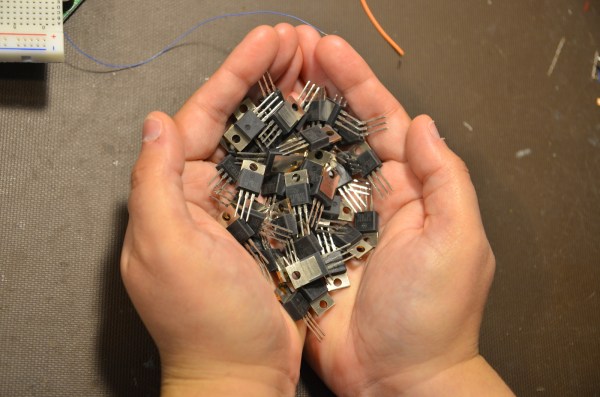
We’ve seen a growing number of posts and recommendations around the net regarding components, specifically transistors. “Don’t use old parts” they cry,  “Go with newer components.”  You can often find these recommendations on Arduino forums. This all came to a head with a page called “Do Not TIP,” which was linked in the Arduino subreddit.  This page belongs to [Tom Jennings], creator of Fidonet, and one of the early authors of what would become Phoenix BIOS. [Tom] and a few others have been calling for everyone to send their old parts to the landfill – not use them, nor gift them to new experimenters. Get them out of the food chain. No offense to [Tom], but we have to disagree. These parts are still perfectly usable for experienced designers, and have a lot to offer new hardware hackers.

TIP is the part number prefix for a series of power transistors created by Texas Instruments.  In fact, “TIP” stands for Texas Instruments Power. The series was originally released in 1969. Yes, that’s right, 1969. Why are we still using parts designed when man first walked on the moon? The same reason people are still using the 555 timer: they’re simple, they’re easily available, they’re robust, and most of all, they get the job done. The TIP series has been used in thousands of classes, tutorials both online and off, and millions of projects over the years. Much of that documentation is already out there on the internet. The TIP series is also out in the distribution channel – they’ve been used for 40 years. Any retail shop that stocks a few electronics parts will have at least one of the TIP series.

The TIP series aren’t always the best transistors for the job. However, for most hobbyist-designed circuits, we don’t need the best performance, nor the best price – we’re going to use the parts we have on hand. There is always room to improve once you get the basic circuit working.

Continue reading “You Can Have My TIPs When You Pry Them From My Cold, Dead Hands”

Hacking A Universal Assembler

I have always laughed at people who keep multitools–those modern Swiss army knives–in their toolbox. To me, the whole premise of a multitool is that they keep me from going to the toolbox. If I’ve got time to go to the garage, I’m going to get the right tool for the job.

Not that I don’t like a good multitool. They are expedient and great to get a job done. That’s kind of the way I feel about axasm — a universal assembler I’ve been hacking together. To call it a cross assembler hack doesn’t do it justice. It is a huge and ugly hack, but it does get the job done. If I needed something serious, I’d go to the tool box and get a real assembler, but sometimes you just want to use what’s in your pocket.

Continue reading “Hacking A Universal Assembler”

Quantum Mechanics In Your Processor: Quantum Computing

Not long after [Hitler] took control of Germany, his party passed laws forbidding any persons of Jewish descent from holding academic positions in German Universities. This had the effect of running many of the world’s smartest people out of the country, including [Albert Einstein]. Einstein settled into his new home in Princeton, and began to seek out bright young mathematicians to work with, for he still had a bone to pick with [Niels Bohr] and his quantum theory. It wasn’t long until he ran into an American, [Nathan Rosen] and a Russian, [Boris Podolsky]. The trio would soon lay before the world a direct challenge that would strike at the very core of quantum theory’s definition of reality. And unlike the previous challenges, this one would not be so easily dismissed by [Bohr].

Need a bit of catching up? You can check out Complimentarity as well as Tunneling and Transistors but  that is just some optional background for wrapping your head around Quantum Computing.

The EPR Argument

On May 4th, 1935, the New York Times published an article entitled “Einstein Attacks Quantum Theory”, which gave a non technical summary of the [Einstein-Podolsky-Rosen] paper. We shall do something similar.

Continue reading “Quantum Mechanics In Your Processor: Quantum Computing”

Build Your Own CPU? That’s The Easy Part!

You want to build your own CPU? That’s great fun, but you might find it isn’t as hard as you think. I’ve done several CPUs over the years, and there’s no shortage of other custom CPUs out there ranging from pretty serious attempts to computers made out of discrete chips to computers made with relays. Not to trivialize the attempt, but the real problem isn’t the CPU. It is the infrastructure.

What Kind of Infrastructure?

I suppose the holy grail would be to bootstrap your custom CPU into a full-blown Linux system. That’s a big enough job that I haven’t done it. Although you might be more productive than I am, you probably need a certain amount of sleep, and so you may want to consider if you can really get it all done in a reasonable time. Many custom CPUs, for example, don’t run interactive operating systems (or any operating system, for that matter). In extreme cases, custom CPUs don’t have any infrastructure and you program them in straight machine code.

Machine code is error prone so, you really need an assembler. If you are working on a big machine, you might even want a linker. Assembly language coding gets tedious after a while, so maybe you want a C compiler (or some other language). A debugger? What about an operating system?

Each one of those things is a pretty serious project all by itself (on top of the project of making a fairly capable CPU). Unless you have a lot of free time on your hands or a big team, you are going to have to consider how to hack some shortcuts.

Continue reading “Build Your Own CPU? That’s The Easy Part!”

Quantum Mechanics In Your Processor: Tunneling And Transistors

By the turn of the 19th century, most scientists were convinced that the natural world was composed of atoms. [Einstein’s] 1905 paper on Brownian motion, which links the behavior of tiny particles suspended in a liquid to the movement of atoms put the nail in the coffin of the anti-atom crowd. No one could actually see atoms, however. The typical size of a single atom ranges from 30 to 300 picometers. With the wavelength of visible light coming in at a whopping 400 – 700 nanometers, it is simply not possible to “see” an atom. Not possible with visible light, that is. It was the summer of 1982 when Gerd Binnig and Heinrich Rohrer, two researchers at IBM’s Zurich Research Laboratory, show to the world the first ever visual image of an atomic structure. They would be awarded the Nobel prize in physics for their invention in 1986.

The Scanning Tunneling Microscope

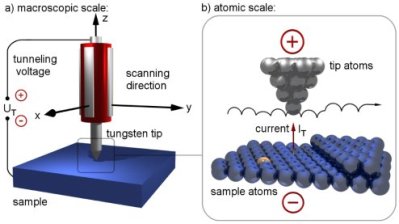
IBM’s Scanning Tunneling Microscope, or STM for short, uses an atomically sharp needle that passes over the surface of an (electrically conductive) object – the distance between the tip and object being just a few hundred picometers, or the diameter of a large atom.

stm
[Image Source]
A small voltage is applied between the needle and the object. Electrons ‘move’ from the object to the needle tip. The needle scans the object, much like a CRT screen is scanned. A current from the object to the needed is measured. The tip of the needle is moved up and down so that this current value does not change, thus allowing the needle to perfectly contour the object as it scans. If one makes a visual image of the current values after the scan is complete, individual atoms become recognizable. Some of this might sound familiar, as we’ve seen a handful of people make electron microscopes from scratch. What we’re going to focus on in this article is how these electrons ‘move’ from the object to the needle. Unless you’re well versed in quantum mechanics, the answer might just leave your jaw in the same position as this image will from a home built STM machine.

Continue reading “Quantum Mechanics In Your Processor: Tunneling And Transistors”