Farewell American Computer Magazines

I grew up in a small town with a small library. The next town over had what I thought at the time was a big library, but it was actually more like my town had a tiny library, and the next one over had an actual small library. When I left to go to University, I found out what a real library looked like, and I was mesmerized. Books! Lots of books, many of them written in the current decade. My grades probably suffered from the amount of time I spent in the library reading things that didn’t directly relate to my classes. But there was one thing I found that would turn out to be life-changing: A real computer magazine. Last month, Harry McCracken pointed out that the last two widely-distributed American consumer computer magazines ceased paper publication. It is the end of an era, although honestly, it is more like a comatose patient expiring than a shocking and sudden demise.

Dr. Dobb’s first issue was far from the slick commercial magazine it would become.

Actually, before I had gone to college, I did have a subscription to Kilobaud, and I still have some copies of those. No offense to Wayne Green, but Kilobaud wasn’t that inspiring. It was more an extension of his magazine “73”, and while I enjoyed it, it didn’t get me dreaming. Dr. Dobb’s Journal — the magazine I found in the stacks of my University’s library — was tangibly different. There was an undertone of changing the world. We weren’t sure why yet, but we knew that soon, everyone would have a computer. Maybe they’d balance their checkbook or store recipes. A few people already saw the potential of digital music reproduction, although, I must admit, it was so poor at the time, I couldn’t imagine who would ever care.

I say it was life-changing to discover the few issues of Dr. Dobb’s that were published back then because I would go on to contribute to Dr. Dobb’s throughout its storied history. I wrote the infamous DOS extender series, produced special issues, and, when it went mostly digital, was the embedded system blogger for them for more years than I care to admit. In fact, I have the dubious distinction of having the final blog posted; although the website has suffered enough bit rot, I’m not sure any of it has survived other than, maybe, on the Wayback machine. While I wasn’t with the magazine for its entire 38-year run, I read it for at least 35 and had some function there for about 24 of those.

Continue reading “Farewell American Computer Magazines”

Methane-Tracking Satellites Hunt For Nasty Greenhouse Gas Emissions

Much of the reporting around climate change focuses on carbon dioxide. It’s public enemy number one when it comes to gases that warm the atmosphere, as a primary byproduct of fossil fuel combustion.

It’s not the only greenhouse gas out there, though. Methane itself is a particularly potent pollutant, and one that is being emitted in altogether excessive amounts. Satellites are now on the hunt for methane emissions in an attempt to save the world from this odorless, colorless gas.

Continue reading “Methane-Tracking Satellites Hunt For Nasty Greenhouse Gas Emissions”

ChatGPT V. The Legal System: Why Trusting ChatGPT Gets You Sanctioned

Recently, an amusing anecdote made the news headlines pertaining to the use of ChatGPT by a lawyer. This all started when a Mr. Mata sued the airline where years prior he claims a metal serving cart struck his knee. When the airline filed a motion to dismiss the case on the basis of the statute of limitations, the plaintiff’s lawyer filed a submission in which he argued that the statute of limitations did not apply here due to circumstances established in prior cases, which he cited in the submission.

Unfortunately for the plaintiff’s lawyer, the defendant’s counsel pointed out that none of these cases could be found, leading to the judge requesting the plaintiff’s counsel to submit copies of these purported cases. Although  the plaintiff’s counsel complied with this request, the response from the judge (full court order PDF) was a curt and rather irate response, pointing out that none of the cited cases were real, and that the purported case texts were bogus.

The defense that the plaintiff’s counsel appears to lean on is that ChatGPT ‘assisted’ in researching these submissions, and had assured the lawyer – Mr. Schwartz – that all of these cases were real. The lawyers trusted ChatGPT enough to allow it to write an affidavit that they submitted to the court. With Mr. Schwartz likely to be sanctioned for this performance, it should also be noted that this is hardly the first time that ChatGPT and kin have been involved in such mishaps.

Continue reading “ChatGPT V. The Legal System: Why Trusting ChatGPT Gets You Sanctioned”

Learning 3D Printing Best Practices From A Pro

It might seem like 3D printing is a thoroughly modern technology, but the fact is, it’s been used in the industry for decades. The only thing that’s really new is that the printers have become cheap and small enough for folks like us to buy one and plop it on our workbench. So why not take advantage of all that knowledge accumulated by those who’ve been working in the 3D printing field, more accurately referred to as additive manufacturing, since before MakerBot stopped making wooden printers?

That’s why we asked Eric Utley, an applications engineer with Protolabs, to stop by the Hack Chat this week. With over 15 years of experience in additive manufacturing, it’s fair to say he’s seen the technology go through some pretty big changes. Hes worked on everything from the classic stereolithography (SLA) to the newer Multi Jet Fusion (MJF) printers, with a recent focus on printing in metals such as Inconel and aluminum. Compared to the sort of 3D printers he’s worked with, we’re basically playing with hot, semi-melted, LEGOs — but that doesn’t mean some of the lessons he’s learned can’t be applied at the hobbyist level. Continue reading “Learning 3D Printing Best Practices From A Pro”

3D Model Subscriptions Are Coming, But Who’s Buying?

We’ve all been there before — you need some 3D printable design that you figure must be common enough that somebody has already designed it, so you point your browser to Thingiverse or Printables, and in a few minutes you’ve got STL in hand and are ready to slice and print. If the design worked for you, perhaps you’ll go back and post an image of your print and leave a word of thanks to the designer.

Afterwards, you’ll probably never give that person a second thought for the rest of your life. Within a day or two, there’s a good chance you won’t even remember their username. It’s why most of the model sharing sites will present you with a list of your recently downloaded models when you want to upload a picture of your print, otherwise there’s a good chance you wouldn’t be able to find the thing.

Now if you really liked the model, you might go as far as following the designer. But even then, there would likely be some extenuating circumstances. After all, even the most expertly designed widget is still just a widget, and the chances of that person creating another one that you’d also happen to need seems exceedingly slim. Most of the interactions on these model sharing sites are like two ships passing in the night; it so happened that you and the creator had similar enough needs that you could both use the same printable object, but there’s no telling if you’ll ever cross paths with them again.

Which is why the recent announcements, dropped just hours from each other, that both Thangs and Printables would be rolling out paid subscription services seems so odd. Both sites claim that not only is there a demand for a service that would allow users to pay designers monthly for their designs, but that existing services such as Patreon are unable to meet the unique challenges involved.

Both sites say they have the solution, and can help creators turn their passion for 3D design into a regular revenue stream — as long as they get their piece of the action, that is.

Continue reading “3D Model Subscriptions Are Coming, But Who’s Buying?”

Own More Than One ‘Scope? You’ve Got Nothing On This Guy!

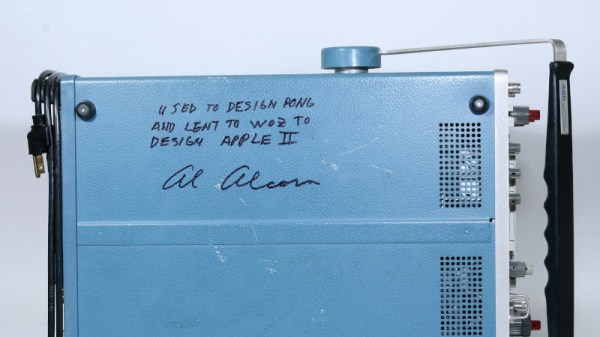
We’re guessing that quite a few of our readers have a surprising amount of redundant test gear, and we ourselves have to admit that more than one instrument adorns our benches. But we are mere dilettantes, amateurs if you will, compared to [Volke Kloke]. He’s got 350 of them in his average American home, and we have to say, among them are some beauties.

The linked newspaper article is sometimes frustratingly light on the details, but fortunately he has a website all of his own where we can all get immersed in the details. Of particular interest is an instrument which doesn’t even have a CRT, the General Radio 338 string oscillograph used a mirror drum to catch a standing wave in a tungsten wire, but there are plenty more. Is your first ‘scope among them?

As we now live in the age of cheap digital ‘scopes, at any surplus sale you’ll see plenty of CRT-based instruments going for relative pennies. Of those, the more recent and high-end ones are still extremely useful instruments, and it’s not just misty-eyed reminiscing to say that they remain a worthy addition to any bench.

Want to know about early ‘scope tech? We’ve taken a look before.

The Art And Science Of Making Beautiful Transparent Ice

For most of us, ice isn’t something we’ve thought about in detail since our high school science classes. For most of us, we pour some tap water into the ice trays, slam it in the freezer, and forget about it. Then we lob the frozen misshapen cubes into a beer and enjoy a quite literally ice-cold beverage.

However, there’s so much more fun to be had with ice if you really get into it. If you’ve ever wondered how pretentious cocktail bars make their fancy ice spheres or transparent cubes, read on!

Continue reading “The Art And Science Of Making Beautiful Transparent Ice”