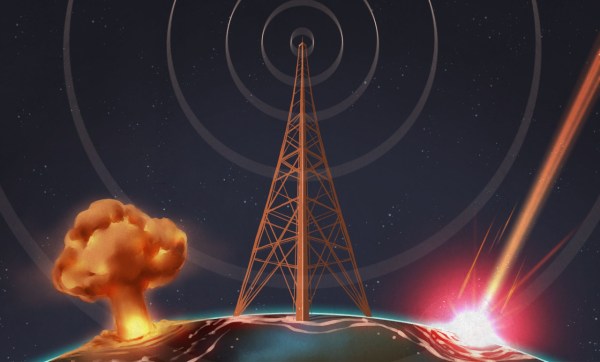
The Radioactive Source Missing In Australian Desert Has Been Found

Nuclear material is relatively safe when used, stored, and managed properly. This generally applies to a broad range of situations, from nuclear medicine to nuclear power generation. Some may argue it’s impossible to use nuclear weapons safely. In any case, stringent rules exist to manage nuclear material for good reason.

Sometimes, though, things go wrong, mistakes are made, and that nuclear material ends up going AWOL. That’s the situation that faced authorities in Australia, as they scoured over a thousand kilometers of desert highway for a tiny missing radioactive source with the potential to cause serious harm. Thankfully, authorities were able to track it down.

Continue reading “The Radioactive Source Missing In Australian Desert Has Been Found”

All About USB-C: Pinecil Soldering Iron

As many people have pointed out, what matters with USB-C isn’t just the standard, it’s the implementations. After all, it’s the implementations that we actually have to deal with, and it’s where most of the problems with USB-C arise. There is some fault to the standard, like lack of cable markings from the get-go, but at this point, I’m convinced that the USB-C standard is a lot better than some people think.

I’d like to walk you through a few USB-C implementations in real, open-source, adjacent, and just interesting products. They’re all imperfect in some way – it can’t be otherwise, as they have to deal with the messy real world, where perfection is a rarity.

Today, let’s check out the Pinecil. A soldering iron by Pine64, released a few years ago, keeping the price low and quality high. It sports both a barrel jack and a USB-C port for its power input – a welcome departure from the Miniware iron strategy, where neither the barrel-jack-only TS100 nor the low-power proprietary-tip TS80 irons quite did it. And, given its design around TS100 T12-style tips, it’s no wonder Pinecil took a well-deserved spot in hobbyist world.

Can’t Just Pull The Trigger

Now, you might be thinking that Pinecil ought to be a simple device. The usual way to get high power out of a USB-C port is a Power Delivery (PD) trigger IC, and you could merely use that. However, if you’ve read the USB-C power article, you might remember the 45 W vs 60 W charger scenario, where such an arrangement would fail immediately. Overall, the configurability of trigger ICs is quite low, and when encountering a PD compatibility problem with some PSU, you can’t do anything about it except replace the IC with a slightly-different-logic IC- if a replacement even exists, and it usually does not. This is costly and limiting for a real-world use product. Continue reading “All About USB-C: Pinecil Soldering Iron”

What Losing Everything Taught Me About Backing Up

Backing up. It’s such a simple thing on paper – making a copy of important files and putting them in a safe place. In reality, for many of us, it’s just another thing on that list of things we really ought to be doing but never quite get around to.

I was firmly in that boat. Then, when disaster struck, I predictably lost greatly. Here’s my story on what I lost, what I managed to hang on to, and how I’d recommend you approach backups starting today.

Continue reading “What Losing Everything Taught Me About Backing Up”

Do You Need The Raspberry Pi Camera Module V3?

This month came the announcement of some new camera modules from Raspberry Pi. All eyes were on version 3 of their standard camera module, but they also sneaked out a new version of their high quality camera with an M12 lens mount. The version 3 module is definitely worth a look, so I jumped on a train to Cambridge for the Raspberry Pi Store, and bought myself one for review.

There’s nothing new about a Pi camera module as they’ve been available for years in both official and third party forms, so to be noteworthy the new one has to offer something a bit special. It uses a 12 megapixel sensor, and is available both in autofocus and wide angle versions in both standard and NoIR variants. Wide angle and autofocus modules may be new in the official cameras, but these are both things which have been on the third-party market for years.

So if an autofocus camera module for your Pi isn’t that new, what can we bring to a review that isn’t simply exclaiming over the small things? Perhaps it’s better instead to view the new camera in the context of the state of the Pi camera ecosystem, and what better way to do that than to turn a Pi and some modules into a usable camera! Continue reading “Do You Need The Raspberry Pi Camera Module V3?”

Open-Sourcing The Lisa, Mac’s Bigger Sister

Forty years ago, on January 19th of 1983, Apple released the Lisa, which was in many ways a revolutionary system. On January 19th of 2023, to celebrate the system’s 40th birthday, the Computer History Museum released the source code for Lisa OS version 3.1 under the Apple Academic License Agreement. Written in Pascal, the source includes over 1,300 source files, covering the OS itself, the Lisa Toolkit development system and a number of applications. The questions one might ask at this point include what the Apple Lisa even is, and why it was such an important system in computer history.

This especially in light of the terrible flop that the Lisa turned out to be, with only 10,000 units sold over two years. Part of this failure was definitely due to the introductory price, that was set at $9,995 (over $27,000 in 2021 dollars). Although it featured an OS with memory protection, despite the lack of an MMU on the Motorola 68k, among other advanced features that placed it well beyond other desktop computers of the time, it got quickly crushed in the market by Apple’s MacIntosh, even after successive Lisa successor releases that sought to address its shortcomings.

Continue reading “Open-Sourcing The Lisa, Mac’s Bigger Sister”

Broken Genes And Scrambled Proteins: How Radiation Causes Biological Damage

If decades of cheesy sci-fi and pop culture have taught us anything, it’s that radiation is a universally bad thing that invariably causes the genetic mutations that gifted us with everything from Godzilla to Blinky the Three-Eyed Fish. There’s a kernel of truth there, of course. One only needs to look at pictures of what happened to Hiroshima survivors or the first responders at Chernobyl to see extreme examples of what radiation can do to living tissues.

But as is usually the case, a closer look at examples a little further away from the extremes can be instructive, and tell us a little more about how radiation, both ionizing and non-ionizing, can cause damage to biochemical structures and processes. Doing so reveals that, while DNA is certainly in the crosshairs for damage by radiation, it’s not the only target — proteins, carbohydrates, and even the lipids that form the membranes within cells are subject to radiation damage, both directly and indirectly. And the mechanisms underlying all of this end up revealing a lot about how life evolved, as well as being interesting in their own right.

Continue reading “Broken Genes And Scrambled Proteins: How Radiation Causes Biological Damage”

NASA Lunar Probe Finds Out It’s Not Easy Being Green

If you’re a space fan, these are very exciting days. There’s so much happening overhead that sometimes it can be difficult to keep up with the latest news. Artemis I just got back from the Moon, the International Space Station crew are dealing with a busted Soyuz, SpaceX is making incredible progress with their Starship architecture, CubeSats are being flung all over the solar system, and it seems like every month a new company is unveiling their own commercially-developed launch vehicle.

Lunar Flashlight

So with everything going on, we wouldn’t be surprised if you haven’t heard about NASA’s Lunar Flashlight mission. The briefcase-sized spacecraft was launched aboard a special “rideshare” flight of SpaceX’s Falcon 9 rocket back on December 11th — tagging along with two other craft heading to our nearest celestial neighbor, the Japanese Hakuto-R lander, and a small rover developed by the United Arab Emirates. There was a time when a launch like that would have been big news, but being that it was only the second of seven launches that SpaceX performed in December alone, it didn’t make many headlines.

But recently, that’s started to change. There’s a growing buzz around Lunar Flashlight, though unfortunately, not for the reasons we’d usually hope. It seems the diminutive explorer has run into some trouble with its cutting-edge “green” propellant system, and unless the issue can be resolved soon, the promising mission could come to an end before it even had a chance to start.

Continue reading “NASA Lunar Probe Finds Out It’s Not Easy Being Green”