Where A Wood Shop Goes, A Hackerspace Follows

The 2×4 Contest at my local hackerspace captured my interest. The challenge was to build something cool out of a single eight-foot 2×4 with the winner getting free wood storage in the space. I had half an idea for a project, but I ran out of time and never even started it. My idea was to cut the board into half-thickness strips and glue them edge-to-edge with some biscuits holding them together — to basically make wider, thinner boards to do… something cool with it.

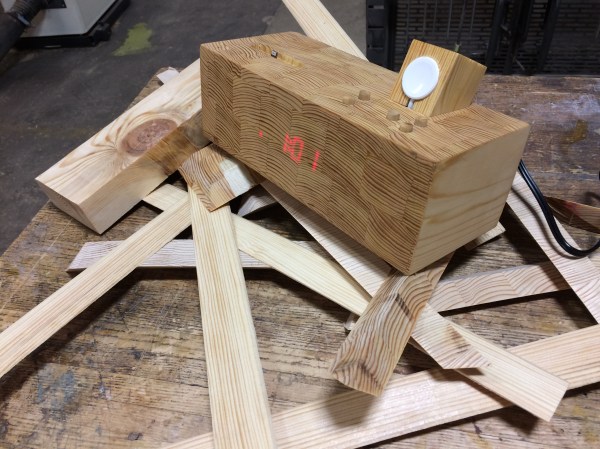
One of the entries is pictured above. [Jon Alt] designed this clock and phone charger that includes a capacitive charger for his smart watch. He makes use of the 2×4’s grain to make a gorgeous enclosure, carving away the rear of the front panel so only a credit-card’s thickness of wood remained, allowing the 7-segments to shine through. The other entries were great as well and I especially liked the 2×4 guitar.
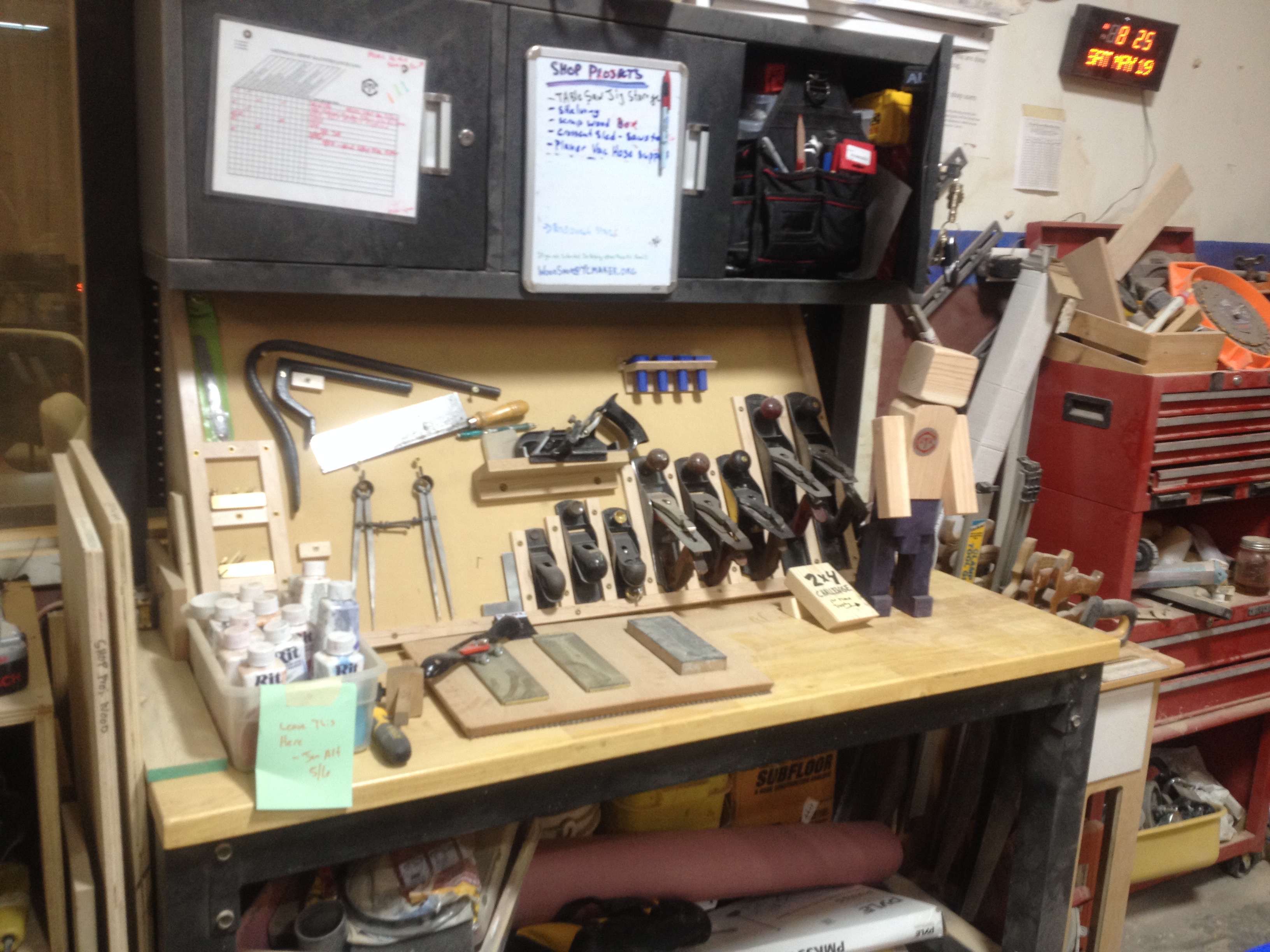
Mostly what interested me about the contest was what it showed about the wood shop: thanks to the volunteers and board, that is a wood shop doing well. Stuff is going on! A sad wood shop doesn’t hold contests. By extension, when the shop is doing well, that means the hackerspace is also doing well.

A wood shop is one of those areas of a hackerspace that is tool-driven. It’s not just a gathering place for like-minded folks; people go to use a specific tool or tools they can’t afford, and let’s face it, there’s always tools to buy that costs a bunch of money.

I’ve seen this particular shop begin as an empty concrete room with a cheap drill press and someone’s old bandsaw. Pretty soon worktables, shelving, and storage were built. More tools arrived, some donated, some loaned, some purchased with dues. So how can other spaces replicate this wood shop success story?

Continue reading “Where A Wood Shop Goes, A Hackerspace Follows”

Telepresence Robot 2000 Leagues Under The Sea

Telepresence robots are now a reality, you can wheel around the office and talk to people, join a meeting, see stuff and bump into your colleagues. But imagine if telepresence were applied to deep sea exploration. Today we can become oceanographers through the telepresence system created by Bob Ballard (known for locating the Titanic, discovered deep sea geothermal vents, and more) and his team at the Inner Space Center. Put on your Submariner wristwatch because its time for all of us to explore the ocean depths via the comfort of our home or office.

Continue reading “Telepresence Robot 2000 Leagues Under The Sea”

Rotary Phones And The Birth Of A Network

I can’t help but wonder how long it will be before the movie title  “Dial M for Murder” becomes mysterious to most of the population. After all, who has seen a dial phone lately? Sure, there are a few retro phones, but they aren’t in widespread use. It may not be murder, but it turns out that the dial telephone has its roots in death — or at least the business of death. But to understand why that’s true, you need to go back to the early days of the telephone.

Did you ever make a tin can phone with a string when you were a kid? That dates back to at least 1667. Prior to the invention of what we think of as the telephone, these acoustic phones were actually used for specialized purposes.

We all know that [Alexander Graham Bell] made a working telephone over a wire, drawing inspiration from the telegraph system. However, there’s a lot of dispute and many others about the same time were working on similar devices. It is probably more accurate to say that [Bell] was the first to successfully patent the telephone (in 1876, to be exact).

Continue reading “Rotary Phones And The Birth Of A Network”

Home Automation: Evolution Of A Term

Home automation: for me the term recalls rich dudes in the ’80s who could turn off their garage lights with remote-control pads. The stereotype for that era was the more buttons your system had—even non-enabled ones—the more awesome it was, and by extension any luxury remote control had to be three times the size of any TV remote.

And it was a luxury–the hardware was expensive and most people couldn’t justify it. Kind of like the laser-disc player of home improvements. The technology was opaque to casual tinkering, it cost a lot to buy, and also was expensive to install.

The richie-rich stereotypes were reinforced with the technology seen in Bond movies and similar near-future flicks. Everything, even silly things, is motorized, with chrome and concrete everywhere. You, the hero, control everything in the house in the comfort of your acrylic half-dome chair. Kick the motorized blinds, dim the track lighting, and volume up the hi-fi!

This Moonraker-esque notion of home automation turned out to be something of a red herring, because home automation stopped being pretty forever ago; eventually it became available to everyone with a WiFi router in the form of Amazon Echo and Google Nest.

But the precise definition of the term home automation remains elusive. I mean, the essence of it. Let’s break it down.

Continue reading “Home Automation: Evolution Of A Term”

Earth Ground And The Grid

The electrical grid transmits power over wires to our houses, and our Bryan Cockfield has covered it very well in his Electrical Grid Demystified series, but what part does the earth ground play? It’s commonly known to be used for safety, but did you know that in some cases it’s also used for power transmission?

Typical House Grounding System

Grounding system normal case

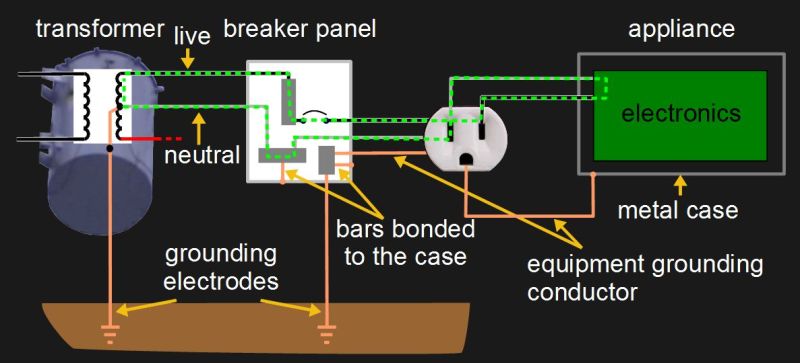
A pretty typical diagram for the grounding system for a house is shown here, along with a few of the current carrying conductors commonly called live and neutral. On the far left is the transformer outside the house and on the far right is an appliance that’s plugged in. In between them is a breaker panel and a wall socket of the style found in North America. The green dashed line shows the normal path for current to flow.

Notice the grounding electrodes for making an electrical connection with the earth ground. To use the US National Electrical Code (NEC) as an example, article 250.52 lists eight types of grounding electrodes. One very good type is an electrode encased in concrete since concrete continues to draw moisture from the ground and makes good physical contact due to its weight. Another is a grounding rod or pipe at least eight feet long and inserted deep enough into the ground. By deep enough, we mean to include factors such as the fact that the frost line doesn’t count as a good ground since it has a high resistance. You have to be careful of using metal water pipes that seemingly go into the ground, as sections of these are often replaced with non-metallic pipes during regular maintenance.

Notice also in the diagram that there are places where the various metal cases are connected to the grounding system. This is called bonding.

Now, how does all this system grounding help us? Let’s start with handling a fault.

Continue reading “Earth Ground And The Grid”

Linux Fu: Better Bash Scripting

It is easy to dismiss bash — the typical Linux shell program — as just a command prompt that allows scripting. Bash, however, is a full-blown programming language. I wouldn’t presume to tell you that it is as fast as a compiled C program, but that’s not why it exists. While a lot of people use shell scripts as an analog to a batch file in MSDOS, it can do so much more than that. Contrary to what you might think after a casual glance, it is entirely possible to write scripts that are reliable and robust enough to use in many embedded systems on a Raspberry Pi or similar computer.

I say that because sometimes bash gets a bad reputation. For one thing, it emphasizes ease-of-use. So while it has features that can promote making a robust script, you have to know to turn those features on. Another issue is that a lot of the functionality you’ll use in writing a bash script doesn’t come from bash, it comes from Linux commands (or whatever environment you are using; I’m going to assume some Linux distribution). If those programs do bad things, that isn’t a problem specific to bash.

One other limiting issue to bash is that many people (and I’m one of them) tend to write scripts using constructs that are compatible with older shells. Often times bash can do things better or neater, but we still use the older ways. For example:

Continue reading “Linux Fu: Better Bash Scripting”

Serious DX: The Deep Space Network

Humanity has been a spacefaring species for barely sixty years now. In that brief time, we’ve fairly mastered the business of putting objects into orbit around the Earth, and done so with such gusto that a cloud of both useful and useless objects now surrounds us. Communicating with satellites in Earth orbit is almost trivial; your phone is probably listening to at least half a dozen geosynchronous GPS birds right now, and any ham radio operator can chat with the astronauts aboard the ISS with nothing more that a $30 handy-talkie and a homemade antenna.

But once our spacecraft get much beyond geosynchronous orbit, communications get a little dicier. The inverse square law and the limited power budget available to most interplanetary craft exact a toll on how much RF energy can be sent back home. And yet the science of these missions demands a reliable connection with enough bandwidth to both control the spacecraft and to retrieve its precious cargo of data. That requires a powerful radio network with some mighty big ears, but as we’ll see, NASA isn’t the only one listening to what’s happening out in deep space. Continue reading “Serious DX: The Deep Space Network”