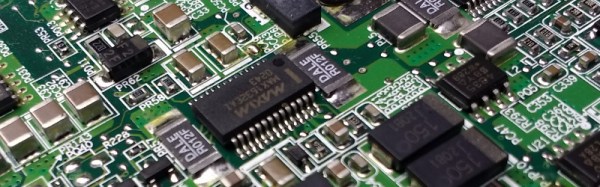
Reflow Soldering At Another Level

We’re used to reflow soldering of our PCBs at the hacker level, for quite a few years people have been reflowing with toaster ovens, skillets, and similar pieces of domestic equipment and equipping them with temperature controllers and timers. We take one or two boards, screen print a layer of solder paste on the pads by using a stencil, and place our surface-mount components with a pair of tweezers before putting them in the oven. It’s a process that requires  care and attention, but it’s fairly straightforward once mastered and we can create small runs of high quality boards.

But what about the same process at a professional level, what do you do when your board isn’t a matchbox-sized panel from OSH Park with less than 50 or so parts but a densely-packed multilayer board  about the size of a small tablet computer and with many hundreds of parts? In theory the same process of screen print and pick and place applies, but in practice to achieve a succesful result a lot more care and planning has to go into the process.

This is being written the morning after a marathon session encompassing all of the working day and half of the night. I was hand-stuffing a row of large high-density boards with components ranging from 0402 passives to large QFPs and everything else in between. I can’t describe the board in question because it is a commercially sensitive prototype for the industrial customer of the friend I was putting in the day’s work for, but it’s worth going through the minutiae of successfully assembling a small batch of prototypes at this level. Apologies then, any pictures will be rather generic.


Continue reading “Reflow Soldering At Another Level”

2016: As The Hardware World Turns

Soon, the ball will drop in Times Square, someone will realize you can turn ‘2018’ into a pair of novelty sunglasses, and the forgotten mumbled lyrics of Auld Lang Syne will echo through New Year’s Eve parties. It’s time once again to recount the last 366 days, and what a year it’s been.

Arduino got into an argument with Arduino and Arduino won. We got new Raspberry Pis. Video cards are finally getting to the point where VR is practical. The FCC inadvertently killed security in home routers before fixing the problem. All of this is small potatoes and really doesn’t capture the essence of 2016. It’s been a weird year.

Want proof 2016 was different? This year, Microsoft announced they would provide a Linux ‘shim’ with every version of Windows. By definition, 2016 was the year of the Linux desktop. That’s how weird things have been in 2016.

Continue reading “2016: As The Hardware World Turns”

How To Nail A Technical Presentation

Whether you’re an engineer, a maker, a hacker or a baker, at some point you’ll want to share your work with other people. Perhaps it’s a meeting at work to discuss process improvements, or a talk at a conference discussing some research you’ve done into hacking a new embedded platform. Or maybe you’ve developed a brand new cooking profile for rye breads that cuts energy usage in half. Whatever it is, there are techniques you can use to help you communicate effectively to a room full of people, and have fun doing it. Unlike some, I actually enjoy getting up in front of a crowd to present my work, so I’ve written this article to share with you some tips that can help you make a technical presentation that everyone will love — including you!

Editor’s Note: We planned the art for this article before the passing of Carrie Fisher. Leia certainly knew how to give a compelling technical presentation. We publish this in memory of a great actress.

Continue reading “How To Nail A Technical Presentation”

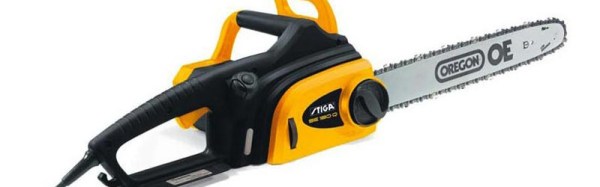
In Defense Of The Electric Chainsaw

Here at Hackaday we are a diverse bunch, we all bring our own experience to the task of bringing you the best of the hardware scene. Our differing backgrounds were recently highlighted by a piece from my colleague [Dan] in which he covered the teardown of a cordless electric chainsaw.

It was his line “Now, we’d normally shy away from any electric chainsaw, especially a cordless saw, and doubly so a Harbor Freight special“. that caught my eye. I’m with him on cordless tools which I see as a cynical ploy from manufacturers to ensure 5-yearly replacements, and I agree that cheap tools are a false economy. But electric chainsaws? Here on this small farm, they’re the saw of choice and here’s why.

Continue reading “In Defense Of The Electric Chainsaw”

Liar’s 3D Printing: Multiple Colors With One Extruder

Good 3D printers now have multiple hot ends. You ought to be able to print in different colors or print support material. However, a lot of us don’t have multiple hot ends. Turns out, you don’t have to have multiple hot ends to print in multiple colors. To accomplish that you need a lot of patience and the willingness to tell bald-faced lies. Don’t worry, though, you’ll only be lying to some computer hardware and software, so that doesn’t count.

You may have seen people talk about putting a pause between layers to switch from one color to another. That works, but it limits your options. For example, if you want to put some colored text on a different colored background, you have to either have the text poke out, or it has to be “under” the background. It can’t be flush if you only have a single extruder and hot end. My method is a lot more trouble, but it can generate good results.

Keep in mind, with hobby-grade printers, multiple color printing has a lot of problems even if you do have multiple extruders. This isn’t a panacea. But you can get results on par with a similar printer that has multiple heads.

Bottom Line Up Front

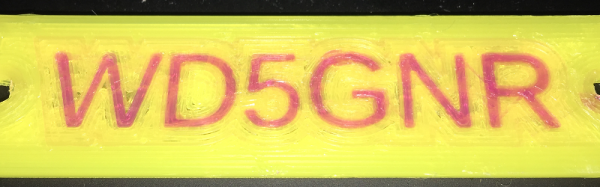
Here are a few pictures of test prints that use this technique. A Monoprice Mini printer with the stock extruder and hot end created them using different PLA filament. On the left is a test cube, with a color spot in the middle of the layers (as well as some spots on the top surface you can’t see). To the right is a plate with my call sign in a contrasting color. It is hard to tell in the picture, of course, but there is one surface. The text is at the same height as the yellow surface.

I didn’t spend a lot of time making these prints since I was more focused on perfecting the methodology. The layer heights aren’t very fine, the infill is sparse, and the print speed was fast. However, you could invest time into making better-looking prints. You can also use the usual techniques that you use with a “real” multi-extrusion printer (such as priming towers, ooze shields, etc.).

Continue reading “Liar’s 3D Printing: Multiple Colors With One Extruder”

200 Years Of The Stirling Engine

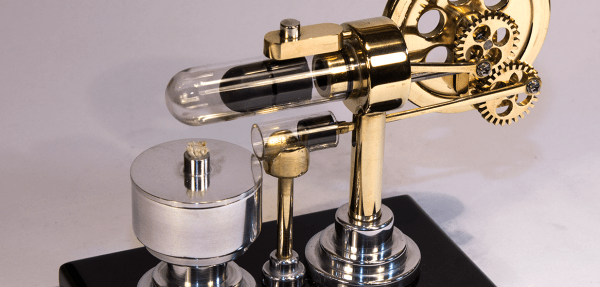
In the early years of the nineteenth century, steam engines were at work in a variety of practical uses. However, they were still imperfect in many ways. One particular problem were the boilers, that had a tendency to explode, causing injuries and fatalities. Reverend Dr. Robert Stirling, a Scottish clergyman, was concerned about the death toll from exploding boilers. Based on previous work by George Cayley (known for his pioneering work on aeronautics), Stirling filed his patent for a safer engine in 1816. That makes this year the bicentenary of this engine. The Stirling engine has the highest theoretical efficiency of any thermal engine. It is also a relatively simple machine. Unlike other types of engines, there are no valves, and that makes the mechanical design much simpler.

Continue reading “200 Years Of The Stirling Engine”

Ask Hackaday: Computing Square Roots On FPGA?

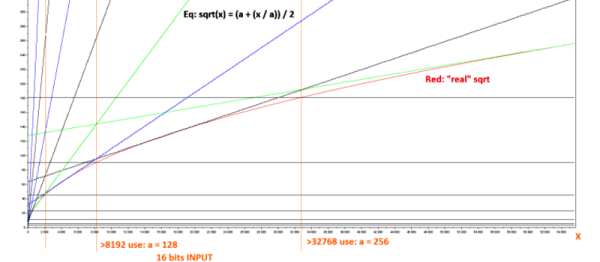
Hackaday reader [nats.fr] wrote in with some code from a project that resizes a video stream on the fly using an FPGA. Doing this right means undoing whatever gamma correction has been applied to the original stream, resizing, and then re-applying the gamma. Making life simpler, [nats.fr] settled on a gamma of two, which means taking a bunch of square roots, which isn’t fast on an FPGA.

[nats]’s algorithm is pretty neat: it uses a first-stage lookup to figure out in which broad range the value lies, and then one step of Hero’s algorithm to refine from there. (We think this is equivalent to saying he does a piecewise linear interpolation, but we’re not 100% sure.) Anyway, it works decently.

Of course, when you start looking into the abyss that is special function calculation, you risk falling in. Wikipedia lists more methods of calculating square roots than we have fingers. One of them, CORDIC, avoids even using multiplication by resorting to clever bitshifts and a lookup table. Our go-to in these type of situations, Chebyshev polynomial approximation, didn’t even make the cut. (Although we suspect it would be a contender in the gamma=1.8 or gamma=2.2 cases, especially if combined with range-reduction in a first stage like [nats.fr] does.)

So what’s the best/fastest approximation for sqrt(x) for 16-bit integers on an FPGA? [nats.fr] is using a Spartan 6, so you can use a multiplier, but division is probably best avoided. What about arbitrary, possibly fractional, roots?