
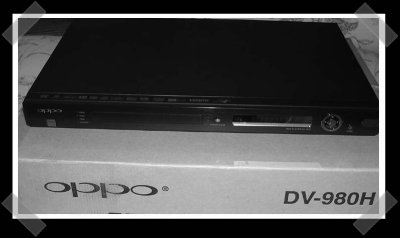
There’s an interesting thread discussing mods to improve the inexpensive Oppo 980 DVD player for better performance. The power supply, capacitors and opamps can benefit from some higher end components. [Occam] suggests several replacement opamps options for upgrading the audio output. The realatively low cost of Oppo gear makes it a better risk than modding a multi-thousand dollar DVD player.
digital audio hacks774 Articles
Funkytown Performed By Old Hardware
Inspired by [James Houston]’s remix of Radiohead’s Nude on obsolete hardware, [bd594] put together this mix of Lipps Inc.’s Funkytown. No sampling was used, but he had to loop the footage of the Avaya dot matrix printer’s drum part because it shook the table too much. The guitar and bass line are performed by a Commodore 64. An Intel 14.4 external modem uses DTMF tones for the first part of of the lead and a TI-99/4A beeps out the rest. The TI is also used as a speech synthesizer and a Maxtor harddrive plays the the vocal track.
[via Matrixsynth]
Music And Visual Arts At The Last HOPE
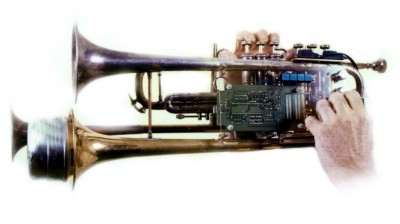
[Peter Kirn] from Create Digital Music has an article up highlighting many of the great music and visual performance pieces planned for The Last HOPE on Friday night. If you are around New York and not accustomed to hacking conferences, this could be a great excuse to go check it out. Here are some of our favorite projects.
Dancing Wall-E And Rhythmic Synth
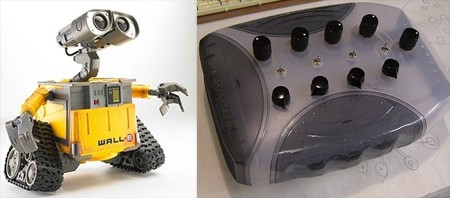
Whether you loved, hated, or didn’t see Wall-E, it’s hard not to fall in love with the iDance Wall-E toy. Connect him to an audio source and Wall-E will dance around like an epileptic Billy Bass.
[Gian Pablo Villamil] at NYC Resistor wondered whether it would work with his custom made Rhythmic Synth, and to his and our delight, it does! The Rhythmic Synth is an older project of his; it is a simple rhythm generator with 4 pitch knobs, 4 modulation knobs, and 4 phase switches. The case was taken from an old external Iomega CD-ROM drive.
Getting the Wall-E to dance isn’t much of a feat, but something about the dancing combined with a synth with embedded lights just screams robot dance party, and that can never be wrong. We’d love to see the Wall-E dancing to a cleaner, more complete synth: maybe this one. Check out Wall-E busting a move after the break.
Tangible Sequencer Interface With Skittles
Using a webcam, some cardboard, and a bag of Skittles, [Kyle McDonald] created this tangible interface for a beat sequencer. The Skittles are dropped onto the rows which correspond to a drum channel and each Skittle represents an 1/8th note. For such cheap components, the system seems to recognize the sequences pretty quick. This is probably due to some clever programming with the processing back-end. He claims his inspiration was the BallBearing sequencer, which uses the ball bearings as contact switches to determine the sequence rather than having a webcam analyze the surface.
It would be really nice to see this project expanded into a full blown instrument. the webcam could allow for dynamic surfaces and he could certainly add more control to the system with some knobs and/or sliders. He claims these features, and the source, will soon arrive.
Optical DJ Controller
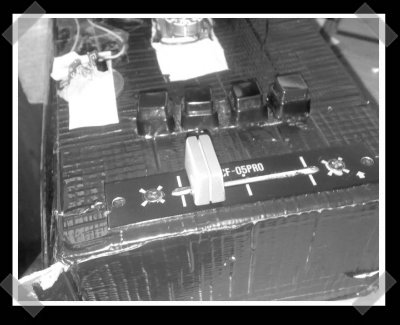
[Adrian] sent in this sweet little optical DJ controller. The ‘turntable’ was made from a CD and an encoder wheel created with a laser printed transparent overhead sheet. You can score some optical gear from a spare mouse, or just buy the parts. A PIC18F452 encodes everything into a midi signal. You can find a good photo of the schematics here. And you can hit the demo video after the break.
Custom Modular Control Interfaces
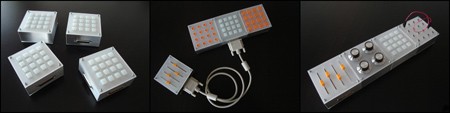
Machinecollective.org is bringing rapid prototyping to every day artists and hackers. We’ve covered similar interfaces like the monome, MIDIbox, and Stribe. Machinecollective allows you to make your own input system using multiple blocks to get exactly what you want. The setup allows you to fit pretty much anything in a block that you can think of. They’re developing potentiometers, slide potentiometers, button grids, toggle switches, LCD’s, FSR/LDR’s, velocity sensitive pads, and touch screens.
Currently, they support software enviroments like: Processing, Max/MSP, VVVV, and Adobe Flash. That list will undoubtedly grow as the community plays with it. They envision the hardware connecting via MIDI, OSC, RS232, TCP/UDP, DMX, or USB.
They encourage others to design their own inputs. Community members can share modifications and designs, though there isn’t a forum or store yet. If you design a setup that you really like, they can even fabricate a single unit for you. Keep your eyes on this one, it could be a real hit.
A similar idea for general gadgetry can be seen over at Bug Labs. Starting with a base unit, you can add different input and output modules to create various useful functions. They currently offer GPS, a camera, a display, and motion sensing. Mix and match to make your dream gadget.









