Upgrading An Old Polaroid Land Camera For 35mm Rolls

Ok, we recognize that this is a bit of an odd upgrade, since many would probably think that a digital upgrade would be more appropriate. However, we found this interesting anyway. [Marker1024] has taken this old Polaroid land camera and modified it to accept a standard 35mm roll. His list of materials may sound fairly MacGyver-ish with foil and sculpey, but his results look to be well done and fairly sturdy. We have to say that the aesthetics of the camera itself are quite appealing and we could see carrying one of these around. As interesting as the writeup is though, we can’t help but wonder what the pictures look like that came out of it!

Kodak ZX3 Teardown And Tetris

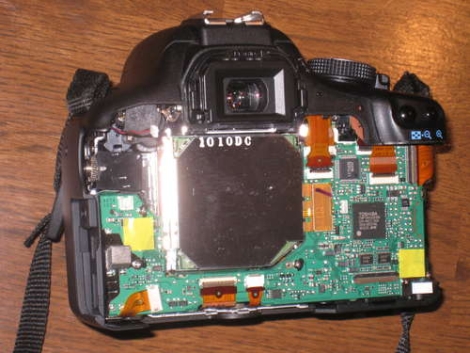
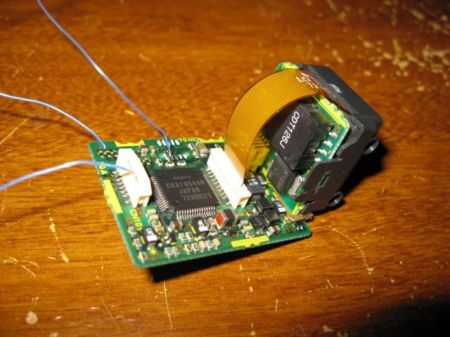
[Sprite_TM] was given a Kodak ZX3 to play with by a forum he moderates.  The Kodak ZX3 is a waterproof HD camcorder in a cell phone / mp3 player form factor. After opening up the camcorder, he did some poking around with a scope and was able to locate a serial port on the board. It quickly became apparent that the system uses a proprietary kernel called PrKernelV4 rather than an open source alternative. Not letting the proprietary kernel get him down, he exploited the system by simply modifying a file called “autoexec.ash” on the sd card. He now has a Tetris clone easily launched from a previously unused menu icon. See it in action after the break.

Continue reading “Kodak ZX3 Teardown And Tetris”

Macro Photos Using An Under-light Rig

[Aki Korhonen] wanted to tighten up his macro photography setup. He already had the camera for the job, but wanted a fully adjustable target platform that he could easily light. What he came up with is a jig to hold the camera and fine tune the subject of each photo. It uses a frame with a piece of glass whose distance from the lens is adjusted by turning a knob. Below the glass a reflective surface redirects light from an LED flashlight up through the platform, lighting the snowflakes he’s shooting. A fixed LED source is in the plans for the next rendition.

Take a look at the overview of his setup in the quick clip after the break.

Continue reading “Macro Photos Using An Under-light Rig”

If You’re Photographing And You Know It Clap Your Hands

If you’ve ever tried to take pictures of yourself you’ll know that it can be a pain. It’s especially hard to get that perfect shot of your godly features when you’re out of breath from sprinting across the room. OK, yes, they have remote controls for that. But what if you lost your remote or you just don’t want to have to carry it? [LucidScience] put together a sweet, um, “hands free” alternative.

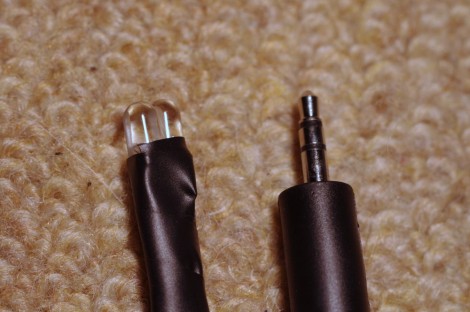
Essentially this hack emulates the IR signals sent by a Nikon remote, either to take a picture right away or to take time lapse photographs at regular intervals. We’ve seen a similar time lapse remote using an arduino before and a really thorough one using an AVR, but they don’t take the same approach as [LucidScience]’s design in terms of monitoring a microphone input for triggering. The project includes several status LEDs and adjustments for ambient noise and triggering, and it can be mounted to the camera body. We wonder how many of the Nikon’s features could be controlled using clap encoding, and how detailed your timing would need to be to have a kind of hand-made (get it?) pulsetrain syntax.  You’d probably need to have world record clap skills.

Check out the demo vid after the break.

Continue reading “If You’re Photographing And You Know It Clap Your Hands”

Using A Chicken As A Steadicam

This has been circulating around the net for a bit. For those that haven’t seen it, let me just give you a quick rundown of what is happening. This guy strapped a camera to a chicken’s head. No really, that’s it. There’s some interesting science behind it though. He’s taking advantage of the Vestibulo-Ocular Reflex in the chicken.  It is basically the reflex that we use to keep our eyes firmly focused on something while our head is moving. In a chicken however, they move their entire head. This means that he can strap a camera to the chicken’s head and have an instant steadicam. At least that is the theory. As you can see in the video after the break, the harder part is getting the chicken to look at what you want it to look at. We also found a conversation about it with the creator,[MrPennywhistle] in some reddit comments.

Continue reading “Using A Chicken As A Steadicam”

You Know That They Say About Guys With Big Lenses?

[Tony Lovell] and [dkpeterborough] built a sizable camera lens using optics from a flight simulator projector. What they ended up with is a 900mm lens that can make a beautiful photo of the moon, or capture distant landscapes in great detail. The body of the lens was designed in CAD and sent off for fabrication out of aluminum, as seen above. The concentric baffles help to prevent lens flare but it can’t be used in its bare-aluminum condition. The internals were coated using a stippling finish that leaves a sandy texture. That was covered with matte black barbecue paint, doing a great job of preventing optical interference, and the outside received a glossy white coat. Finished weight: 59 pounds, but once you see the pictures you’ll agree it’s worth lugging the bulky instrument around to grab that killer shot.

[via Make]

Time-lapse Camera Dolly

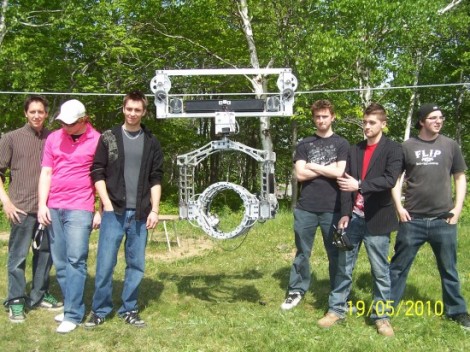
[Brian Grabski] was asked by a friend to design and build a dolly that would move a camera during a time-lapse sequence. Above you can see the product of his toils, and the videos after the break show off the parts that went into the design and showcase effectiveness of the build.

The dolly is designed to ride on a pair of tubular rails. These can be bent to match any desired path and the dolly will have no problem following it thanks to two features. First, the triad of skateboard wheels on each of the three corners are mounted on a swivel bearing that allows them to rotate without binding. The other piece of the puzzle is a set of drawer slides that let the third support move perpendicular to the other two sets of rollers. A motor drives a geared wheel to move the dolly along the track with speed adjustments courtesy of the motor controller. There’s also a failsafe that will shut the system down when it runs out of track, protecting that fancy piece of hardware taking the pictures.

We’ve seen timelapse equipment that moves the camera in the past, but those hacks usually involve rotating the camera along and axis. This track-based setup is a well executed tool useful at all levels of photography. We can’t wait to see the arch-based dolly that is teased at the end of the demo video.

Continue reading “Time-lapse Camera Dolly”