Engineering degrees are as wide and varied as the potential careers on offer out in the real world. There’s plenty of maths to learn, and a cavalcade of tough topics, from thermodynamics to fluid mechanics. However, the real challenge is the capstone project. Generally taking place in the senior year of a four-year degree, it’s a chance for students to apply everything they’ve learned on a real-world engineering project.
Known for endless late nights and the gruelling effort required, it’s an challenge that is revered beforehand, and boasted about after the fact. During the project, everyone is usually far too busy to talk about it. My experience was very much along these lines, when I undertook the Submarine That Can Fly project back in 2012. The project taught me a lot about engineering, in a way that solving problems out of textbooks never could. What follows are some of the lessons I picked up along the way. Continue reading “The Young Engineers Guide To University Capstone Projects”→
Many cities around the world routinely struggle with smog. Apart from being unsightly, heavy air pollution has serious negative health effects, both in the short term and with regards to long-term life expectancy. Over the years, governments have tried to tackle the problem with varied tactics around the world.
When talking about smog, Brussels is not one of the cities that comes first to mind. Regardless, the local government has developed its new climate plan that seeks to abolish fossil fuel vehicles from its streets by 2035. The scheme has a variety of measures that will be staggered over the coming years. It’s part of a broadening trend in transportation, and something we’ll likely see more of around the world in coming years.
What’s The Go?
Brussels is in the process of reducing congestion by converting former roads into pedestrian-only spaces. REUTERS/Eric Vidal
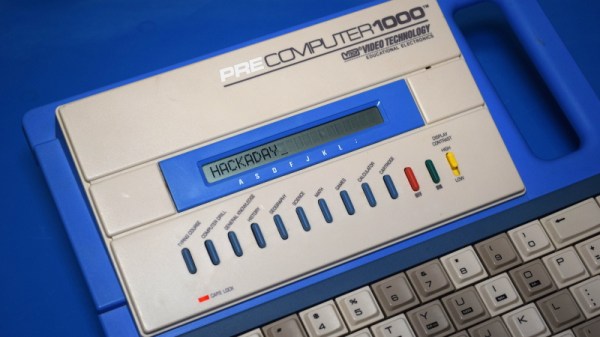
Back in the days before kids could be placated with a $50 Android burner phone, many a youngster was gifted a so-called “educational computer” to keep them occupied. Invariably looking like a fever dream version of the real computer their parents didn’t want to let them use, these gadgets offered monochromatic exploits that would make Zork look like Fortnite. Due equally to their inherent hardware limitations and the premise of being an educational toy, the “games” on these computers often took the form of completing mathematical equations or answering history questions.
The VTech PreComputer 1000 is a perfect specimen of this particular style of educational toy. Released in 1988, it was advertised as a way for pre-teens to become more comfortable with operating a real computer; since at that point, it had become abundantly clear that the coming decade would see a beige box on every professional’s desk. Its full-size QWERTY keyboard was specifically mentioned in the product’s accompanying literature as a way to get young hands accustomed to the ways of touch typing.
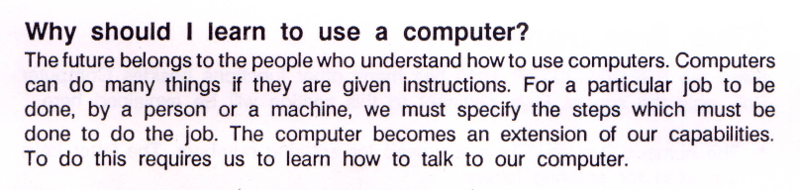
Words of wisdom from the PreComputer 1000’s manual.
By the mid-1990s these devices would have progressed far enough to include passable text-to-speech capabilities and primitive graphics, but the junior professional who found him or herself seated in front of the PreComputer 1000 was treated to a far more spartan experience. It’s perhaps just as well that this particular educational computer was listed as a training tool, because even in 1988, surely a session with this toy must have felt very much like work.
But that’s not to say the PreComputer 1000 is without its own unique charms. In an effort to help cement its role as a “trainer” for more conventional computers, VTech saw fit to equip the PreComputer with its own BASIC interpreter. They even included generous written documentation that walked young programmers through the various commands and functions. Even today, there’s something oddly appealing about a mobile device with a full keyboard that can run BASIC programs for better than 24 hours on batteries (even if they’re alkaline “C” cells).
Let’s take a look inside this more than 30 year old mobile device, and see how the designers managed to create a reasonable facsimile of actual computing on a kid-friendly budget.
There’s a newish development in the world of keyboards; the optical switch. It’s been around for a couple years in desktop keyboards, and recently became available on a laptop keyboard as well. These are not replacements for your standard $7 keyboard with rubber membrane switches intended for puttering around on your raspberry pi. Their goal is the gamer market.
The question, though, is are these the equivalent of Monster Cables for audiophiles: overpriced status symbols? Betteridge would be proud; the short answer is that no, there is a legitimate advantage, and for certain types of use, it makes a lot of sense.
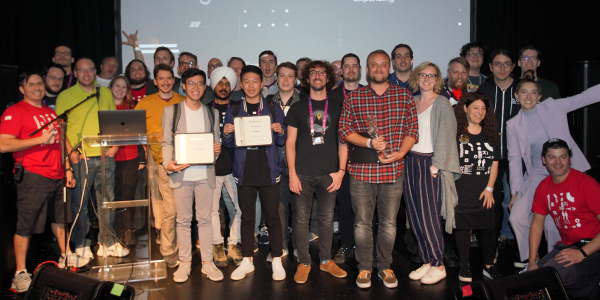
FieldKit, an open-source, modular sensor system for conducting research in harsh environments has just been named the Grand Prize winner of the 2019 Hackaday Prize. The award for claiming the top place and title of “Best Product” in this nine-month global engineering initiative is $125,000. Five other top winners and five honorable mentions were also named during this evening’s Hackaday Prize Ceremony, held during the Hackaday Superconference in Pasadena, California.
This year’s Hackaday Prize focused on product development. From one good idea and a working prototype, entrants were encouraged to iterate on their UX, industrial design, ergonomics, software, and mechanical plans as they worked toward a product that is both manufacturable and meets the needs of the user it has been designed for. Out of twenty finalists, the top eleven are covered below. Over $200,000 in cash prizes have been distributed as part of this year’s initiative where thousands of hardware hackers, makers, and artists compete to build a better future. Continue reading “FieldKit Is The Grand Prize Winner Of The 2019 Hackaday Prize”→
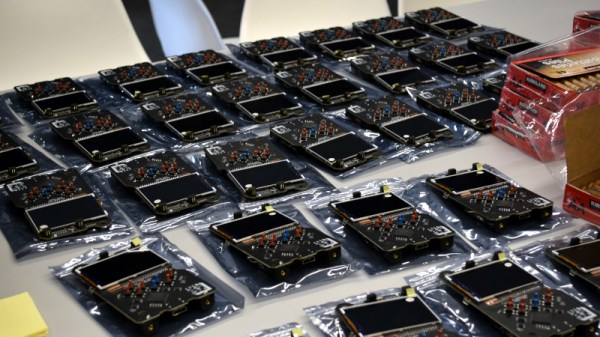
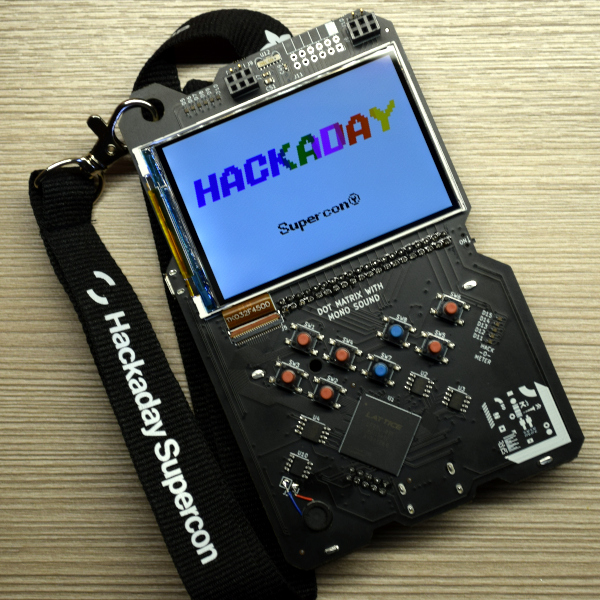
If you count yourself among the several hundred of our closest friends that have joined us at Supplyframe HQ for the 2019 Hackaday Superconference, then by now you’ll have your hands on one of this year’s incredible FPGA badges. It should come as no surprise that an incredible amount of time and effort went into developing and manufacturing this exceptionally unique piece of hardware; the slick gadget in your hands today took nearly an entire year to develop, and work continued on it until very literally the last possible moment.
Badge designer Jeroen Domburg (aka Sprite_TM), Hackaday staff, and a team of dedicated volunteers were still putting the final touches on these ambitious devices less than 24 hours before they were distributed to the first wave of Superconference attendees. Naturally, that’s not exactly how things were supposed to go. But when you’ve got a group of people that want to push the envelope and build something truly incredible, convincing them to actually stop working can be a challenge in itself.
In fact, development of the badge is still ongoing. Fixes and improvements are being made to the software even as you read this, and if you haven’t already, you should upgrade your badge to make sure you’ve got the latest and greatest from our international team of wizards. We all know that conference badges have an unfortunate habit of languishing on the shelf and collecting dust, but the 2019 Superconference badge was built to challenge you for longer than just one weekend. Consider yourself warned: for every Supercon badge that gets tossed in a drawer come Monday, Sprite_TM will shed a single tear.
After the break, come along as we turn back the clock and take a look at the last minute dash to get 500+ badges programmed and ready to go before the doors opened for the 2019 Hackaday Superconference.
I admit that I’m late to the 3D printing game. While I just picked up my first printer in 2018, the rest of us have been oozing out beautiful prints for over a decade. And in that time we’ve seen many people reimagine the hardware for mischief besides just printing plastic. That decade of hacks got me thinking: what if the killer-app of 3D printing isn’t the printing? What if it’s programmable motion? With that, I wondered: what if we had a machine that just offered us motion capabilities? What if extending those motion capabilities was a first class feature? What if we had a machine that was meant to be hacked?
One year later, I am thrilled to release an open-source multitool motion platform I call Jubilee. For a world that’s hungry for toolchanging 3D printers, Jubilee might be the best toolchanging 3D printer you can build yourself–with nothing more than a set of hand tools and some patience. But it doesn’t stop there. With a standardized tool pattern established by E3D and a kinematically coupled hot-swappable bed, Jubilee is rigged to be extended by anyone looking to harness its programmable motion capabilities for some ad hoc automation.
Jubilee is my homage to you, the 3D printer hacker; but it’s meant to serve the open-source community at large. Around the world, scientists, artists, and hackers alike use the precision of automated machines for their own personal exploration and expression. But the tools we use now are either expensive or cumbersome–often coupled with a hefty learning curve but no up-front promise that they’ll meet our needs. To that end, Jubilee is meant to shortcut the knowledge needed to get things moving, literally. Jubilee wants to be an API for motion.